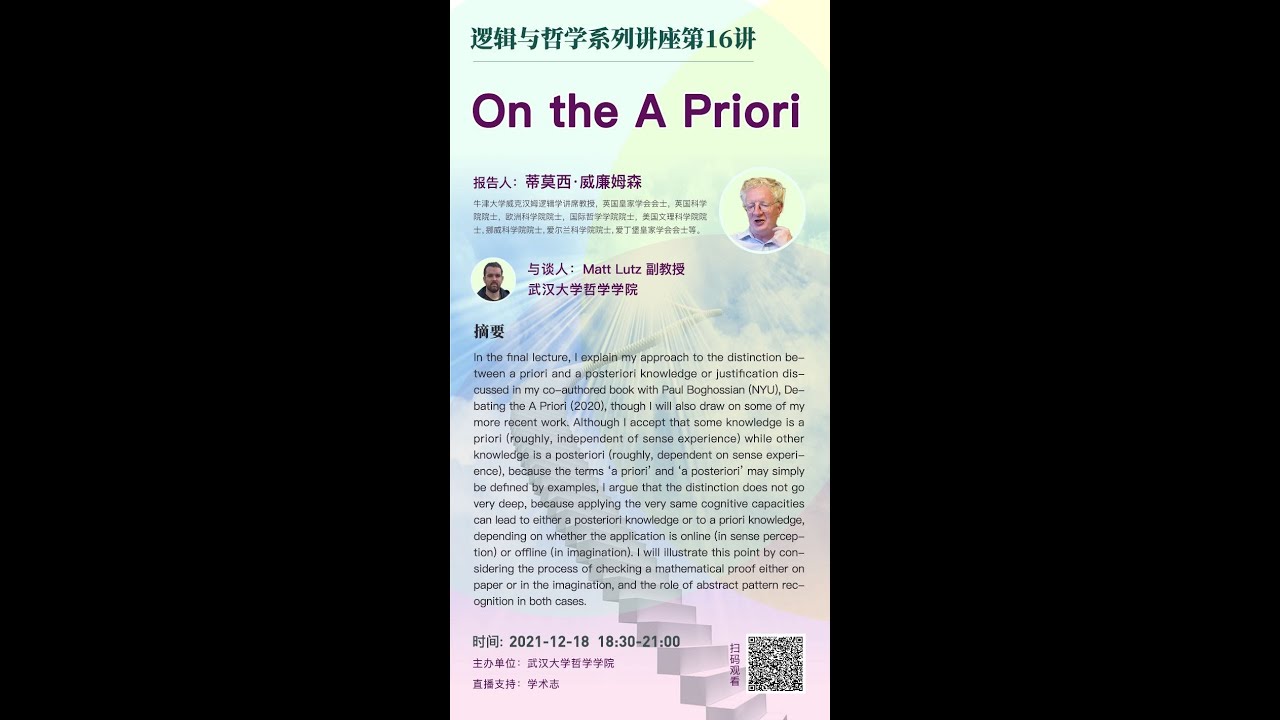
On the A Priori
Keywords
Summary
147 words
Critical Evaluation
Value of the Information & Strength of the Argument
The lecture provides valuable insights into the nature of the a priori/a posteriori distinction, challenging traditional views with clear examples and rigorous reasoning. Williamson’s argument that the distinction is not deep is well-supported by his analysis of online/offline cognitive processes and his critique of epistemological analyticity. He engages with opposing views, such as Paul Boghossian’s, and offers a compelling case for his externalist perspective. The argumentation is solid, though it relies on philosophical intuition and thought experiments rather than empirical evidence.
Scientific Rigor, Source Quality, Title Accuracy
Williamson demonstrates scientific rigor by grounding his discussion in his own published work, including ‘Debating the A Priori’ (2020) and ‘The Philosophy of Philosophy’ (2007), and by referencing other philosophers like Russell and Kripke. He carefully explains his reasoning and acknowledges complexities. The title accurately reflects the content, and the lecture is well-structured. The description provides context, including the event and the interlocutor, but no external sources are cited in the video itself.
169 words
Title / Content Match
The title accurately reflects the content, which is a detailed philosophical examination of the a priori/a posteriori distinction.
Quality & Reliability
8/10
The lecture is delivered by a leading philosopher (Timothy Williamson) and presents a well-argued, nuanced position on a central epistemological distinction. The argumentation is rigorous, drawing on examples and engaging with opposing views. However, as a lecture, it does not provide formal proof or empirical data, and the claims are based on philosophical reasoning rather than experimental evidence.
Key Moments
Markers derived by PSI from the transcript: the creator did not define chapters.
- Introduction: Williamson outlines the lecture's focus on the a priori/a posteriori distinction.
- Discussion of the standard definition and the role of experience in enabling vs. evidential roles.
- Introduction of Russell's stopped clock example and its use as a thought experiment.
- Explanation of online vs. offline cognitive capacities with examples like chess and color relations.
- Critique of epistemological analyticity, referencing Boghossian and the modus ponens example.
- Discussion of the calibration of recognitional capacities and the role of forgotten experiences.
- Conclusion: Williamson summarizes his view that the distinction is not deep and suggests implications for philosophical methodology.
Cited Sources
- Debating the A Priori — Co-authored with Paul Boghossian, this book is the basis for the lecture's discussion.
- The Philosophy of Philosophy — Williamson's earlier work that contains his initial critique of the a priori/a posteriori distinction.
Concurring Sources
- Debating the A Priori — The book presents Williamson's and Boghossian's opposing views, with Williamson's lecture aligning with his chapters.
Dissenting Sources
- Paul Boghossian's internalist perspective — Boghossian argues for a more robust role for a priori justification, which Williamson critiques.
Contribution & Novelties
Williamson’s lecture offers a novel perspective on the a priori/a posteriori distinction by emphasizing the continuity between online and offline cognitive processes. He argues that the same recognitional capacities can yield both a posteriori and a priori knowledge, depending on whether they are applied in perception or imagination. This challenges the traditional view that the distinction is fundamental. He also provides a detailed critique of epistemological analyticity, arguing that understanding a concept does not require accepting specific logical principles.
Pour aller plus loin :
- A priori and a posteriori — Overview of the distinction.
- Thought experiment — Relevance to philosophical methodology.
- Epistemological externalism — Williamson’s position in the debate.
109 words
Radar Profile
The radar profile shows high scores in quality of information and technical level, reflecting the lecture's depth and rigor. The quantity of information is also high, but the overall score is slightly lower due to the lack of empirical evidence and the subjective nature of philosophical argumentation.
💬 No comments were provided for analysis.