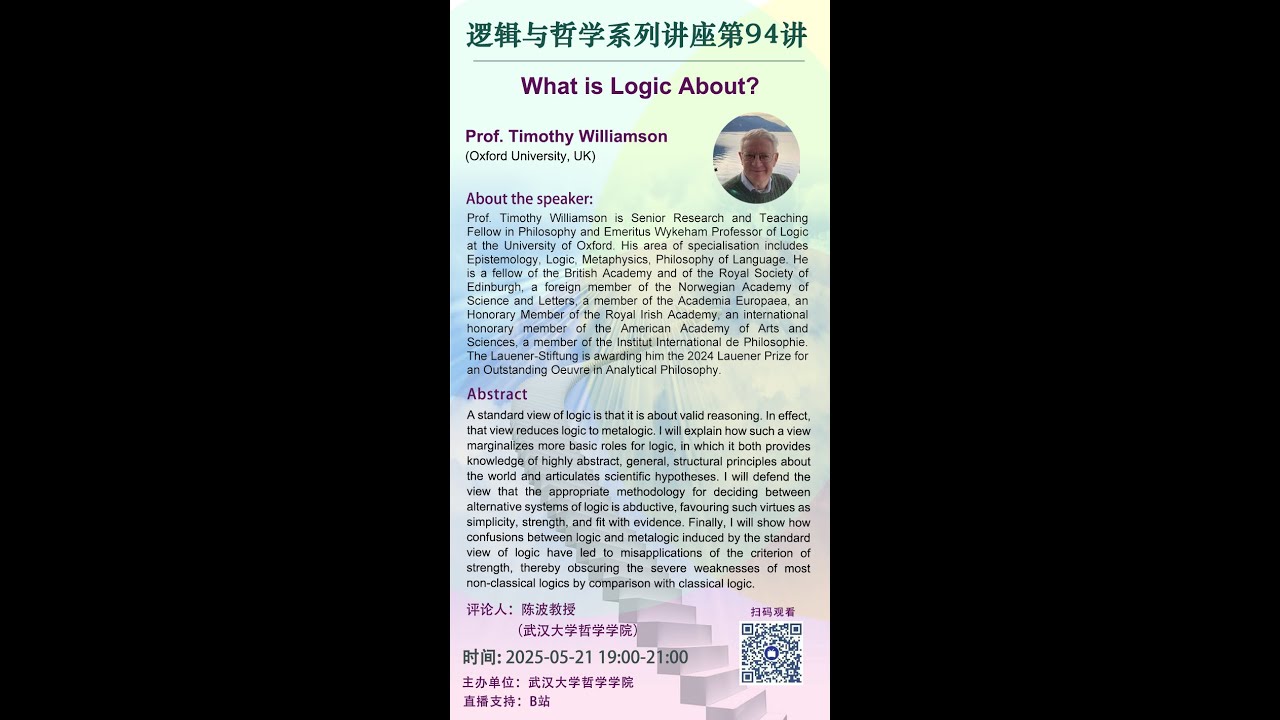
What is Logic About?
Keywords
Summary
172 words
Critical Evaluation
Value of the Information & Strength of the Argument
The lecture provides a high-value philosophical analysis of the nature of logic. Williamson’s argument is well-structured and builds on a critical examination of the standard view. He uses concrete examples, such as the scarlet/red argument, to illustrate the distinction between good reasoning and logical consequence. His engagement with Tarski’s work adds depth and authority. The argumentation is solid, though it represents a particular perspective within the philosophy of logic.
Scientific Rigor, Source Quality, Title Accuracy
The lecture demonstrates scientific rigor by grounding its claims in the work of Tarski, a key figure in the field. The discussion of Tarski’s 1936 paper is accurate and nuanced. The title is appropriate and directly reflects the content. The lecture does not cite external sources beyond Tarski, but it is a philosophical talk rather than a literature review.
143 words
Title / Content Match
The title accurately reflects the content, which directly addresses the nature and scope of logic.
Quality & Reliability
8/10
The lecture is delivered by a prominent philosopher (Timothy Williamson) and engages with foundational literature (Tarski 1936). The argumentation is rigorous and well-structured, though it represents a single expert perspective rather than a systematic review.
Key Moments
Markers derived by PSI from the transcript: the creator did not define chapters.
- Introduction: The standard answer that logic is about validity is presented.
- Discussion of mathematical logic branches (model theory, proof theory, set theory, computability) and their relation to validity.
- Questioning the pre-theoretic notion of logical consequence; example of scarlet/red argument.
- Introduction of Tarski's 1936 paper on logical consequence and its stipulative aspects.
- Explanation of Tarski's model-theoretic definition of logical consequence.
- Discussion of logical constants and the variability of what counts as logical, with temporal operators as an example.
- The role of logic in drawing out consequences from theories; logic as a theory in the object language.
- Warning against a purely metalinguistic view of logic; logical truths as universal generalizations.
Cited Sources
- On the Concept of Logical Consequence — Tarski's 1936 paper, discussed extensively in the lecture as the basis for the model-theoretic definition of logical consequence.
Concurring Sources
- Logical Consequence (Stanford Encyclopedia of Philosophy) — Provides a comprehensive overview of logical consequence, including Tarski's definition.
Contribution & Novelties
The lecture offers a fresh perspective on the question of what logic is about, challenging the standard view that it is solely about validity. It emphasizes the role of logic as a theory in the object language and the importance of logical truths. The discussion of Tarski’s work and the variability of logical constants provides a nuanced understanding.
Pour aller plus loin :
- Logical consequence (Wikipedia) — Overview of the concept.
- Tarski’s 1936 paper (Stanford Encyclopedia of Philosophy) — Background on Tarski’s philosophy.
- Model theory (Wikipedia) — Related field in mathematical logic.
92 words
Radar Profile
The radar profile shows high scores in quality and reliability, with moderate scores in quantity and technical level. This indicates a focused, well-argued lecture with substantial philosophical depth but limited breadth of coverage.