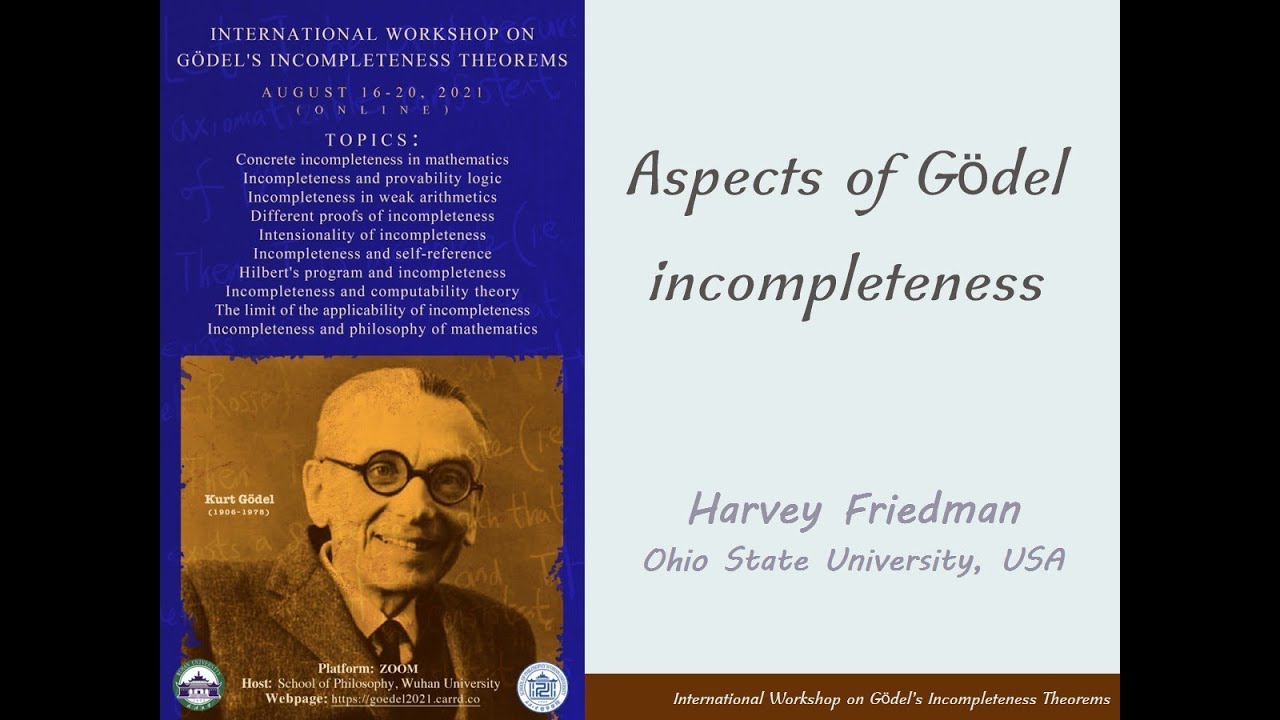
Harvey Friedman: Aspects of Gödel incompleteness
Keywords
Summary
131 words
Critical Evaluation
Value of the Information & Strength of the Argument
The lecture provides a high-level overview of current research directions on Gödel’s incompleteness theorems. Friedman’s argumentation is rigorous, as he carefully distinguishes between known results, conjectures, and open problems. He offers a systematic template for G1 that unifies many known formulations, and he proposes a novel proof of G2 that separates the auxiliary construction from the verification. The value lies in the synthesis of many results and the identification of promising research avenues, such as the minimal complexity of base theories and the role of interpretability.
Scientific Rigor, Source Quality, Title Accuracy
Friedman is a leading expert in mathematical logic, and the talk is part of an academic workshop. He references the work of other logicians, such as Fedor Pakhomov and Emil Jeřábek, and mentions a paper by the workshop organizer. The sources cited are appropriate and relevant. The title accurately reflects the content, which covers various aspects of Gödel’s incompleteness theorems. The talk is not peer-reviewed, but it is a scholarly presentation.
172 words
Title / Content Match
The title accurately reflects the content: Friedman discusses various aspects of Gödel's incompleteness theorems, including formulations, proofs, and open problems.
Quality & Reliability
8/10
Talk by a leading expert in mathematical logic, part of an academic workshop. The content is technical and precise, with references to known results and open problems. However, the presentation is informal and not peer-reviewed, and some claims are presented as conjectures or work in progress.
Key Moments
Markers derived by PSI from the transcript: the creator did not define chapters.
- Introduction to the talk and overview of topics.
- Discussion of adequacy conditions and wildness properties for G1.
- Introduction of pure G1 and the role of Robinson's Q and R.
- Open problems about minimal complexity of base theories.
- Transition to Gödel's second incompleteness theorem (G2).
- Model-theoretic formulations of G2 and interpretability.
- Introduction of explicitly remarkable sets and a novel proof of G2.
- Discussion of tangible incompleteness at higher large cardinal levels.
Cited Sources
- Workshop website — Official website of the Online International Workshop on Gödel's Incompleteness Theorems.
- Workshop slides — Slides for all lectures of the workshop, including Friedman's.
- Friedman's talk at 'Celebrating 90 Years of Gödel's Incompleteness Theorems' — Another talk by Friedman on a related topic.
Concurring Sources
- Workshop website — The talk is part of this workshop, and the website provides additional context.
Contribution & Novelties
The lecture offers a systematic framework for Gödel’s first incompleteness theorem, unifying various formulations and highlighting open problems. It also presents a slightly novel proof of Gödel’s second incompleteness theorem using the notion of explicitly remarkable sets, which cleanly separates the auxiliary construction from the direct verification. The talk stimulates further research by proposing specific conjectures, such as the minimal complexity of base theories for G1.
Pour aller plus loin :
- Gödel’s incompleteness theorems - Wikipedia — Background on the theorems.
- Robinson arithmetic - Wikipedia — The system Q and its role.
- Interpretability - Wikipedia — The notion of interpretability used in the talk.
104 words
Radar Profile
The radar profile shows high scores in technical level and information quality, reflecting the advanced and rigorous nature of the content. The lower score in quantity of information is due to the talk's focus on specific aspects rather than a broad overview.