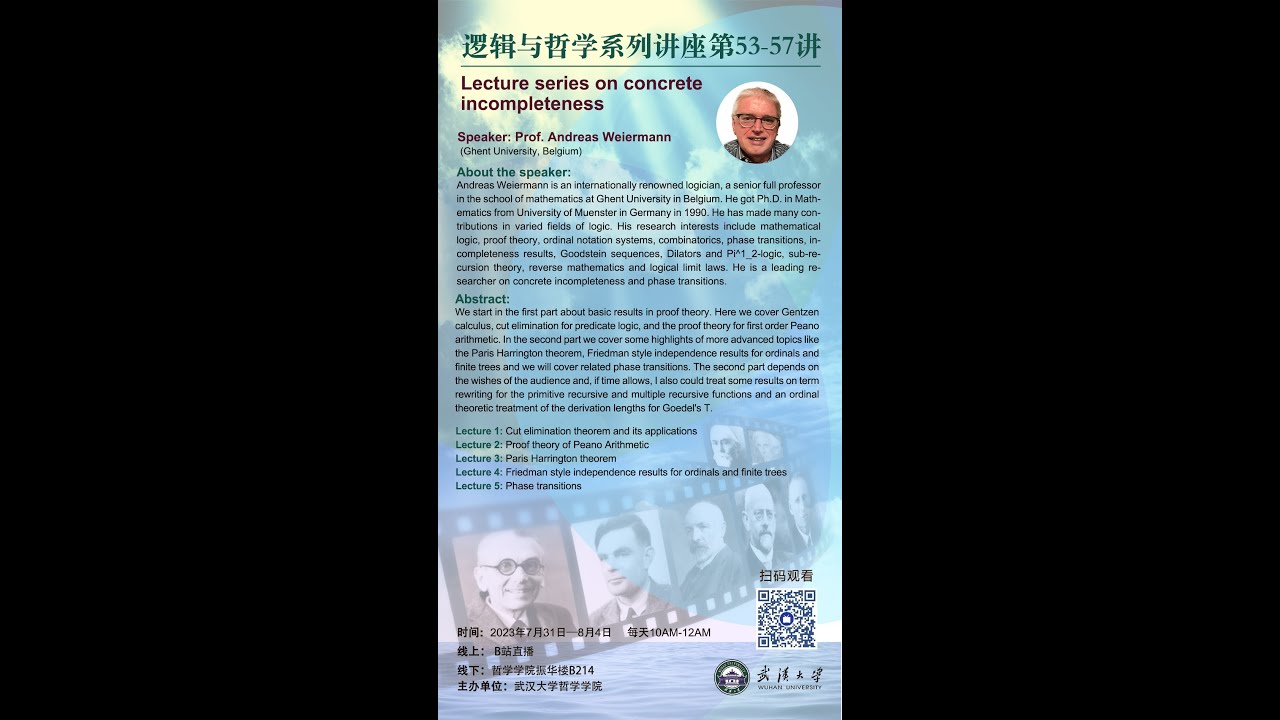
Lecture series on concrete incompleteness-3: Paris Harrington theorem
Keywords
Summary
199 words
Critical Evaluation
Value of the Information & Strength of the Argument
The lecture provides a detailed and rigorous proof of the Paris-Harrington theorem’s unprovability in PA, which is a significant result in mathematical logic. The argumentation is solid, building from basic definitions to a complex combinatorial construction. The speaker carefully explains each step, emphasizing the role of ordinal notations and the shift graph coloring. The proof is self-contained, though it requires a high level of mathematical maturity. The value lies in the deep insight into the connection between combinatorial principles and proof theory, and the argumentation is convincing and well-structured.
Scientific Rigor, Source Quality, Title Accuracy
The lecture is scientifically rigorous, with a clear logical structure and careful definitions. The speaker cites sources: he mentions following the work of an author (likely ‘Rathjen’ or similar) and refers to a paper by Ketonen and Solovay published in the Proceedings of the AMS. However, the lecture relies on unpublished lecture notes, which are not peer-reviewed. The title accurately reflects the content, as the lecture is indeed about the Paris-Harrington theorem. The presentation is technical and assumes prior knowledge of ordinal analysis and proof theory.
190 words
Title / Content Match
The title accurately reflects the content: the lecture is the third in a series on concrete incompleteness and focuses on the Paris-Harrington theorem.
Quality & Reliability
8/10
The lecture is given by a recognized expert (Prof. Andreas Weiermann) and presents a rigorous proof of the Paris-Harrington theorem, a well-established result in mathematical logic. The content is technically accurate and follows standard mathematical practice. However, it is a lecture, not a peer-reviewed publication, and relies on unpublished lecture notes by another author, which slightly reduces the score.
Key Moments
Markers derived by PSI from the transcript: the creator did not define chapters.
- Introduction and non-mathematical interlude with paintings.
- Start of the mathematical content: introduction to the Paris-Harrington theorem and its relation to Ramsey's theorem.
- Definition of ordinal normal forms and the rank function.
- Definition of the shift graph coloring and the first lemma about homogeneous sets.
- Construction of the partition for the Paris-Harrington theorem.
- Statement and proof of the main lemma: homogeneous sets are short.
- Induction step and conclusion of the proof.
Cited Sources
- Lecture notes by an author (possibly Rathjen) on ordinal analysis — The speaker mentions following the work of an author (likely Rathjen) and using his unpublished lecture notes from a university.
- Ketonen and Solovay, 'Rapidly growing Ramsey functions', Proceedings of the AMS — The speaker references this paper as the origin of comparing the Paris-Harrington function with fast-growing functions.
Concurring Sources
- Paris-Harrington theorem — Wikipedia article confirming the theorem and its unprovability in PA.
- Ketonen and Solovay, 'Rapidly growing Ramsey functions' — The paper is a standard reference for the growth rate of the Paris-Harrington function.
Contribution & Novelties
The lecture provides a detailed and self-contained proof of the Paris-Harrington theorem’s unprovability in PA, using a refined ordinal analysis and a specific combinatorial partition. It offers a clear exposition of the techniques involved, making the result accessible to advanced students. The main novelty is the pedagogical presentation of the proof, which is often considered complex.
Pour aller plus loin :
- Paris-Harrington theorem — Overview of the theorem and its significance.
- Ordinal analysis — Background on the use of ordinals in proof theory.
- Fast-growing hierarchy — Connection to the growth rates of functions.
93 words
Radar Profile
The radar profile shows high scores in quantity of information, technical level, and reliability, reflecting the dense and rigorous content. The quality of information is also high, but slightly lower due to the reliance on unpublished notes. Overall, the lecture is a strong technical resource for experts.