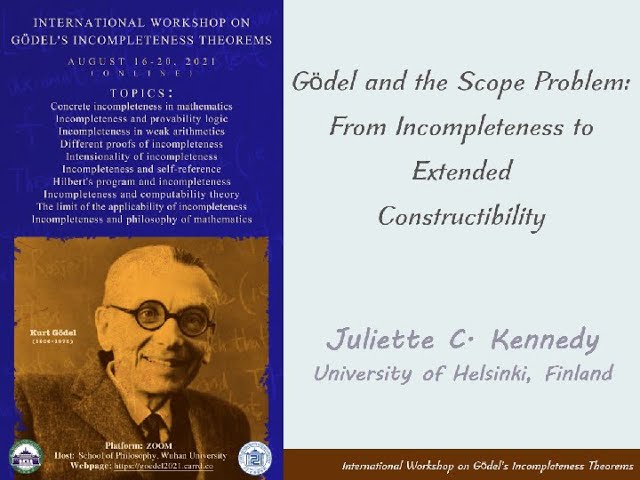
Gödel and the Scope Problem: From Incompleteness to Extended Constructibility
Keywords
Summary
144 words
Critical Evaluation
Value of the Information & Strength of the Argument
The talk provides valuable insights into Gödel’s philosophical ideas and their mathematical implementation. Kennedy’s argumentation is solid, building on historical context and technical results. She clearly explains the motivation and the steps taken, making a compelling case for the relevance of studying definability with non-first-order logics. The presentation is well-structured, moving from historical analysis to current research, and she acknowledges open questions and limitations.
Scientific Rigor, Source Quality, Title Accuracy
The talk demonstrates high scientific rigor, with careful attention to historical accuracy and technical details. Kennedy cites relevant literature and mentions specific results, though she does not provide a formal bibliography. The title accurately reflects the content, focusing on Gödel’s scope problem and the extension of constructibility. The talk is part of a workshop on Gödel’s incompleteness theorems, and the description provides links to slides and the workshop website, which serve as sources for further reference.
155 words
Title / Content Match
The title accurately reflects the content: the talk explores Gödel's scope problem and presents a research program extending constructibility using non-first-order logics.
Quality & Reliability
8/10
The talk is by a recognized expert in logic and set theory, presenting original research and historical analysis. The content is technical and well-structured, with references to established results. However, as a lecture, it lacks formal peer review and some claims are presented as ongoing work.
Key Moments
Markers derived by PSI from the transcript: the creator did not define chapters.
- Introduction and overview of the talk's theme: sensitivity of mathematical structures to underlying logic.
- Discussion of Gödel's 1946 Princeton Bicentennial Lecture and the concepts of computability, provability, and definability.
- Explanation of Turing's contribution to the absolute definition of computability and Gödel's reaction.
- Introduction of the research program: varying the logic in the constructible hierarchy.
- Presentation of the Magidor-Malitz quantifier and the cofinality quantifier, and their effects on L.
- Results on the continuum hypothesis in the inner model C* and generic absoluteness.
- Discussion of large cardinals in C* and the stationary logic.
- Philosophical reflections on formalism-freeness and the ongoing nature of the project.
Cited Sources
- Workshop website — Official website of the workshop where the talk was given, containing information about the event.
- Workshop slides — Link to the slides of the lectures, including this talk, as mentioned in the description.
Concurring Sources
- Gödel's 1946 lecture — The lecture that inspired the research program, discussing absolute notions of definability.
- Kennedy's publications on this topic — The speaker has published several papers on this research, which are not directly linked in the video description.
Contribution & Novelties
The talk presents an original research program that extends Gödel’s ideas on definability by systematically varying the underlying logic in the constructible hierarchy. This approach yields new inner models and results, such as the behavior of the continuum hypothesis and generic absoluteness. The work contributes to the understanding of formalism-freeness and the relationship between logic and mathematical structure.
Pour aller plus loin :
- Gödel’s 1946 lecture — The original lecture where Gödel discusses absolute definability and the scope problem.
- Constructible universe — Overview of Gödel’s constructible hierarchy L.
- Second-order logic — Background on second-order logic and its properties.
98 words
Radar Profile
The radar profile shows high scores in technical level and information quality, reflecting the advanced nature of the content. The lower score in quantity of information is due to the lecture format, which covers a broad topic but with limited depth in some areas. Overall, the talk is highly reliable and valuable for an expert audience.