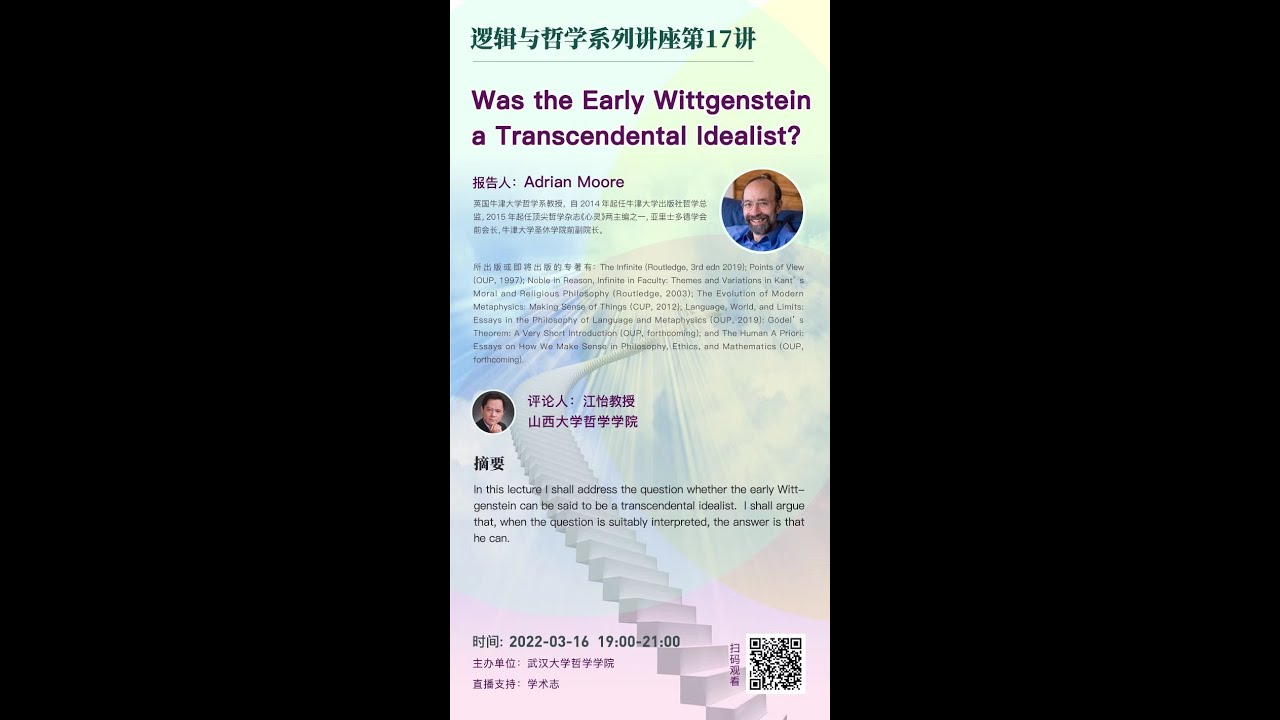
Was the Early Wittgenstein a Transcendental Idealist?
Keywords
Summary
162 words
Critical Evaluation
Value of the Information & Strength of the Argument
The lecture provides a nuanced and well-structured argument, engaging with both the text of the Tractatus and secondary literature. Moore carefully distinguishes between different senses of ’transcendental idealism’ and offers a plausible reading of the relevant passages. His argument is strengthened by his engagement with Peter Sullivan’s contrasting interpretation, which he critiques in a respectful and detailed manner. The value of the information lies in its scholarly depth and the clarity with which complex philosophical issues are presented.
Scientific Rigor, Source Quality, Title Accuracy
The lecture demonstrates high scholarly rigor, with careful attention to the text of the Tractatus and relevant secondary literature. Moore cites specific remarks (e.g., 5.6, 5.61) and engages with the work of Peter Sullivan. The title accurately reflects the content, and the lecture is well-suited for an academic audience. The recording quality is adequate, though the lack of visual aids may hinder comprehension for some viewers.
159 words
Title / Content Match
The title accurately reflects the lecture's focus on the early Wittgenstein's relation to transcendental idealism.
Quality & Reliability
8/10
Lecture by a recognized Oxford philosopher, with a clear argumentative structure and engagement with secondary literature (Peter Sullivan). The content is scholarly, but the recording quality and lack of visual aids limit accessibility.
Key Moments
Markers derived by PSI from the transcript: the creator did not define chapters.
- Introduction of Prof. Adrian Moore and his academic background.
- Moore outlines the three issues: definition of transcendental idealism, its presence in the text, and its role.
- Discussion of the remarks in section 5.6 and the role of the subject.
- Comparison with Peter Sullivan's reading and the contrast with logical categories.
- Exploration of the connection between inexpressible knowledge and transcendental idealism.
- Discussion of the world as the totality of facts and its relation to limits.
- Moore addresses potential objections and clarifies his position.
- Conclusion and summary of the argument.
Cited Sources
- Tractatus Logico-Philosophicus — Primary text discussed throughout the lecture.
- Points of View — Moore's own book where he previously attributed transcendental idealism to the early Wittgenstein.
Concurring Sources
- Tractatus Logico-Philosophicus — Primary source for the argument.
Dissenting Sources
- Peter Sullivan's interpretation — Sullivan argues that Wittgenstein ultimately rejects transcendental idealism, whereas Moore sees it as a corrective.
Contribution & Novelties
The lecture offers a fresh perspective on the debate over Wittgenstein’s relation to transcendental idealism, arguing for a nuanced reading that sees it as a corrective rather than a doctrine to be rejected. Moore’s engagement with Sullivan’s interpretation provides a clear contrast and deepens the discussion.
Pour aller plus loin :
- Transcendental idealism - Wikipedia — Overview of the concept.
- Ludwig Wittgenstein - Stanford Encyclopedia of Philosophy — Comprehensive entry on Wittgenstein’s philosophy.
- Tractatus Logico-Philosophicus - Project Gutenberg — Full text of the Tractatus.
84 words
Radar Profile
The radar profile shows high scores in quality of information and technical level, reflecting the lecture's scholarly depth. The lower score in quantity of information is due to the focused nature of the talk, which does not cover a broad range of topics.
💬 No comments were provided for analysis.