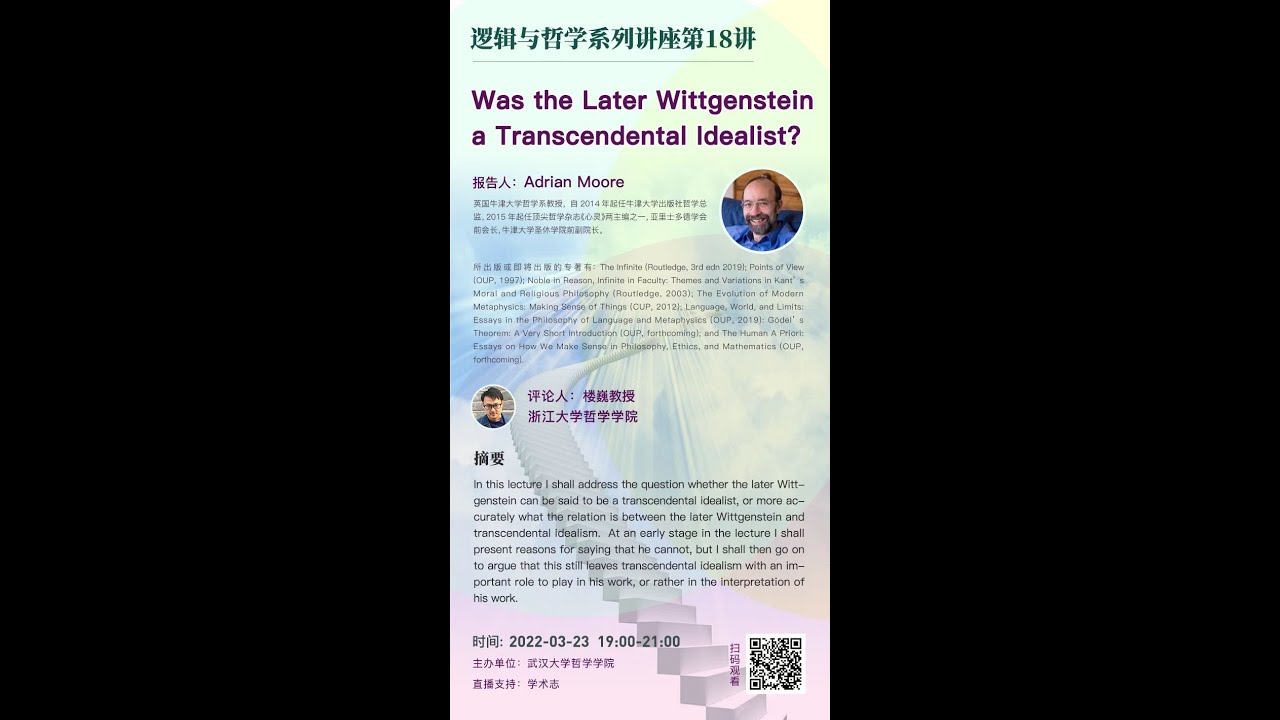
Was the Later Wittgenstein a Transcendental Idealist?
Keywords
Summary
187 words
Critical Evaluation
Value of the Information & Strength of the Argument
The lecture provides a valuable and nuanced analysis of the relationship between Wittgenstein’s later philosophy and transcendental idealism. Moore’s argument is carefully structured, moving from definitions to a detailed examination of Wittgenstein’s views on language, necessity, and forms of life. He effectively uses quotations from Bernard Williams and Stanley Cavell to support his interpretation. The argumentation is solid, though it remains an interpretive position that may be debated. Moore acknowledges the complexity of the issue and offers qualifications, which strengthens the credibility of his argument.
Scientific Rigor, Source Quality, Title Accuracy
The lecture demonstrates high scientific rigor, with clear definitions and careful reasoning. Moore draws on primary sources (Wittgenstein, Kant) and secondary literature (Williams, Cavell) appropriately. The title accurately reflects the content, and the lecture is well-structured. The sources are cited in the context of the discussion, though no explicit references are provided in the description. The lecture is suitable for an academic audience familiar with philosophy.
166 words
Title / Content Match
The title accurately reflects the central question addressed throughout the lecture.
Quality & Reliability
8/10
Lecture by a recognized Oxford professor, based on published work and engaging with key philosophical sources (Kant, Wittgenstein, Williams, Cavell). The argument is structured and nuanced, though it remains an interpretive position rather than empirical research.
Key Moments
Markers derived by PSI from the transcript: the creator did not define chapters.
- Introduction and overview of the lecture topic.
- Definition of transcendental idealism and empirical idealism.
- Discussion of Wittgenstein's conception of philosophy as therapy.
- Exploration of the contingency of language and forms of life.
- Quotation from Stanley Cavell on forms of life.
- Discussion of Bernard Williams' view on philosophy from the inside.
- Examination of the idea that our language could have been different.
- Conclusion: Wittgenstein not a transcendental idealist, but transcendental idealism relevant to his work.
Cited Sources
- Wittgenstein and Idealism — Bernard Williams' article discussed in the lecture.
- The Availability of Wittgenstein's Later Philosophy — Stanley Cavell's essay quoted in the lecture.
Concurring Sources
- Wittgenstein and Idealism — Bernard Williams' article aligns with Moore's interpretation.
Dissenting Sources
- Possible alternative interpretations — Some scholars may argue that Wittgenstein's later philosophy is closer to empirical idealism or that he entirely rejects any form of idealism.
Contribution & Novelties
The lecture offers a fresh perspective on the relationship between Wittgenstein and transcendental idealism, arguing that while Wittgenstein himself rejected the doctrine, his philosophy provides incentives for embracing it. This nuanced interpretation adds to the existing literature on the topic.
Pour aller plus loin :
- Transcendental idealism — Overview of the concept from Kantian philosophy.
- Ludwig Wittgenstein — Background on Wittgenstein’s life and philosophy.
- Forms of life — Explanation of this key concept in Wittgenstein’s later work.
77 words
Radar Profile
The radar profile shows high scores in quantity and quality of information, with a moderate level of technicality. This indicates a lecture that is rich in content and well-argued, but may require some background in philosophy to fully appreciate.
💬 No comments were provided for analysis.