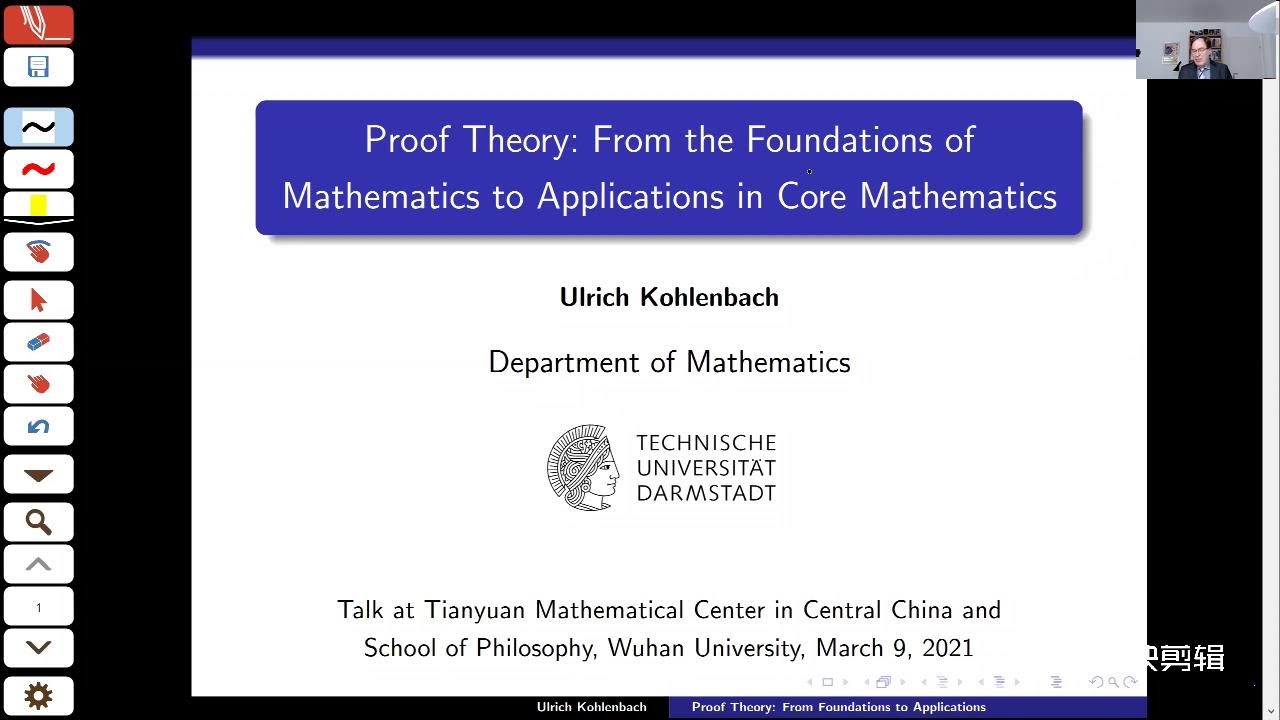
Ulrich Kohlenbach: From the Foundations of Mathematics to Applications in Core Mathematics
Keywords
Summary
165 words
Critical Evaluation
Value of the Information & Strength of the Argument
The lecture provides a comprehensive and rigorous overview of proof mining, demonstrating its value in extracting concrete mathematical content from non-constructive proofs. The argumentation is solid, built on a clear logical framework and supported by numerous examples from analysis. Kohlenbach carefully explains the technical machinery, such as the Dialectica interpretation and logical metatheorems, and justifies their applicability. He also addresses limitations, such as the need for purely existential statements, and discusses alternatives like metastability. The presentation is well-structured, moving from foundational concepts to practical applications, and effectively argues for the significance of proof mining in core mathematics.
Scientific Rigor, Source Quality, Title Accuracy
The lecture is scientifically rigorous, with a clear presentation of logical concepts and their mathematical applications. Kohlenbach cites relevant literature, including his own work and that of others, such as Kreisel and Tao. The title accurately reflects the content, covering both foundational aspects and applications. The description provides context and references, but no specific sources are listed in the video description. The lecture is suitable for an audience with some background in logic and analysis, but the speaker makes an effort to explain concepts intuitively.
197 words
Title / Content Match
The title accurately reflects the content, covering both foundational aspects and applications in core mathematics.
Quality & Reliability
9/10
Lecture by a leading expert in proof theory, with rigorous logical foundations and detailed technical content. The presentation is well-structured and based on published research.
Key Moments
Markers derived by PSI from the transcript: the creator did not define chapters.
- Introduction to Hilbert's program and the use of ideal principles.
- Explanation of proof interpretations and their role in relative consistency proofs.
- Introduction to Gödel's Dialectica interpretation and its adaptation for analysis.
- Discussion of logical metatheorems and the extraction of uniform bounds.
- Explanation of metastability and its connection to Terence Tao's work.
- Application to fixed point theory and asymptotic regularity.
- Application to convex optimization and the von Neumann alternating projection method.
- Discussion of rates of convergence and modulus of uniqueness.
- Conclusion and summary of the proof mining program.
Cited Sources
- Proof Mining: A Systematic Way of Analysing Proofs in Mathematics — Kohlenbach's own work on proof mining, likely referenced in the lecture.
- Gödel's Dialectica interpretation — Mentioned as a key technique in proof mining.
- Terence Tao's article on metastability — Referenced in the lecture as a related concept.
Concurring Sources
- Proof Mining: A Systematic Way of Analysing Proofs in Mathematics — Kohlenbach's own work, which the lecture is based on.
- Gödel's Dialectica interpretation — Foundational technique discussed in the lecture.
Contribution & Novelties
This lecture provides a clear and comprehensive introduction to proof mining, a relatively recent applied form of proof theory. It highlights the novelty of extracting constructive content from non-constructive proofs, leading to explicit bounds and uniformity results in core mathematics. The lecture also emphasizes the connection to Terence Tao’s metastability, bridging logic and mainstream analysis.
Pour aller plus loin :
- Proof mining - Wikipedia — Overview of proof mining and its applications.
- Dialectica interpretation - Wikipedia — Explanation of Gödel’s Dialectica interpretation.
- Metastability - Wikipedia — General concept of metastability, though not specific to Tao’s usage.
- Kohlenbach’s publications — List of research papers on proof mining.
106 words
Radar Profile
The radar profile shows high scores across all dimensions, indicating a lecture with substantial information content, high technical depth, and strong reliability. The balanced profile suggests a well-rounded presentation suitable for an advanced audience.
💬 No comments were provided for analysis.