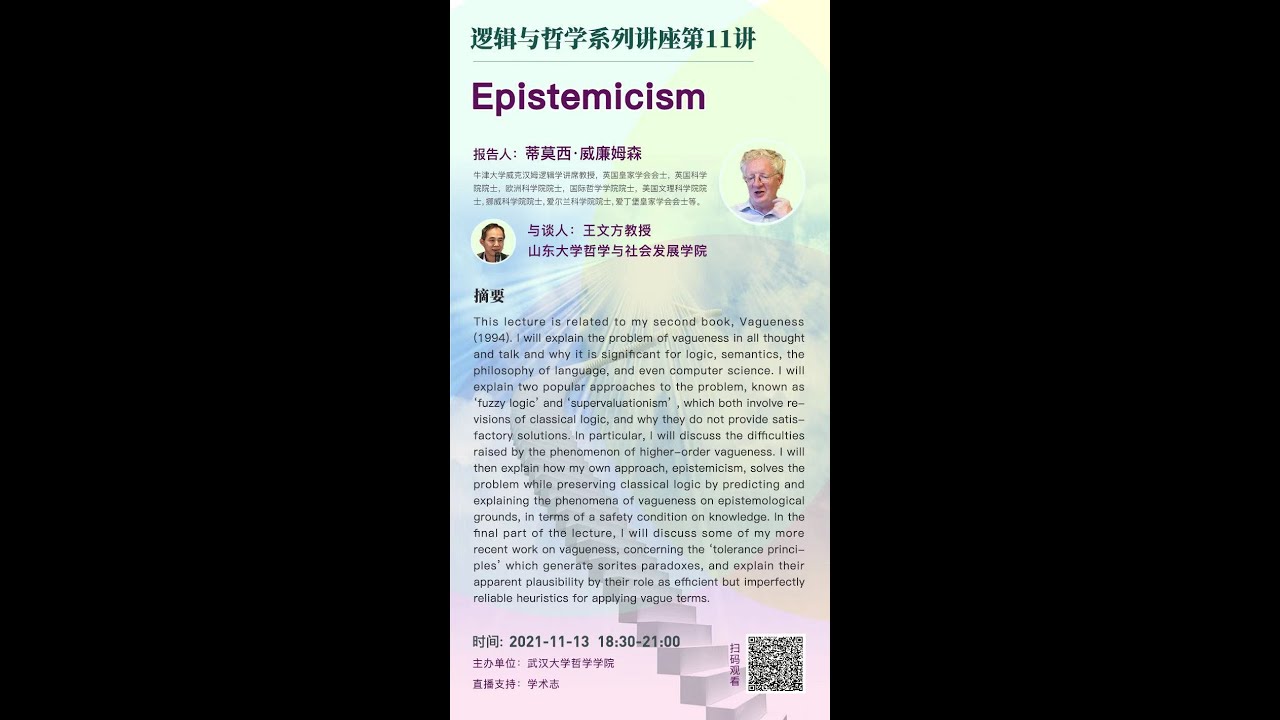
Epistemicism
Keywords
Summary
177 words
Critical Evaluation
Value of the Information & Strength of the Argument
The lecture provides a high-value, in-depth analysis of the problem of vagueness and the epistemicist solution. Williamson’s argumentation is rigorous and systematic: he clearly defines the problem, presents the main competing theories, and offers a detailed defense of his own view. He anticipates and addresses potential objections, such as the arbitrariness of sharp boundaries, by appealing to the safety condition on knowledge. The discussion of higher-order vagueness and tolerance principles adds depth and shows the theory’s explanatory power. The argumentation is solid and persuasive, though some may find the epistemicist commitment to unknowable boundaries counterintuitive.
Scientific Rigor, Source Quality, Title Accuracy
The lecture demonstrates high scientific rigor. Williamson is a leading expert, and the content is based on his published work, particularly ‘Vagueness’ (1994). He engages with the relevant literature, including fuzzy logic and supervaluationism, and provides a clear philosophical argument. The title accurately reflects the content. No external sources are cited in the video description, but the lecture itself references his own work and the broader philosophical context. The adéquation between title and content is excellent.
186 words
Title / Content Match
The title accurately reflects the content, which is a detailed exposition and defense of epistemicism.
Quality & Reliability
9/10
Lecture by a leading philosopher (Timothy Williamson) at a university event, presenting his well-known theory of epistemicism. The content is rigorous, well-structured, and based on his published work (Vagueness, 1994). The speaker is a highly credible authority in the field.
Key Moments
Markers derived by PSI from the transcript: the creator did not define chapters.
- Introduction by chair, Professor Yong Cheng, and presentation of Timothy Williamson.
- Williamson begins his lecture, introducing the problem of vagueness with the color series example.
- Discussion of the sorites paradox and its historical origins in ancient Greek philosophy.
- Explanation of how vagueness challenges classical logic, specifically the law of excluded middle and bivalence.
- Critique of fuzzy logic and supervaluationism as solutions to vagueness.
- Introduction of epistemicism and its claim that vague statements have determinate truth values.
- Discussion of higher-order vagueness and how epistemicism handles it.
- Explanation of the safety condition on knowledge and its role in epistemicism.
- Discussion of tolerance principles and their role in generating sorites paradoxes.
- Conclusion and Q&A session with interlocutor Professor Wenfang Wang.
Cited Sources
- Vagueness (1994) — Williamson's book where he first presented epistemicism.
- Knowledge and its Limits (2000) — Williamson's book that develops the safety condition on knowledge.
Concurring Sources
- Vagueness (1994) — Williamson's own book, which the lecture is based on.
Dissenting Sources
- Fuzzy logic — Williamson critiques fuzzy logic as an inadequate solution to vagueness.
- Supervaluationism — Williamson critiques supervaluationism as an inadequate solution to vagueness.
Contribution & Novelties
The lecture provides a comprehensive and accessible overview of epistemicism, a significant theory in contemporary philosophy. It offers a clear defense of the view that vagueness is an epistemic phenomenon, not a semantic one, and that classical logic can be preserved. The discussion of tolerance principles as heuristics is a novel contribution from Williamson’s recent work.
Pour aller plus loin :
- Sorites paradox — Provides background on the paradox and various solutions.
- Vagueness — Stanford Encyclopedia of Philosophy entry on vagueness, covering major theories.
- Epistemicism — Overview of the epistemicist position.
- Timothy Williamson — Biography and list of works.
99 words
Radar Profile
The radar profile shows high scores across all dimensions, indicating a lecture that is rich in information, technically deep, and highly reliable. The balance between quantity and quality is excellent, with a strong emphasis on rigorous argumentation.