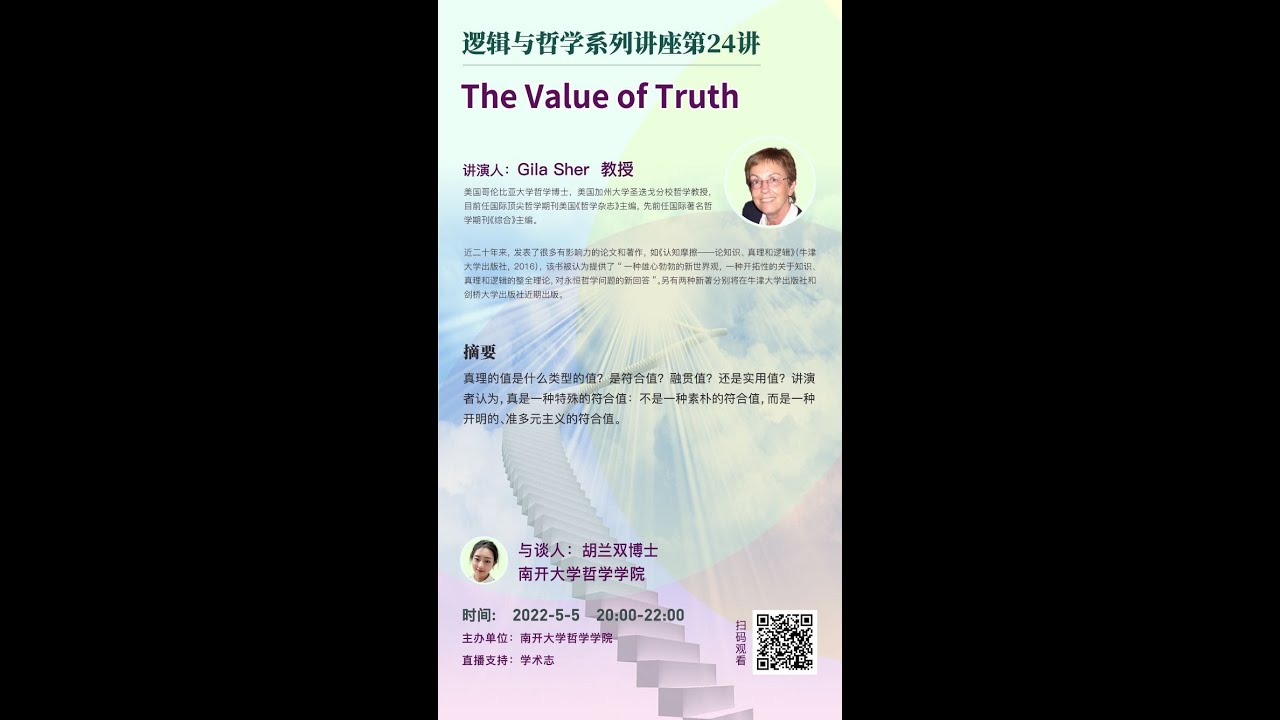
The Value of Truth
Keywords
Summary
127 words
Critical Evaluation
Value of the Information & Strength of the Argument
The lecture provides a substantive philosophical analysis of truth as a human value, offering a nuanced defense of correspondence theory against common objections. Sher’s argumentation is rigorous, building on historical and contemporary sources, and she addresses potential counterarguments, such as the conflict between truth and other values. The value lies in its original synthesis of ideas, proposing a ‘quasi-pluralist’ correspondence that accommodates different domains. The argument is well-structured, moving from general considerations of human values to specific epistemological implications.
Scientific Rigor, Source Quality, Title Accuracy
Sher demonstrates scholarly rigor by referencing key figures like Quine, Tarski, Kant, and Rorty, and she engages with contemporary research on misinformation. The sources are appropriate for the philosophical topic, though the lecture does not provide formal citations. The title accurately reflects the content, and the lecture is well-organized. The transcription contains errors and lacks visual aids, which slightly detracts from the presentation, but the intellectual content remains solid.
163 words
Title / Content Match
The title accurately reflects the content, which is a philosophical exploration of the value of truth.
Quality & Reliability
8/10
The lecture is a scholarly presentation by a recognized philosopher, with a clear argumentative structure and references to established theories (e.g., Tarski, Quine, Kant). The content is well-reasoned, but the transcription contains errors and the video lacks visual aids, which slightly reduces reliability.
Key Moments
Markers derived by PSI from the transcript: the creator did not define chapters.
- Introduction of the lecture and the speaker.
- Discussion on truth as a human value and its importance.
- Explanation of human values and their objectivity.
- Introduction of the correspondence theory of truth.
- Detailed analysis of immanence and transcendence in truth.
- Discussion on indirect correspondence for mathematical truths.
- Application to post-truth crisis and research on misinformation.
- Conclusion and Q&A session begins.
Cited Sources
- Philosophy and the Mirror of Nature — Mentioned as a critique of correspondence theory by Richard Rorty.
- The Concept of Truth — Referenced in the context of Tarski's theory of truth.
- Epistemic Friction — Mentioned as a book by Gila Sher.
Concurring Sources
- Epistemic Friction — Sher's own book, which aligns with her views on truth and knowledge.
Dissenting Sources
- Philosophy and the Mirror of Nature — Rorty's critique of correspondence theory is a direct challenge to Sher's position.
Contribution & Novelties
The lecture offers a fresh perspective on truth as a human value, integrating insights from epistemology, ethics, and social philosophy. Sher’s concept of ’enlightened correspondence’ provides a nuanced alternative to traditional correspondence theories, addressing criticisms from postmodernism. The discussion of indirect correspondence for mathematical truths is particularly innovative.
Pour aller plus loin :
- Correspondence theory of truth — Overview of the theory and its variations.
- Post-truth politics — Context for the societal implications discussed.
- Hannah Arendt — Her views on truth and politics are relevant to the lecture’s discussion.
89 words
Radar Profile
The radar profile shows high scores in information quality and reliability, with slightly lower technical level due to the philosophical nature. The lecture is well-balanced, with strong argumentation and clear structure.
💬 No comments were provided for analysis.