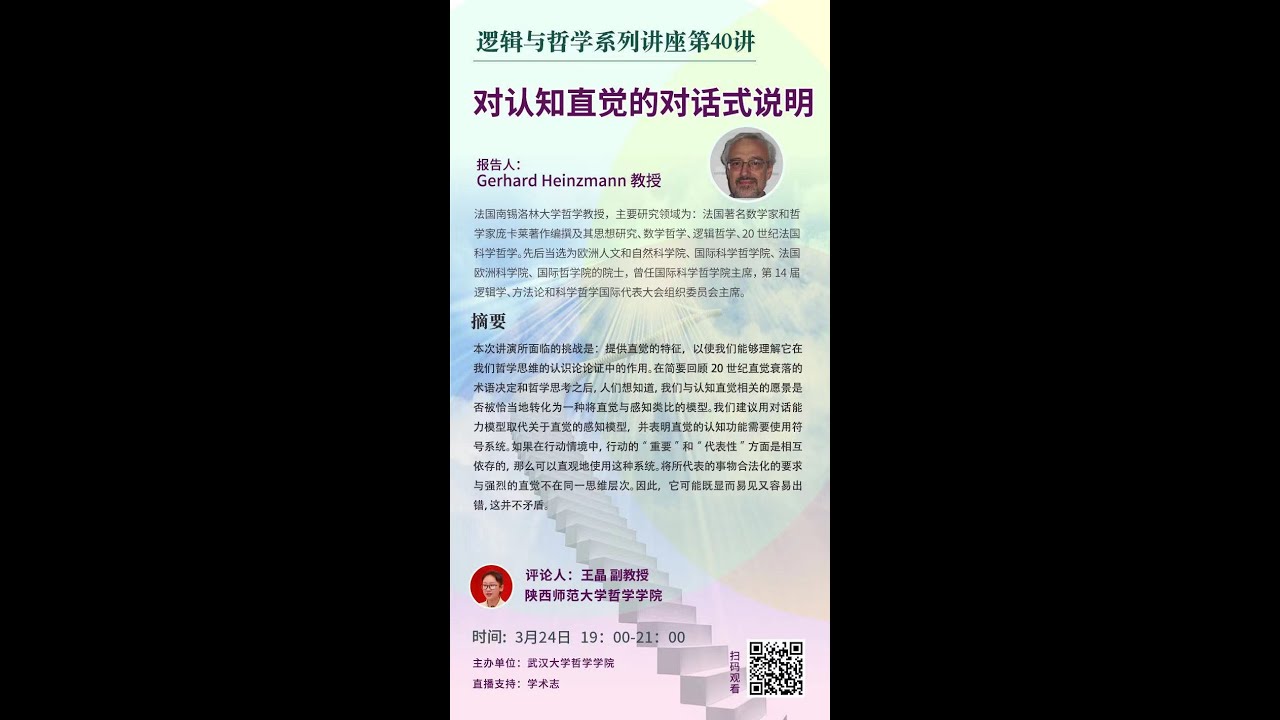
A conversational explanation of cognitive intuition
Keywords
Summary
162 words
Critical Evaluation
Value of the Information & Strength of the Argument
The lecture provides a valuable historical and conceptual overview of epistemic intuition, synthesizing perspectives from major philosophers. The argumentation is solid, building a case for a pragmatic, skill-based account of intuition. Heinzmann effectively critiques traditional views and offers a novel framework. The discussion of examples, such as the limitations of geometric intuition and the paradox of comprehension, strengthens the argument. However, the lecture is dense and assumes familiarity with philosophical terminology, which may limit accessibility.
Scientific Rigor, Source Quality, Title Accuracy
The lecture demonstrates scientific rigor through careful historical analysis and engagement with primary sources. Heinzmann cites numerous philosophers, including Peirce, Wittgenstein, Locke, Descartes, and Kant, and references specific works and arguments. The title accurately reflects the content, which is a conversational explanation of cognitive intuition. The lecture is not based on original empirical research but on expert interpretation and synthesis, which is appropriate for a philosophical talk.
157 words
Title / Content Match
The title accurately reflects the conversational and explanatory nature of the lecture, focusing on cognitive intuition.
Quality & Reliability
7/10
The lecture is given by a recognized expert in philosophy of mathematics and logic, with a structured argument and references to historical and contemporary philosophers. However, the transcription is imperfect, and the content is highly specialized and not peer-reviewed.
Key Moments
Markers derived by PSI from the transcript: the creator did not define chapters.
- Introduction of Prof. Heinzmann and his academic background.
- Definition of epistemic intuition and distinction between intuition of and intuition that.
- Historical overview of intuition from Plato to Kant.
- Discussion of the decline of intuition in modern mathematics and logical empiricism.
- Introduction of the biological skill model of intuition.
- Application of the model to philosophy and mathematics.
- Conclusion and Q&A session.
Cited Sources
- Peirce's Pragmatism — Heinzmann draws on Peirce's pragmatism to frame his account of intuition.
- Wittgenstein's Philosophy — Heinzmann references Wittgenstein's ideas on understanding and language games.
- Locke's Essay Concerning Human Understanding — Discussed in the context of intuitive knowledge.
- Descartes' Rules for the Direction of the Mind — Referenced for the concept of intellectual intuition.
- Kant's Critique of Pure Reason — Mentioned in relation to pure intuition and space/time.
Concurring Sources
- Peirce's Pragmatism — Heinzmann's approach aligns with Peirce's pragmatic maxim.
- Wittgenstein's Later Philosophy — The emphasis on language games and understanding resonates with Wittgenstein.
Dissenting Sources
- Logical Empiricism — Logical empiricists like Schlick exclude intuition from knowledge, contrasting with Heinzmann's view.
Contribution & Novelties
The lecture offers a novel synthesis of pragmatist and Wittgensteinian ideas to develop a skill-based account of epistemic intuition. It challenges traditional views that treat intuition as a form of knowledge and instead proposes that intuition is a semiotic skill that enables understanding. This perspective has implications for the philosophy of mathematics and epistemology.
Pour aller plus loin :
- Pragmatism — Overview of pragmatism, relevant to Heinzmann’s framework.
- Intuition (philosophy) — General background on the concept.
- C.S. Peirce — Detailed entry on Peirce’s philosophy.
- Ludwig Wittgenstein — Entry on Wittgenstein’s later philosophy.
- Epistemic justification — Relevant to the discussion of justification.
101 words
Radar Profile
The radar profile shows high scores in information quantity, quality, and technical level, indicating a dense and rigorous lecture. The fiabilite_globale is slightly lower, reflecting the subjective nature of philosophical argumentation.