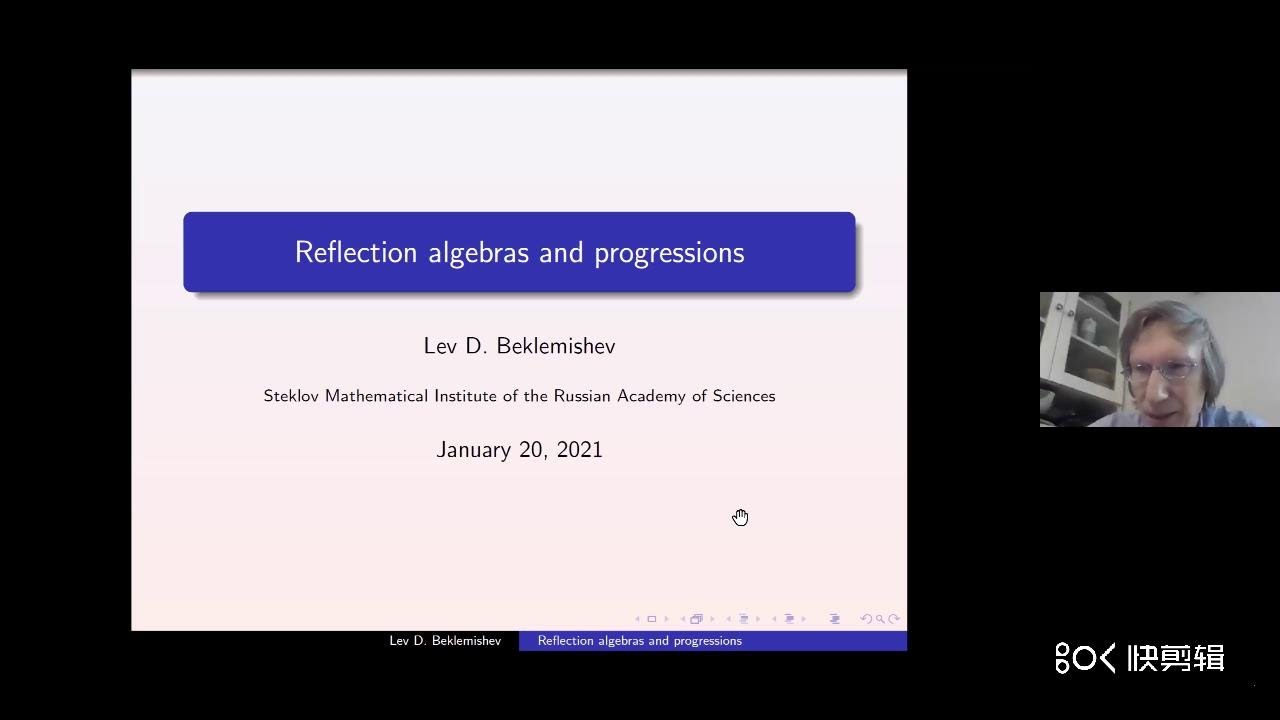
Lev D. Beklemishev: Reflection Algebras and Progressions
Keywords
Summary
171 words
Critical Evaluation
Value of the Information & Strength of the Argument
The lecture provides a comprehensive overview of a sophisticated area of proof theory, offering valuable insights into the use of reflection principles for ordinal analysis. Beklemishev’s argumentation is clear and well-structured, building from historical context to abstract algebraic formulations. He effectively motivates the need for reflection algebras by highlighting the limitations of Turing’s original approach and demonstrates their utility in defining canonical systems. The presentation is rigorous, with careful definitions and explanations, making it a valuable resource for researchers and advanced students.
Scientific Rigor, Source Quality, Title Accuracy
The lecture is scientifically rigorous, with Beklemishev referencing key works by Gödel, Turing, and others, and providing a detailed account of the mathematical framework. The sources cited are appropriate and relevant, though the lecture does not provide explicit citations for all claims. The title accurately reflects the content, focusing on reflection algebras and progressions. The presentation is well-organized and the technical level is high, consistent with an expert audience.
166 words
Title / Content Match
The title accurately reflects the content, focusing on reflection algebras and their role in transfinite progressions.
Quality & Reliability
8/10
The lecture is given by a leading expert in proof theory, with a clear and rigorous presentation of advanced concepts. The content is well-structured and based on established research, though it is an exposition of existing work rather than new results.
Key Moments
Markers derived by PSI from the transcript: the creator did not define chapters.
- Introduction to formal systems and proof theory
- Explanation of the Worm Principle and its independence from PA
- Historical background: Gödel's incompleteness and Turing's progressions
- Introduction to reflection algebras and their algebraic structure
- Application of reflection algebras to ordinal analysis
- Discussion of canonical ordinal notation systems
- Transfinite hierarchies of reflection principles
- Conclusion and outlook
Cited Sources
- System of Logic Based on Ordinals — Turing's 1939 paper introducing progressions of theories based on ordinal notations.
Concurring Sources
- Provably recursive functions and the hierarchy of fast-growing functions — Related to the discussion of provably recursive functions and their growth rates.
Contribution & Novelties
The lecture presents a novel algebraic framework for understanding reflection principles and their use in ordinal analysis. It offers a unified perspective on Turing’s progressions and addresses the problem of canonical ordinal notations. The concept of reflection algebras provides a new tool for proof theory, potentially leading to more systematic classifications of arithmetical sentences.
Pour aller plus loin :
- Ordinal analysis — Provides background on the field and its goals.
- Reflection principle — General concept in logic.
- Goodstein’s theorem — An example of a combinatorial statement independent of PA, related to the Worm Principle.
94 words
Radar Profile
The radar profile shows high scores in quality and technical level, with slightly lower scores in quantity and reliability, reflecting the depth and specialization of the content.