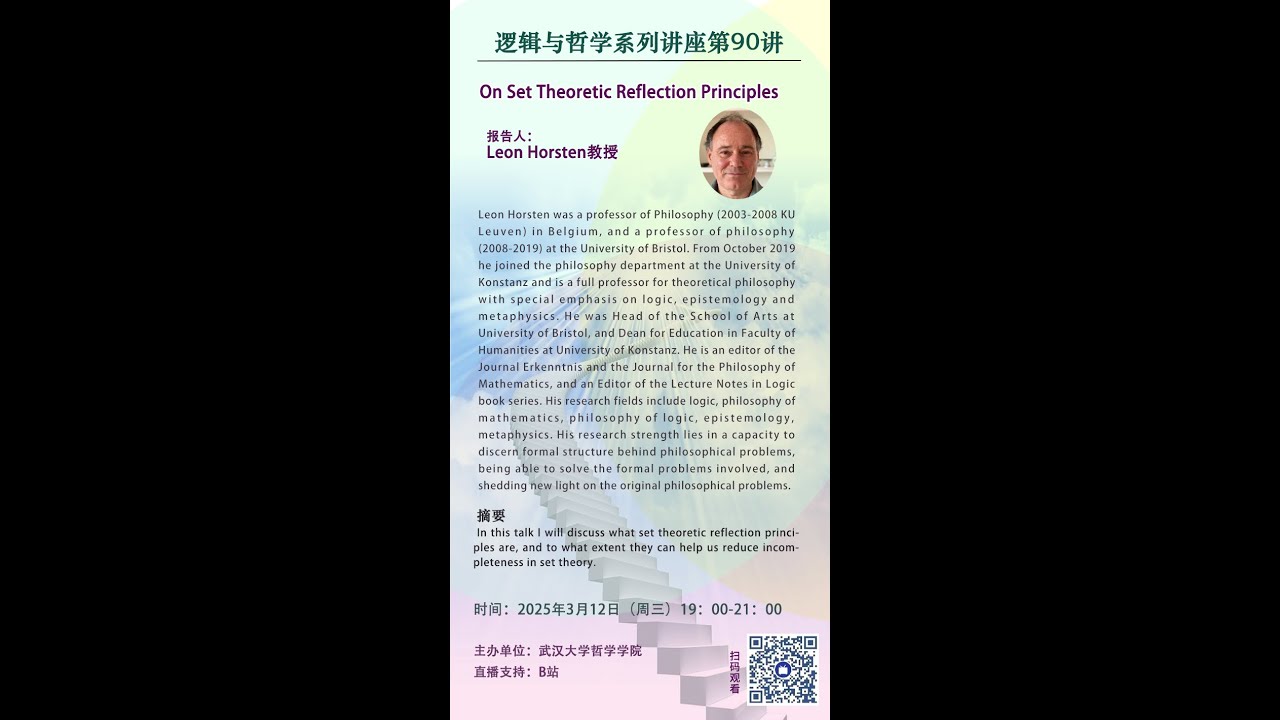
On set theoretic reflection principles
Keywords
Summary
167 words
Critical Evaluation
Value of the Information & Strength of the Argument
The lecture provides a valuable critical perspective on set theoretic reflection principles, challenging the consensus that they are well understood and limited in strength. Horsten argues that the concept of reflection is more controversial than often assumed, and he questions the intrinsic justification typically attributed to these principles. He supports his arguments with historical context and technical examples, such as the Montague-Levy and Bernays principles. The argumentation is coherent and well-structured, though some claims are presented as personal philosophical views rather than established results. The talk stimulates further thought on the foundations of set theory.
Scientific Rigor, Source Quality, Title Accuracy
The talk demonstrates scientific rigor by grounding the discussion in established set theory and referencing key figures like Montague, Levy, and Bernays. Horsten mentions his collaboration with Philip Welch and cites works by Donald Martin and Michel Foucault, though specific references are not detailed. The title accurately reflects the content, which is a focused examination of set theoretic reflection principles. The lecture is well-organized and technically accurate, with clear explanations of complex concepts. However, as a philosophical talk, it includes subjective interpretations that are clearly labeled as such.
198 words
Title / Content Match
The title accurately reflects the content, which focuses on set theoretic reflection principles, their history, strength, and philosophical implications.
Quality & Reliability
8/10
The talk is given by a recognized professor of philosophy and mathematics, presenting a well-structured argument with historical context and technical details. The content is consistent with established set theory, though it includes personal philosophical interpretations and some deliberate exaggerations.
Key Moments
Markers derived by PSI from the transcript: the creator did not define chapters.
- Introduction to the talk and distinction between epistemic and ontological reflection.
- Historical background on ontological reflection in Renaissance philosophy.
- Definition of set theoretic reflection principles and the received wisdom.
- Presentation of Montague-Levy and Bernays reflection principles.
- Discussion on the strength of reflection principles and their relation to large cardinals.
- Challenging the intrinsic justification of reflection principles.
- Proposal for interpreting reflection principles using ideas from Sam Roberts.
- Conclusion and summary of the main arguments.
Cited Sources
- The Order of Things — Mentioned as a work by Michel Foucault discussing the Renaissance hermetic tradition.
- Set Theory — General background for the talk.
- Reflection principle — Relevant concept discussed in the talk.
Concurring Sources
- Reflection principles in set theory — Supports the existence and basic formulation of reflection principles.
Dissenting Sources
- Intrinsic justification of large cardinals — Some philosophers argue that large cardinals have intrinsic justification, contrary to Horsten's claim that they only have extrinsic warrant.
Contribution & Novelties
The talk offers a critical reassessment of set theoretic reflection principles, arguing that they are less understood and potentially stronger than commonly believed. It challenges the intrinsic justification often attributed to them and suggests alternative interpretations. The lecture bridges historical philosophy and modern set theory, providing a fresh perspective on a foundational topic.
Pour aller plus loin :
- Reflection principle (Wikipedia) — Overview of reflection principles in set theory.
- Large cardinal (Wikipedia) — Related concept of strong principles of infinity.
- Montague reflection (Stanford Encyclopedia of Philosophy) — Detailed discussion of reflection principles in philosophy of mathematics.
96 words
Radar Profile
The radar profile shows high scores in information quantity, quality, technical level, and reliability, indicating a dense and rigorous lecture. The speaker demonstrates deep expertise and provides a balanced mix of technical detail and philosophical reflection.
💬 No comments were provided for analysis.