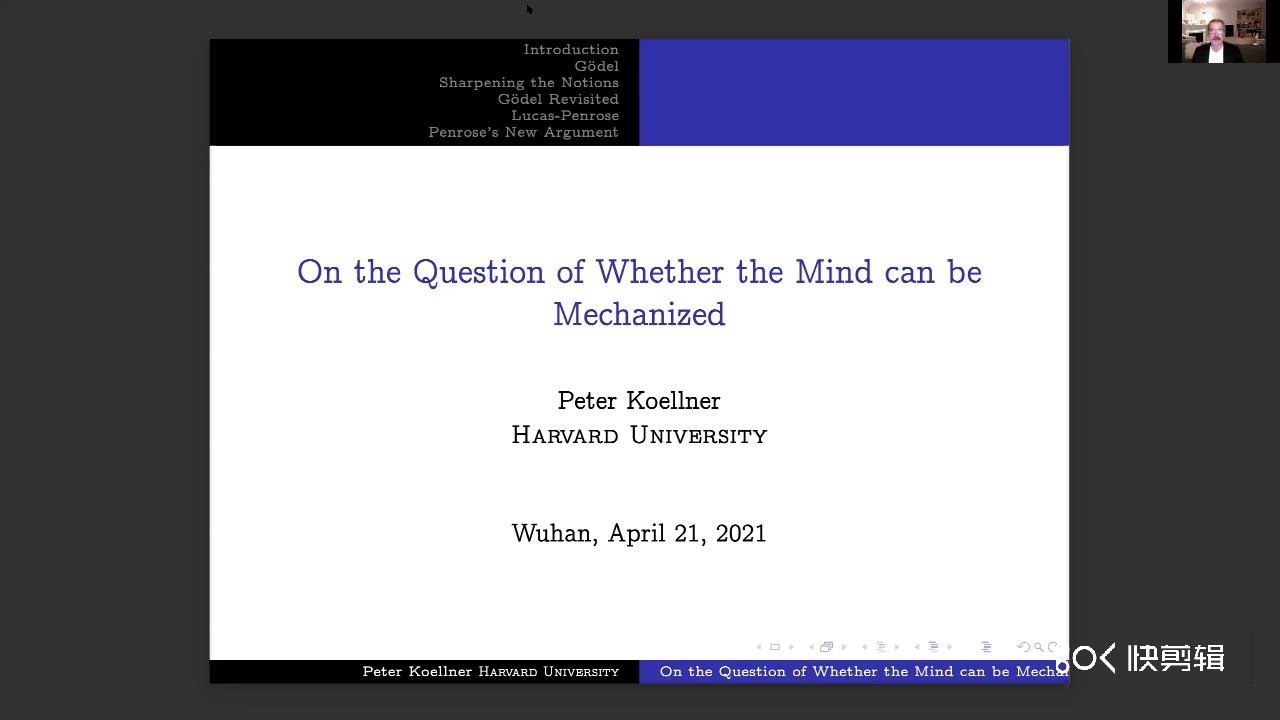
On the Question of Whether the Mind Can be Mechanized
Keywords
Summary
149 words
Critical Evaluation
Value of the Information & Strength of the Argument
The lecture provides a high value by offering a rigorous formalization of a notoriously vague question. Koellner’s argumentation is solid: he carefully defines the key terms, distinguishes between different interpretations, and presents formal results that clarify the logical landscape. He does not overclaim, instead showing that under certain formalizations, the disjunction is provable but neither disjunct is. This is a significant contribution to the debate, as it moves beyond informal speculation to precise mathematical results. The argumentation is systematic and well-structured, with clear steps and a logical flow.
Scientific Rigor, Source Quality, Title Accuracy
The lecture demonstrates high scientific rigor. Koellner relies on established results from mathematical logic, such as Gödel’s incompleteness theorems and Turing’s analysis of computability. He also references his own recent work on independence results. The sources are not explicitly cited in the video, but the content is based on peer-reviewed research. The title accurately reflects the content, though it is somewhat broader than the specific focus on mathematical outputs. The lecture is well-organized and the arguments are presented with precision.
183 words
Title / Content Match
The title accurately reflects the content: the lecture directly addresses the question of whether the mind can be mechanized, focusing on the implications of Gödel's incompleteness theorems. The speaker refines the question and provides a formal analysis.
Quality & Reliability
8/10
The lecture is given by a Harvard professor, Peter Koellner, a recognized expert in mathematical logic and philosophy. The content is rigorous, formal, and based on established results (Gödel's incompleteness theorems, Turing's analysis). The speaker carefully defines concepts and presents conditional results, avoiding overstatement. The presentation is technical and precise, with a clear structure. The video is a recording of an academic talk, which adds to its reliability.
Key Moments
Markers derived by PSI from the transcript: the creator did not define chapters.
- Introduction: Koellner shares his personal history with Gödel's work and outlines the lecture's focus.
- Definition of the refined question: comparing mathematical outputs of idealized human mind and Turing machines.
- Gödel's disjunctive conclusion: either mind cannot be mechanized or there are absolutely undecidable statements.
- Discussion of the three realms: material, mental, and mathematical, and the reductionist implications.
- Explanation of formal systems, consistency, and completeness, leading to Gödel's incompleteness theorems.
- Presentation of the second incompleteness theorem and its implications for formal systems.
- Formalization of the notions of mind and machine, and the proof of Gödel's disjunction in a precise setting.
- Independence results: neither disjunct is provable or refutable, even with strengthened principles.
- Conclusion: the questions themselves may be absolutely undecidable.
Cited Sources
- Gödel's Incompleteness Theorems — Referenced as the foundation of the discussion.
- Turing's Analysis of Computability — Referenced for the definition of mechanization.
Concurring Sources
- Gödel's Incompleteness Theorems — Supports the presentation of the theorems.
Dissenting Sources
- Lucas-Penrose Argument — The lecture argues against the stronger claim that the incompleteness theorems imply the mind cannot be mechanized, which is the central claim of the Lucas-Penrose argument.
Contribution & Novelties
The lecture provides a novel formalization of the question of mind mechanization, showing that Gödel’s disjunction is provable but neither disjunct is. This is a significant contribution to the philosophical debate, as it clarifies the logical structure of the problem. The independence results presented are recent and add to the understanding of the limits of formal reasoning.
Pour aller plus loin :
- Gödel’s Incompleteness Theorems (Stanford Encyclopedia) — Essential background.
- Turing Machines (Stanford Encyclopedia) — For the concept of mechanization.
- Penrose’s Argument (Wikipedia) — Related to the Lucas-Penrose thesis.
89 words
Radar Profile
The radar profile shows high scores in quality and technical level, with slightly lower scores in quantity and reliability. This indicates a dense, rigorous lecture that may be challenging for a general audience but is highly informative for those familiar with logic.
💬 No comments were provided for analysis.