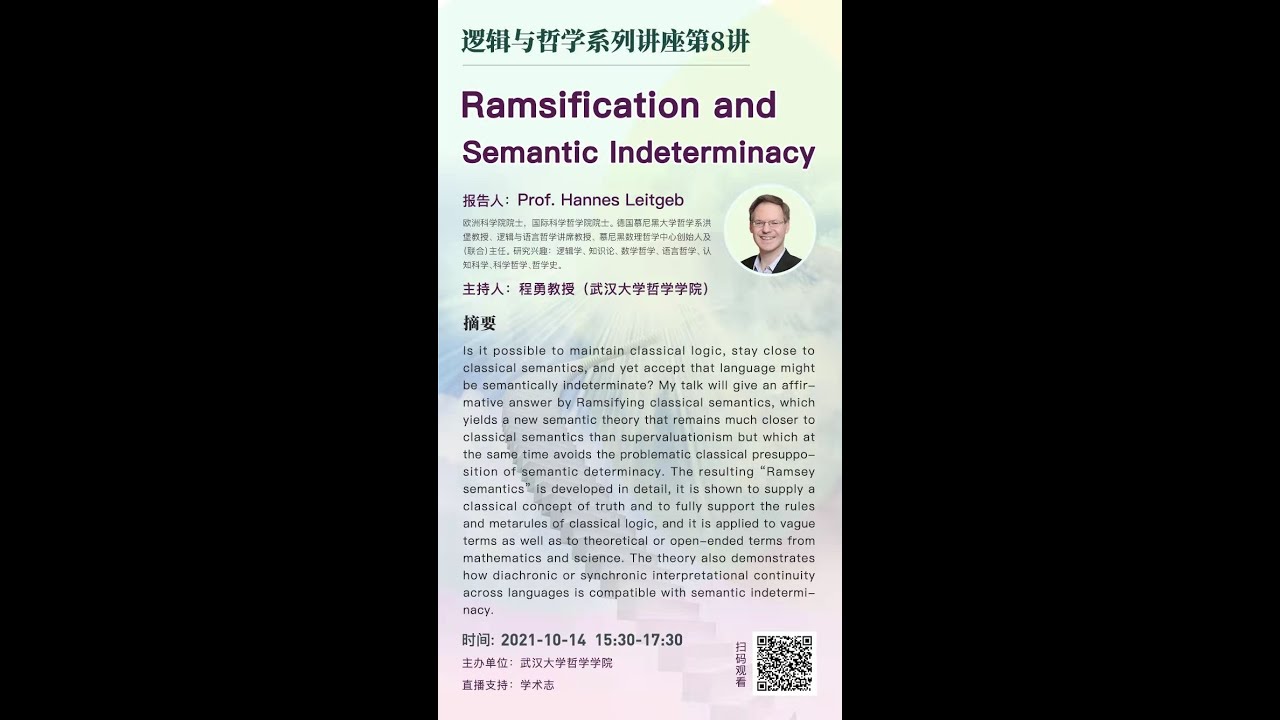
Ramsification and Semantic Indeterminacy
Keywords
Summary
153 words
Critical Evaluation
Value of the Information & Strength of the Argument
The lecture provides a high-value contribution to the philosophy of language and logic by proposing a novel solution to the problem of semantic indeterminacy. The argumentation is rigorous and well-structured, building from a clear presentation of classical semantics to a detailed development of Ramsey semantics. Leitgeb carefully motivates the need for the theory and addresses potential objections. The comparison with supervaluationism is particularly valuable, as it highlights the advantages of his approach. The application to concrete examples strengthens the practical relevance of the theory.
Scientific Rigor, Source Quality, Title Accuracy
The lecture demonstrates high scientific rigor, with precise formal definitions and careful reasoning. The speaker engages with the relevant philosophical literature, including the work of Putnam and Ramsey, and situates his proposal within the broader context of logical empiricism. The title accurately reflects the content, which focuses on Ramsification as a method to handle semantic indeterminacy. The presentation is clear and well-organized, though the lack of visual aids in the transcript limits the assessment of the slides.
176 words
Title / Content Match
The title accurately reflects the content, which focuses on the method of Ramsification applied to classical semantics to address semantic indeterminacy.
Quality & Reliability
8/10
The lecture is given by a recognized expert in logic and philosophy, with a clear formal structure and rigorous argumentation. The content is based on original research and engages with established philosophical literature. The presentation is technical and precise, though the lack of visual aids in the transcript limits full assessment.
Key Moments
Markers derived by PSI from the transcript: the creator did not define chapters.
- Introduction and overview of the lecture plan
- Classical semantics and its presupposition of semantic determinacy
- Examples of semantic indeterminacy: vague terms, theoretical terms, open-ended terms
- Introduction of Ramsey semantics as a solution
- Development of Ramsey semantics and its properties
- Comparison with supervaluationism
- Application to the three examples
- Philosophical conclusions and discussion
Cited Sources
- Putnam's twin earth thought experiment — Mentioned in the context of meta-semantic laws and the determination of meaning.
- Ramsey's method of Ramsification — The core method applied to classical semantics.
Concurring Sources
- Stanford Encyclopedia of Philosophy: Ramsification — Provides background on Ramsification, the method used in the lecture.
- Stanford Encyclopedia of Philosophy: Supervaluationism — Discusses supervaluationism, which the lecture compares to Ramsey semantics.
Dissenting Sources
- Intuitionistic logic — Some philosophers reject classical logic, which the lecture assumes as a starting point.
Contribution & Novelties
The lecture presents an original contribution by applying Ramsification to classical semantics, resulting in a new theory that addresses semantic indeterminacy while preserving classical logic. This approach is novel and offers a middle ground between classical semantics and supervaluationism. The theory has implications for the philosophy of language, logic, and the philosophy of science.
Pour aller plus loin :
- Ramsification — Stanford Encyclopedia of Philosophy entry on Ramsification.
- Supervaluationism — Stanford Encyclopedia of Philosophy entry on supervaluationism.
- Semantic indeterminacy — Stanford Encyclopedia of Philosophy entry on indeterminacy.
87 words
Radar Profile
The radar profile shows high scores across all dimensions, indicating a well-rounded and rigorous presentation. The lecture is technically demanding but accessible to a specialized audience, with strong emphasis on formal methods and philosophical argumentation.
💬 No comments were provided for analysis.