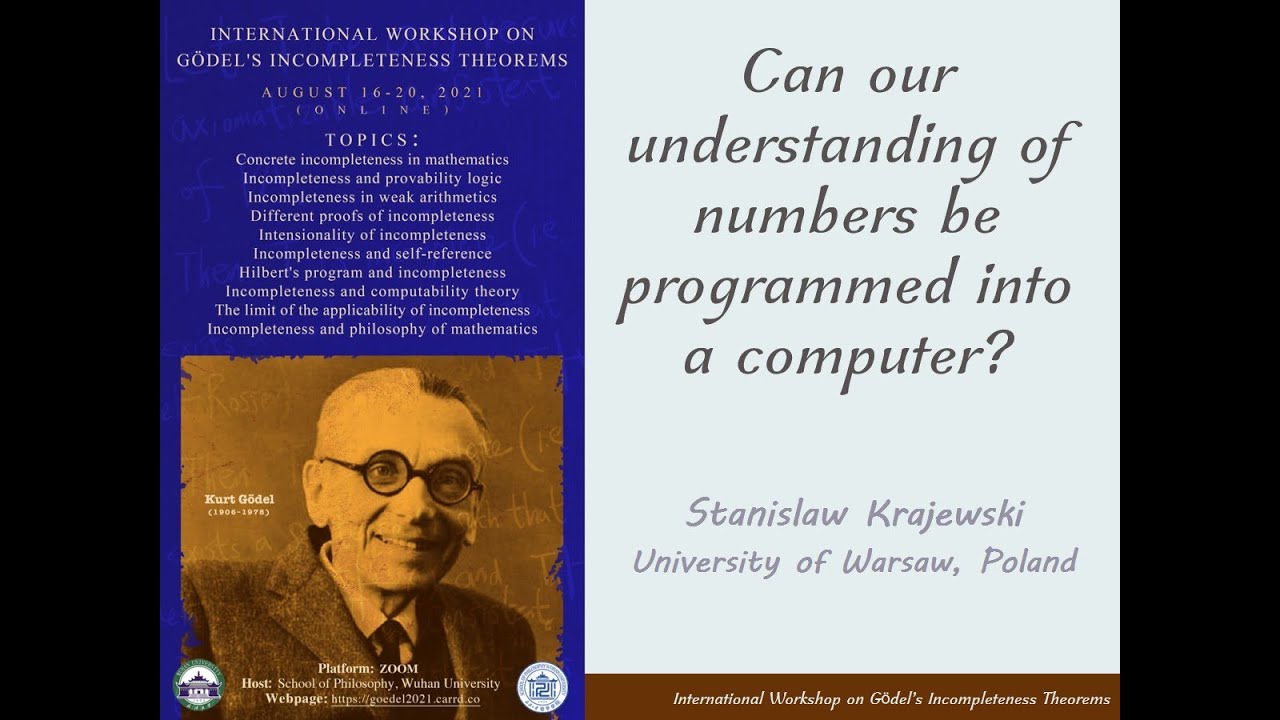
Stanislaw Krajewski: Can our understanding of numbers be programmed into a computer?
Keywords
Summary
167 words
Critical Evaluation
Value of the Information & Strength of the Argument
The talk provides a valuable and rigorous analysis of the Lucas-Penrose argument, offering a novel formalization that strengthens previous refutations. Krajewski carefully distinguishes between different versions of the argument and identifies the key assumptions that lead to failure. His argumentation is solid, building on well-known results and providing a clear logical structure. The discussion of ‘Gödelian emergence’ adds an original philosophical perspective, though it is somewhat speculative. Overall, the talk is intellectually stimulating and contributes to the ongoing debate on mechanism and the philosophy of mathematics.
Scientific Rigor, Source Quality, Title Accuracy
The talk demonstrates high scientific rigor, with precise references to Gödel’s theorems, the Lucas-Penrose argument, and related literature. Krajewski cites specific works, such as Lucas’s paper and Penrose’s books, and mentions John Burgess’s commentary. The sources are appropriate and credible. The title accurately reflects the content, as the talk indeed explores the question of whether our understanding of numbers can be mechanized. The talk is part of an academic workshop, which adds to its credibility. No comments were provided, so no analysis of public reception is possible.
188 words
Title / Content Match
The title accurately reflects the central question of the talk, which explores whether our understanding of natural numbers can be mechanized, concluding with a nuanced analysis of the implications of Gödel's theorems.
Quality & Reliability
8/10
The talk is given by a professor of philosophy at the University of Warsaw, an expert in logic and philosophy of mathematics. The content is well-structured and references established results (Gödel's theorems, Lucas-Penrose arguments) and includes a novel formalization of the anti-mechanist argument. However, it is a single expert's perspective without peer review or empirical validation.
Key Moments
Markers derived by PSI from the transcript: the creator did not define chapters.
- Introduction: Krajewski outlines the talk's structure, mentioning constructive consequences, emergence, Lucas-Penrose argument, and the implementation project.
- Discussion of constructive consequences: Gödel's discovery compared to incommensurability, and the representation of consistency as Diophantine equations.
- Introduction of 'Gödelian emergence': the unexpected complexity arising from combining addition and multiplication, leading to undecidability.
- Analysis of Lucas-Penrose argument: four steps, and the critique that it overlooks the possibility of inconsistent machines or consistent machines that don't know their consistency.
- Formalization of the anti-mechanist argument: conditions for any such argument, and the proof that the set of responses is inconsistent.
- Discussion of the unsoundness theorem for sound machines, and the conclusion that Penrose's argument fails.
- Introduction of the 'implementation project': whether our understanding of numbers can be programmed into a computer, and the role of tacit knowledge.
- Discussion of practical irrelevance of Gödelian limitations for most computational tasks, and the possibility of inconsistent machines.
- Conclusion: the anti-mechanist argument does not follow from Gödel's theorems, and the question remains open.
Cited Sources
- Workshop website — The talk is part of the Online International Workshop on Gödel's Incompleteness Theorems at Wuhan University.
- Workshop slides — All slides of lectures of this workshop are available at this link.
Concurring Sources
- Gödel's incompleteness theorems — The talk relies on these theorems as the foundation for its arguments.
Contribution & Novelties
The talk offers a fresh perspective on the Lucas-Penrose argument by providing a formalization that shows the inconsistency of any effective anti-mechanist response. It also introduces the concept of ‘Gödelian emergence’ to describe the unexpected complexity of arithmetic. The discussion of the implementation project raises important questions about the nature of mathematical understanding and its potential mechanization.
Pour aller plus loin :
- Gödel’s incompleteness theorems — Provides background on the theorems central to the talk.
- Lucas-Penrose argument — Overview of the argument critiqued in the talk.
- Church-Turing thesis — Relevant to the assumption that machines are equivalent to formal systems.
100 words
Radar Profile
The radar profile shows high scores in quantity and quality of information, indicating a dense and well-argued talk. The technical level is also high, reflecting the formal nature of the content. The overall reliability is strong, given the speaker's expertise and the academic context.