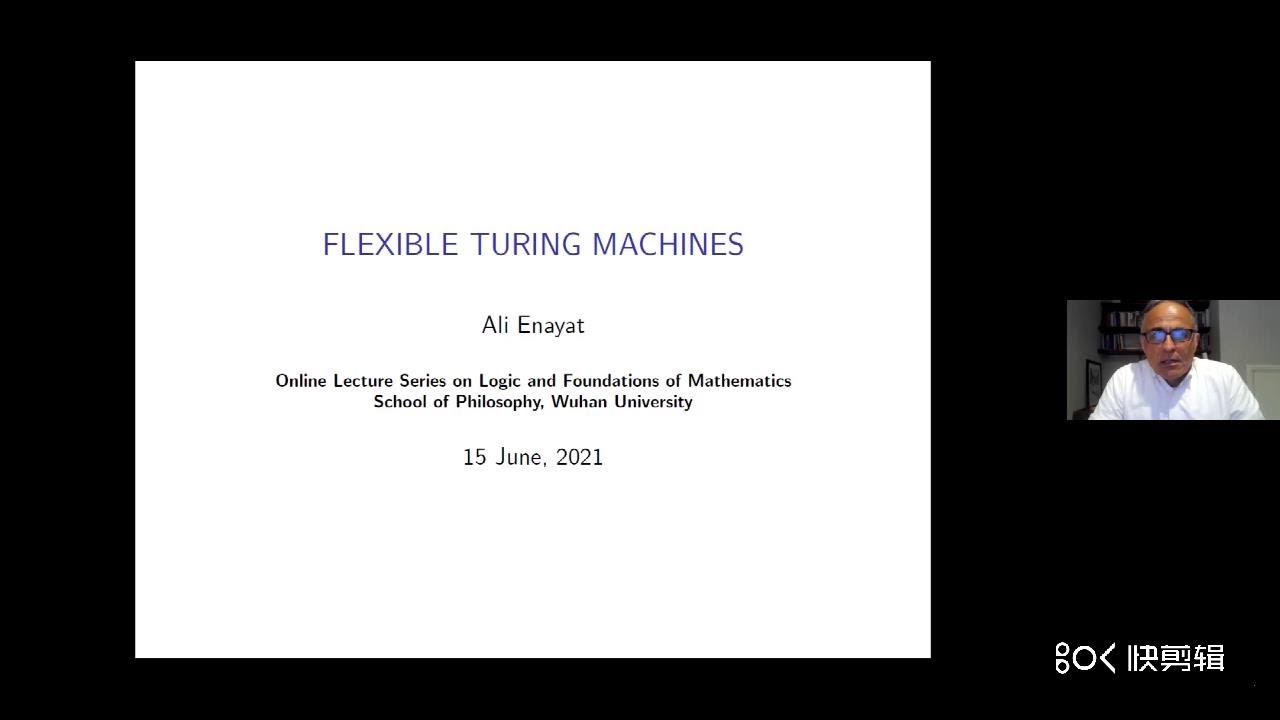
Ali Enayat: Flexible Turing Machines
Keywords
Summary
146 words
Critical Evaluation
Value of the Information & Strength of the Argument
The talk provides a deep and rigorous exposition of a niche but significant topic in mathematical logic. Enayat clearly explains the historical development from Kripke’s original construction to Woodin’s more sophisticated version, and his own refinements. The argumentation is solid, with all key theorems stated precisely and proofs sketched in sufficient detail to convey the main ideas. The value lies in the synthesis of results and the clarification of the relationships between them, which is valuable for researchers in the field.
Scientific Rigor, Source Quality, Title Accuracy
The talk is based on published research, including Woodin’s 2011 paper and Enayat and Blanck’s 2017 paper. Enayat explicitly references these works and provides context for their significance. The title accurately reflects the content, focusing on flexible Turing machines. The presentation is rigorous, with careful definitions and proofs. The talk is suitable for an expert audience, and the mathematical content is reliable.
158 words
Title / Content Match
The title accurately reflects the content, focusing on the concept of flexible Turing machines as introduced by Kripke and Woodin.
Quality & Reliability
9/10
The talk is given by a leading expert in the field, based on published research in reputable journals, with rigorous mathematical proofs and clear definitions.
Key Moments
Markers derived by PSI from the transcript: the creator did not define chapters.
- Introduction and overview of the talk's structure.
- Definition of Robinson arithmetic and the representation theorem.
- Discussion of the diagonal lemma and its applications.
- Presentation of Kripke's theorem on flexible Turing machines.
- Connection to Mostowski's theorem and Chaitin's incompleteness.
- Woodin's theorem and its formulation in terms of sequences and sets.
- Refinement of Woodin's theorem by Enayat and Blanck.
- Discussion of end extensions and the role of models of arithmetic.
- Comparison of Kripke's and Woodin's constructions.
- Conclusion and outlook for future research.
Cited Sources
- Woodin, W. H. (2011). A potential subtlety concerning the distinction between determinism and nondeterminism. — The paper that introduced the concept of flexible Turing machines and motivated the talk.
- Enayat, A., & Blanck, R. (2017). Marginalia on a theorem of Woodin. — The paper presenting the refinement of Woodin's theorem, which is the main topic of the talk.
Concurring Sources
- Kripke, S. (1961). The undecidability of the theory of models of arithmetic. — Original construction of flexible Turing machines.
- Mostowski, A. (1961). A generalization of the incompleteness theorem. — Theorem that Kripke's result generalizes.
Contribution & Novelties
The talk provides a clear and detailed exposition of the concept of flexible Turing machines, highlighting the evolution from Kripke’s original construction to Woodin’s more sophisticated version and the speaker’s own refinements. It clarifies the relationships between these results and related theorems in incompleteness theory. The talk is valuable for researchers in mathematical logic, offering insights into the interplay between computability and models of arithmetic.
Pour aller plus loin :
- Robinson arithmetic — Foundational theory used throughout the talk.
- Diagonal lemma — Key tool in the proofs of incompleteness theorems.
- Kripke’s theory of truth — Related work by Kripke on truth and paradoxes.
103 words
Radar Profile
The radar profile shows very high scores across all dimensions, indicating a talk that is rich in information, technically rigorous, and highly reliable. The balance between quantity and quality is excellent, with a strong emphasis on formal correctness.
💬 No comments were provided for analysis.