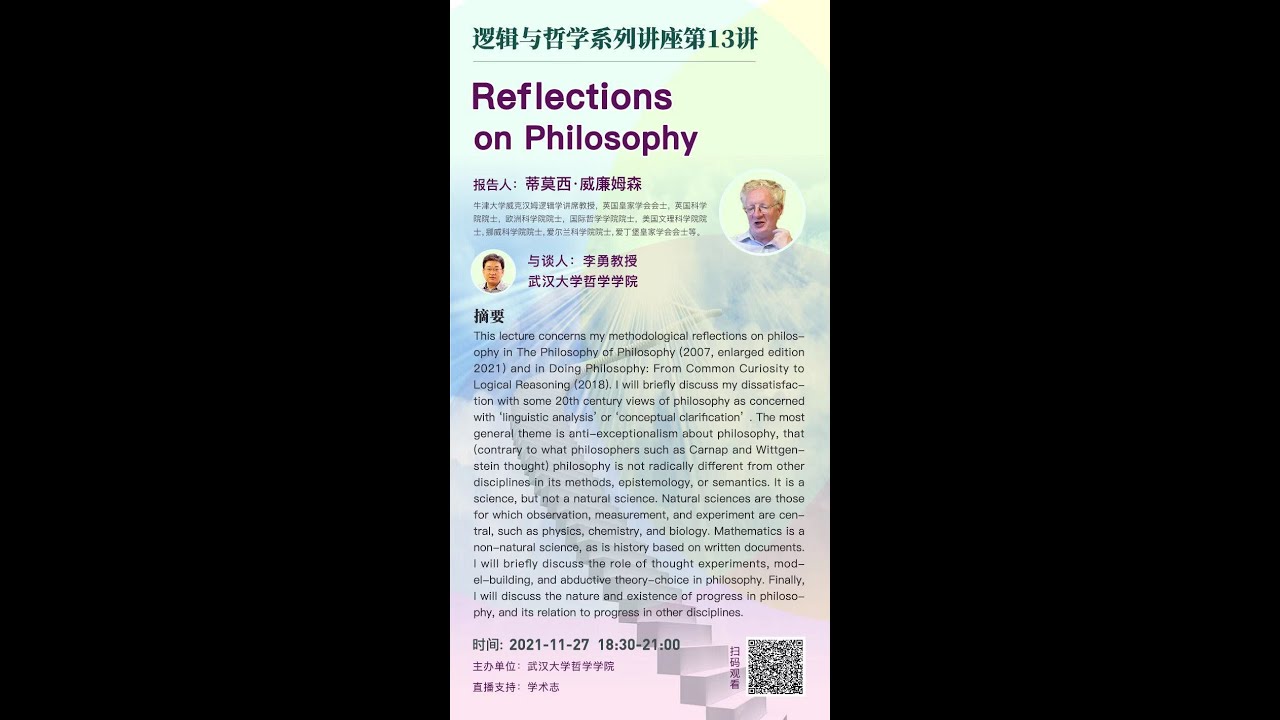
Reflections on Philosophy
Keywords
Summary
172 words
Critical Evaluation
Value of the Information & Strength of the Argument
The lecture provides valuable insights into the methodology of philosophy, drawing on Williamson’s extensive experience and published work. His argumentation is rigorous and well-structured, systematically dismantling the idea of philosophical intuition and advocating for anti-exceptionalism. He supports his claims with concrete examples and references to his own books, making a compelling case for a naturalistic approach to philosophy.
Scientific Rigor, Source Quality, Title Accuracy
Williamson demonstrates high scientific rigor, grounding his arguments in his published works and engaging with major philosophical figures. The sources cited are his own books and the works of others, which are reliable and relevant. The title accurately reflects the content, as the lecture is a personal reflection on philosophy. No comments were provided, so no analysis of public reception is included.
135 words
Title / Content Match
The title accurately reflects the content, which is a personal and methodological reflection on philosophy.
Quality & Reliability
9/10
Lecture by a leading philosopher (Timothy Williamson) at a university event, based on his published works. High intellectual rigor, clear argumentation, and no commercial or promotional content.
Key Moments
Markers derived by PSI from the transcript: the creator did not define chapters.
- Introduction by chair, Yong Cheng, and presentation of Timothy Williamson.
- Williamson begins his lecture, discussing his undergraduate years and the influence of Wittgenstein, Dummett, and Quine.
- Critique of behaviorist psychology and its impact on philosophy of language.
- Discussion of the analytic-continental divide in Ireland and its sectarian parallels.
- Transition to meta-philosophy and the role of intuitions in philosophy.
- Critique of the notion of philosophical intuition and the analogy with perception.
- Explanation of thought experiments as offline analogs of perceptual judgments.
- Introduction of anti-exceptionalism: philosophy as a non-natural science.
- Discussion of progress in philosophy and its relation to other disciplines.
- Conclusion and Q&A session begins.
Cited Sources
- The Philosophy of Philosophy — Williamson's book, central to his methodological reflections.
- Doing Philosophy: From Common Curiosity to Logical Reasoning — Another key work by Williamson, mentioned in the abstract.
Concurring Sources
- The Philosophy of Philosophy — Williamson's book, which the lecture draws upon.
- Doing Philosophy: From Common Curiosity to Logical Reasoning — Another work by Williamson, referenced in the abstract.
Contribution & Novelties
The lecture offers a clear and accessible presentation of Williamson’s anti-exceptionalist view, synthesizing arguments from his books. It provides a valuable critique of the concept of philosophical intuition and offers a naturalistic account of thought experiments. The discussion of progress in philosophy is particularly insightful.
Pour aller plus loin :
- Anti-exceptionalism about philosophy — Overview of the view that philosophy is not methodologically special.
- Thought experiment — General concept and examples.
- Abductive reasoning — Key method in philosophy and science.
80 words
Radar Profile
The radar profile shows high scores across all dimensions, reflecting the lecture's strong informational content, technical depth, and reliability. The balance between quantity and quality of information is notable, with a slight emphasis on quality.