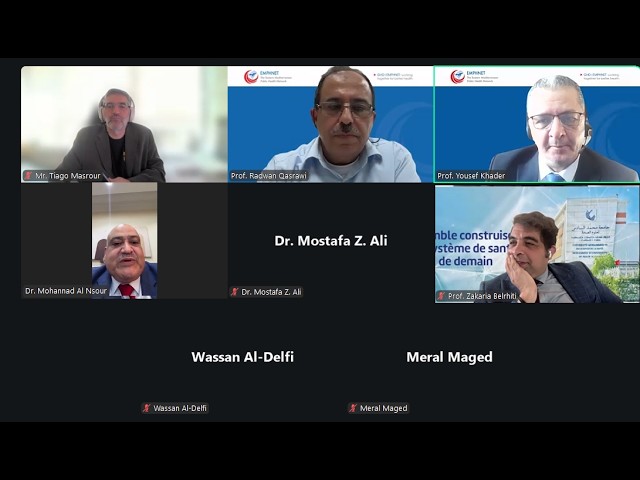
WEBi 53: Investment in AI to Promote Public Health in the Middle East and North Africa
Keywords
Summary
159 words
Critical Evaluation
Value of the Information & Strength of the Argument
The webinar provides valuable insights into the state of AI in public health in the MENA region, drawing on the expertise of the speakers. The argumentation is coherent and well-structured, with speakers building on each other’s points. They present a balanced view, acknowledging both opportunities and challenges. However, the discussion is largely qualitative, with limited quantitative data or case studies to substantiate claims. The speakers rely on their professional experience and a report mentioned but not detailed, which somewhat weakens the empirical foundation. Nonetheless, the arguments are persuasive and practical, offering actionable recommendations for stakeholders.
Scientific Rigor, Source Quality, Title Accuracy
The webinar demonstrates scientific rigor through the involvement of established experts and references to WHO ethical principles and regional strategies. However, specific sources are not cited during the discussion, and the mentioned report is not publicly referenced. The title accurately reflects the content, and the webinar stays on topic. The lack of explicit citations and the reliance on expert opinion rather than peer-reviewed literature slightly reduce the scientific robustness. The discussion is well-organized and addresses the key themes promised in the description.
192 words
Title / Content Match
The title accurately reflects the content, which focuses on investment in AI for public health in the MENA region, discussing current status and future challenges.
Quality & Reliability
7/10
The webinar features recognized experts in public health and AI, providing a credible overview of the regional landscape. However, the discussion is largely based on expert opinion and a report not publicly cited, with limited presentation of empirical data or peer-reviewed sources.
Key Moments
Markers derived by PSI from the transcript: the creator did not define chapters.
- Introduction by moderator Prof. Yousef Khader, setting the stage for the webinar.
- Dr. Mohannad Al Nsour presents the global and regional landscape of AI in public health, categorizing countries into tiers.
- Discussion on the strengths and weaknesses of AI adoption in the Eastern Mediterranean region.
- Dr. Al Nsour outlines EMPHNET's role in strengthening workforce capacity and regional coordination.
- Prof. Radwan Qasrawi introduces AI concepts and applications in health, emphasizing the importance of data.
- Examples of AI use in low-income countries like Zimbabwe and Nigeria, and Gulf states' initiatives.
- Challenges to AI deployment: data privacy, algorithm bias, transparency, and regulatory gaps.
- Recommendations for building digital infrastructure, fostering collaboration, and investing in education.
Cited Sources
- WHO ethical principles for AI in health — Referenced by Prof. Qasrawi as a framework for ethical AI implementation in health.
Concurring Sources
- WHO ethical principles for AI in health — Aligns with the webinar's emphasis on ethical AI implementation.
Contribution & Novelties
The webinar provides a comprehensive overview of the AI landscape in MENA public health, highlighting the gap between research and deployment. It emphasizes the need for regional coordination and policy development, offering a tiered classification of countries that can guide investment strategies. The discussion brings together diverse perspectives from public health and technology experts, underscoring the importance of workforce training and ethical governance.
Pour aller plus loin :
- Artificial intelligence in healthcare — Overview of AI applications in healthcare.
- WHO guidance on ethics and governance of AI for health — Official WHO document on ethical principles.
- Digital health in the Eastern Mediterranean Region — WHO regional initiatives on digital health.
110 words
Radar Profile
The radar profile shows balanced scores across information quantity, quality, technical level, and reliability, indicating a well-rounded discussion. The slightly lower technical level reflects the focus on policy and implementation rather than deep technical details, while the high reliability is supported by expert speakers and references to WHO guidelines.