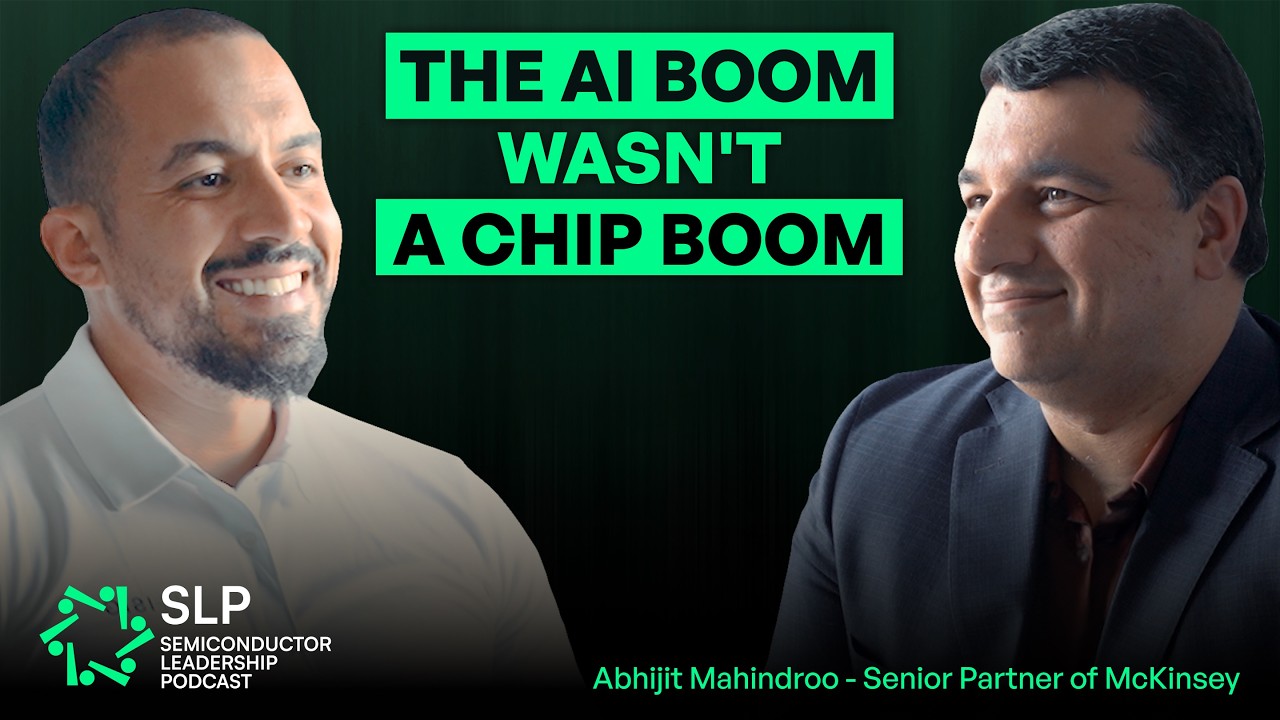
The AI Boom Wasn't a Chip Boom
Keywords
Summary
164 words
Critical Evaluation
Value of the Information & Strength of the Argument
The value of the information is high, as Mahindroo provides unique insights from his extensive consulting experience with top semiconductor companies. He offers concrete examples and frameworks, such as the ‘full potential’ approach to operations improvement and the three pillars of successful M&A integration. His argumentation is generally solid, backed by data points like the economic profit comparison and the AI capex estimate. However, some claims are forward-looking and speculative, such as the $5-7 trillion AI capex figure, which is presented as an estimate without detailed methodology. The discussion is more opinion-based than evidence-based, but the opinions are informed and well-articulated.
Scientific Rigor, Source Quality, Title Accuracy
The scientific rigor is moderate, as the conversation is based on expert opinion and consulting experience rather than peer-reviewed research. Mahindroo references his own article from April 2025 and mentions concepts like Conway’s Law and the Manhattan Project, but does not provide specific citations. The sources cited are primarily the guest’s own expertise and the podcast’s context. The title ‘The AI Boom Wasn’t a Chip Boom’ is somewhat misleading, as the discussion covers a wide range of semiconductor topics, not just the AI boom’s relationship to chips. However, the AI boom is a central theme, so the title is acceptable. The content is well-structured and the guest is credible, but the lack of verifiable sources limits the overall rigor.
235 words
Title / Content Match
The title is somewhat misleading as the discussion covers a broad range of semiconductor industry topics, not just the AI boom's relationship to chips. However, the AI boom is a central theme, so the title is acceptable.
Quality & Reliability
8/10
The guest is a senior partner at McKinsey with deep industry experience, providing informed opinions and data-driven insights. However, the discussion is largely based on personal expertise and consulting experience rather than peer-reviewed research, and some claims (e.g., AI capex estimates) are forward-looking and uncertain.
Chapters
- Cold open: is the AI data center bubble real
- Guest introduction
- Full welcome and introduction
- Rapid fire round
- His career story
- Why no country has industrialized without semiconductors
- Capacity as the industry's top challenge
- What good M&A integration looks like
- What an operations transformation looks like in a fab
- What R&D productivity really means
- Breaking down his April 2025 article on AI's impact on the industry
- Three decades of the industry, compared
- Revisiting the AI bubble question
- The public debate gap: state of US manufacturing
- Who is most at risk of disruption in the AI cycle
- The M&A wave in photonics, and why buy instead of build
- Geopolitics, supply chains, and "design for resilience"
- The hardest advice he's had to give a client
- Misconceptions about strategy consulting
- The one shift executives are most underweighting
- Closing and sign-off
Cited Sources
- McKinsey & Company — The guest is a senior partner at McKinsey, and the discussion draws on McKinsey's research and insights.
- I, Robot by Isaac Asimov — Recommended by the guest as a book every semiconductor executive should read.
- A Century of Plenty — Book written by McKinsey colleagues, mentioned by the guest.
Concurring Sources
- McKinsey & Company — The guest's firm, which publishes research on semiconductors and AI.
Contribution & Novelties
The podcast provides a strategic perspective on the semiconductor industry’s current state and future, offering insights from a top consultant. It highlights the unprecedented scale of AI-driven capex and the concentration of economic profit, and discusses operational and strategic challenges. The discussion on R&D productivity and M&A integration offers practical frameworks.
Pour aller plus loin :
- Conway’s Law — Relevant to the discussion on product architecture and organizational structure.
- Manhattan Project — Referenced as a historical comparison for AI capex.
- Semiconductor industry — Provides background on the industry’s evolution and importance.
91 words
Radar Profile
The radar profile shows high scores in quantity and quality of information, reflecting the guest's expertise and the breadth of topics covered. The technical level is moderately high, suitable for an audience familiar with the semiconductor industry. The overall reliability is good, though the reliance on expert opinion rather than peer-reviewed sources slightly lowers the score.