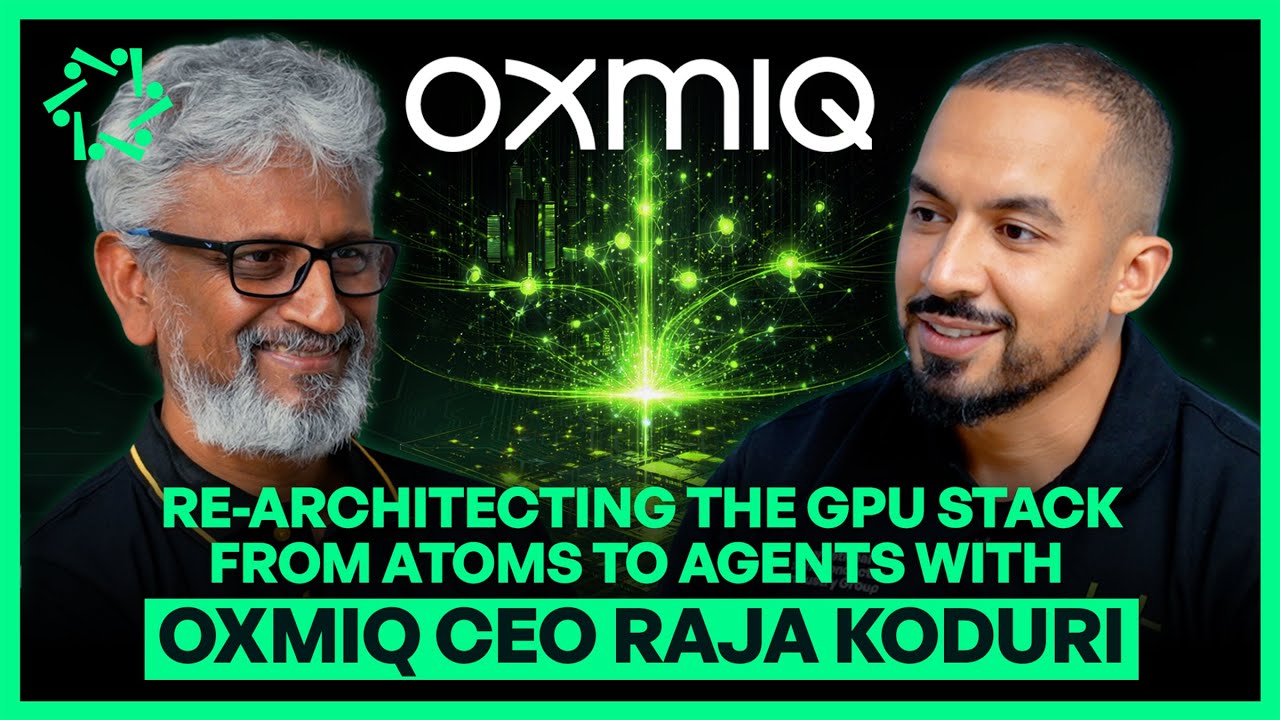
OXMIQ CEO Raja Koduri on Re-Architecting the GPU Stack: From Atoms to Agents
Keywords
Summary
181 words
Critical Evaluation
Value of the Information & Strength of the Argument
The value of the information is high, offering unique insights from a leading industry figure on the future of GPU architecture and AI infrastructure. Koduri provides concrete examples and data, such as the $30 billion per gigawatt silicon cost and the projected token demand, to support his arguments. His argumentation is solid, grounded in his extensive experience at Intel and AMD, and he clearly articulates the challenges of hardware-software co-design and the limitations of current standardization efforts. He presents a compelling case for Oxmiq’s approach, though some claims are forward-looking and not yet fully validated.
Scientific Rigor, Source Quality, Title Accuracy
The discussion is rigorous in its technical depth, with Koduri referencing specific projects like Ponte Vecchio and partnerships like Tenstorrent. However, the content is primarily opinion and experience-based, with no formal citations to external sources. The title accurately reflects the content, focusing on re-architecting the GPU stack. The podcast format allows for a candid and detailed exploration of the topics, but the lack of verifiable sources limits its scientific rigor. The description provides chapter markers that help navigate the content, but no additional references are given.
196 words
Title / Content Match
The title accurately reflects the content, focusing on re-architecting the GPU stack from hardware to software, with a vision from atoms to agents.
Quality & Reliability
8/10
The speaker is a highly experienced industry leader with deep technical expertise in GPU architecture and software stacks. The discussion is grounded in practical experience and specific examples, though it is primarily opinion and forward-looking vision rather than peer-reviewed research.
Chapters
- Intro
- What problem is OXMIQ solving first
- Hardware or Software
- What is OXCORE
- What is OXPython
- Most overrated and underrated GPU metric
- Freedom of Fragmentation
- One design choice Raja will never compromise on
- One KPI that proves TCO actually improved
- A partnership that would 10x QXMIQ roadmap
- What to do with 10x budget
- Most overhyped and under-hyped term in AI compute
- Failure that improved playbook
- "Hello, world!" for OXMIQ developers
- The greatest GPU software
- One piece of advice
- Career journey
- The perfect timing for OXMIQ
- Concerns over players in the game
- Rebuilding from atom to agents
- What success looks like
- Philosophy behind OXCORE
- OXPython possibilities and limits
- What is OXCapsule
- What's next
- Investment capability or market access
- Scaling with talent bottleneck
- Top 2 technical D-risks
- Competition, pricing, innovation
- One piece of advice
- Raja's vision for OXMIQ
Contribution & Novelties
This podcast provides a unique perspective on the future of GPU architecture from a key industry insider. Koduri’s concept of OXCORE as a unified computing core and OXPython as a software-level solution to the ‘CUDA virus’ offers novel approaches to the challenges of AI hardware and software. His emphasis on bandwidth over compute and the need to reduce silicon costs are important contributions to the discussion on AI infrastructure scalability.
Pour aller plus loin :
118 words
Radar Profile
The radar profile shows high scores in quantity of information, quality, and technical level, reflecting the depth of the discussion. The reliability score is slightly lower due to the opinion-based nature of the content, but overall the podcast offers valuable insights for professionals in the semiconductor and AI fields.