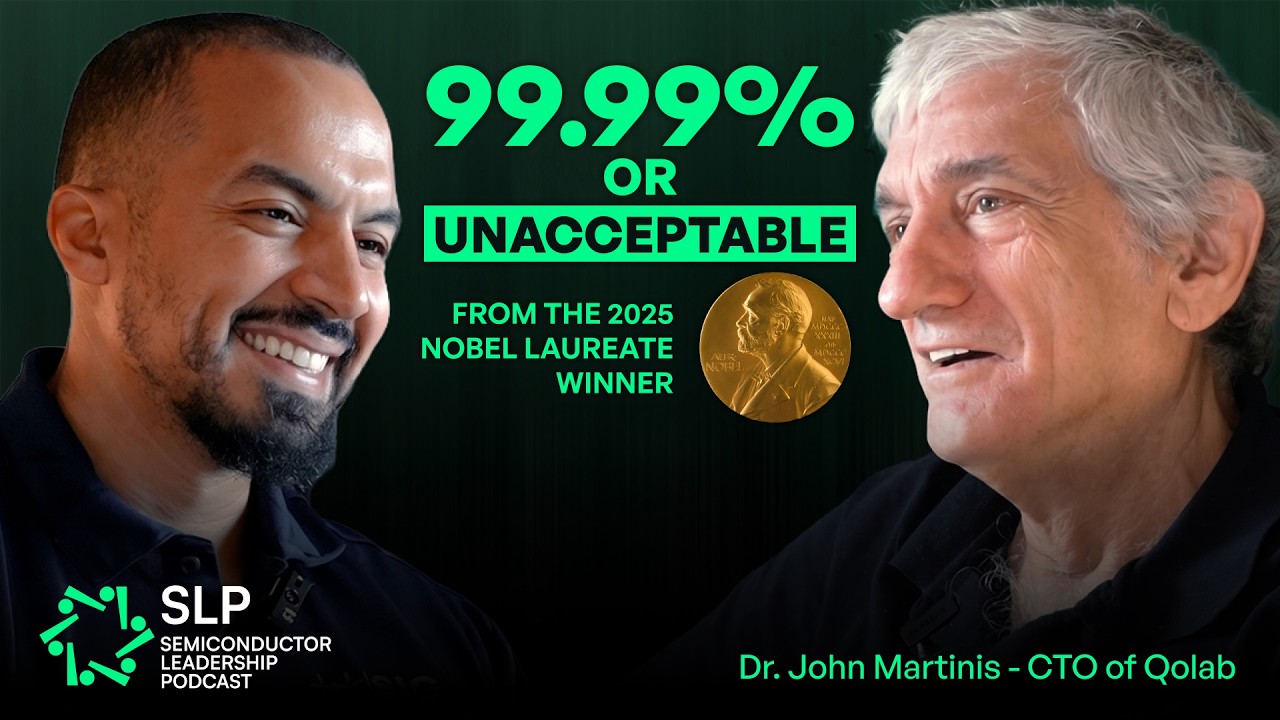
The Nobel Prize Winner Building Quantum Computers the Semiconductor Way
Keywords
Summary
149 words
Critical Evaluation
Value of the Information & Strength of the Argument
The value of the information is high, as it provides unique insights from a leading expert in the field. Martinis offers a clear argument for why quantum computing must adopt semiconductor manufacturing standards to scale. He supports his claims with specific technical details, such as the need for 99.99% yield and the use of wafer-scale integration. His argumentation is solid, grounded in decades of experience and practical examples from his work at Google and Qolab. The discussion on the dangers of ‘hero device’ results is particularly valuable, highlighting a systemic issue in the field. Overall, the content is informative and well-argued, though it is primarily opinion and perspective rather than peer-reviewed research.
Scientific Rigor, Source Quality, Title Accuracy
The scientific rigor is high, given the speaker’s credentials and the depth of technical discussion. The sources cited are limited to the host’s book, but the content is based on the speaker’s own research and experience, which adds credibility. The title accurately reflects the content, focusing on the intersection of quantum computing and semiconductor manufacturing. The video includes a brief promotional segment for the host’s book, but this does not detract from the overall quality. No comments were provided for analysis.
208 words
Title / Content Match
The title accurately reflects the content, focusing on the intersection of quantum computing and semiconductor manufacturing.
Quality & Reliability
8/10
The content is an expert interview with a Nobel laureate, providing deep technical insights into quantum computing hardware. The information is credible and grounded in the speaker's extensive experience, though it is primarily opinion and perspective rather than peer-reviewed research.
Chapters
- Book Announcement: Game of Chips hits 20,000 Amazon orders
- Cold Open: Semiconductor-grade yield and the quantum manufacturing gap
- Guest Introduction: Dr. John Martinis, CTO of Qolab
- Full Welcome and Bio
- Rapid Fire: The Nobel Prize call and how his wife found out first
- Rapid Fire: What still surprises him about superconducting qubits
- Rapid Fire: Academia vs. industry, which brings out his best science
- Rapid Fire: One book every quantum newcomer should read
- Rapid Fire: Quantum supremacy 2019, relief, high stakes, and getting demoted
- Rapid Fire: Leadership style at Qolab ("metrology, not mythology")
- Rapid Fire: The biggest myth about what quantum supremacy actually proved
- Rapid Fire: If not quantum physics, what field?
- Rapid Fire: What four decades of qubit research taught him about persistence
- Deep Dive: What quantum needs from the semiconductor industry in the next five years
- The tooling and materials bottleneck the industry hasn't fully recognized
- Government, policy, and a potential Quantum CHIPS Act
- Quantum's vertical structure vs. the semiconductor industry's horizontal model
- wo-level state defects, coherence times, and the decoherence problem
- Audience Question: Surface code vs. LDPC codes and systems engineering trade-offs
- Qolab's architecture: wafer-scale integration, silicon thermal interconnects, and cryogenic CMOS
- Target yield: 99.99% and why current qubit chips still fall short
- Path to a million qubits: tiling 300mm wafer modules
- Revisiting the 2019 Sycamore paper and what everyone missed
- Post-Nobel: What opinions people now take seriously, and what the industry still won't hear
- The 2026 equivalent of the 1985 macroscopic quantum tunneling paper
- Bitcoin, elliptic curve codes, and the quantum security threat
- Ten years out: Is Qolab a component supplier or a full quantum system builder?
- Closing message to the quantum and semiconductor community
Cited Sources
- Game of Chips — Book by the host Salah Nasri, mentioned at the beginning of the video.
Concurring Sources
- Quantum supremacy - Wikipedia — Provides context on the 2019 Google quantum supremacy experiment mentioned in the interview.
Contribution & Novelties
This interview provides a unique perspective on the intersection of quantum computing and semiconductor manufacturing, emphasizing the need for fab discipline and yield standards. It offers insights into the challenges of scaling quantum systems and the importance of metrology over mythology. The discussion on the potential of quantum computers to break Bitcoin’s encryption is particularly timely.
Pour aller plus loin :
- Quantum computing - Wikipedia — Provides a general overview of quantum computing concepts.
- Superconducting qubit - Wikipedia — Detailed information on superconducting qubits, the technology discussed.
- Wafer-scale integration - Wikipedia — Explains the concept of building chips on full wafers, a key topic in the interview.
- Cryogenic CMOS - Wikipedia — Discusses CMOS technology operating at cryogenic temperatures, relevant to Qolab’s architecture.
123 words
Radar Profile
The radar profile shows high scores in information quantity, quality, technical level, and reliability, indicating a technically dense and credible interview. The balanced scores suggest a well-rounded content with strong expert input.