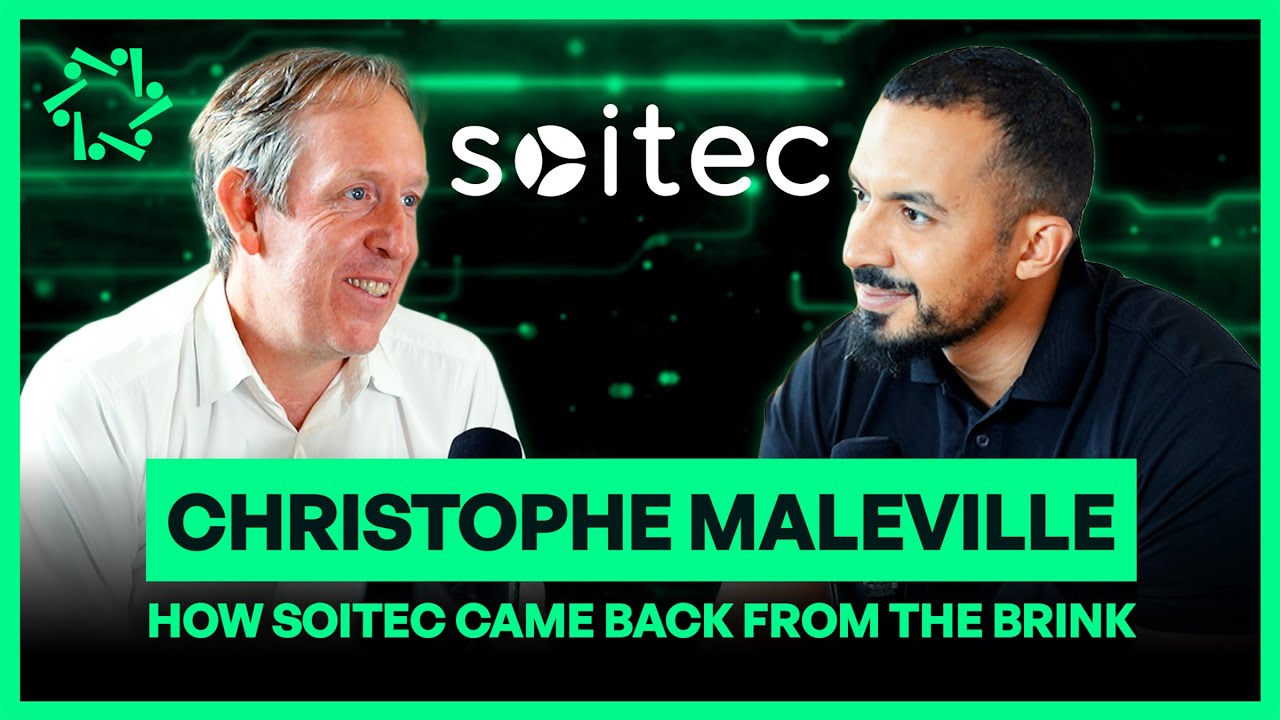
How One Company Rescued the Semiconductor Industry from a Global Crisis
Keywords
Summary
157 words
Critical Evaluation
Value of the Information & Strength of the Argument
The value of the information lies in the firsthand account of a key player in semiconductor materials innovation. Maleville provides specific examples, such as the RF market transition from GaAs to silicon, and the strategic allocation of R&D resources. The argumentation is coherent and based on decades of experience, though it is largely anecdotal and lacks quantitative data. The discussion on balancing long-term and short-term research is insightful, but the claims about sustainability and efficiency are not backed by specific metrics. Overall, the podcast offers valuable perspectives for industry professionals, but the lack of external references limits its scientific rigor.
Scientific Rigor, Source Quality, Title Accuracy
The podcast is an expert opinion piece, not a scientific study. No external sources are cited, and the claims are based on personal experience. The title is somewhat sensationalist, but the content does address how Soitec contributed to solving industry challenges. The technical details are plausible and align with known industry trends, but without references, the reliability is moderate. The title’s claim of ‘rescuing’ the industry is an overstatement, but the content does discuss significant contributions. Overall, the scientific rigor is limited by the anecdotal nature of the discussion.
204 words
Title / Content Match
The title is somewhat sensationalist ('Rescued the Semiconductor Industry') but the content does discuss Soitec's role in overcoming challenges, particularly in RF and power semiconductors. The title slightly overstates the impact but remains broadly relevant.
Quality & Reliability
7/10
The podcast features a high-level industry expert (CTO of Soitec) with 30+ years of experience, providing firsthand insights into semiconductor materials innovation. The discussion is anecdotal and based on personal experience rather than peer-reviewed data, but the technical details are plausible and align with known industry trends. No external sources are cited, limiting verifiability.
Key Moments
Markers derived by PSI from the transcript: the creator did not define chapters.
- Introduction of guest Christophe Maleville, CTO of Soitec, and his background.
- Maleville discusses the early breakthrough of defect-free layer transfer and its impact on his career.
- Discussion on the near-bankruptcy in 2015 and lessons learned from crisis.
- Explanation of the RF market transition from GaAs to silicon and the role of SOI.
- Soitec's strategy for balancing long-term research (25%) and short-term product development (75%).
- Discussion on challenges in power semiconductors, including silicon carbide and gallium nitride.
- Maleville emphasizes efficiency as the next scaling law and the importance of sustainability.
Contribution & Novelties
The podcast provides unique insights from a CTO of a leading engineered substrates company, offering a rare look into the strategic decisions behind SOI technology and its impact on the semiconductor industry. The discussion on balancing long-term and short-term R&D, and the creation of incubators, offers practical lessons for innovation management.
Pour aller plus loin :
- Silicon on insulator — Overview of SOI technology and its applications.
- Smart Cut — The layer transfer process developed by Soitec.
- Gallium arsenide — The material that SOI replaced in RF applications.
- Silicon carbide — Key material for power electronics, discussed in the podcast.
- FD-SOI — Fully depleted silicon on insulator, a specific SOI variant.
111 words
Radar Profile
The radar profile shows a balanced performance across all dimensions, with slightly higher scores in information quantity and quality, reflecting the expert's depth of knowledge. The lower scores in technical level and reliability are due to the conversational format and lack of external references.