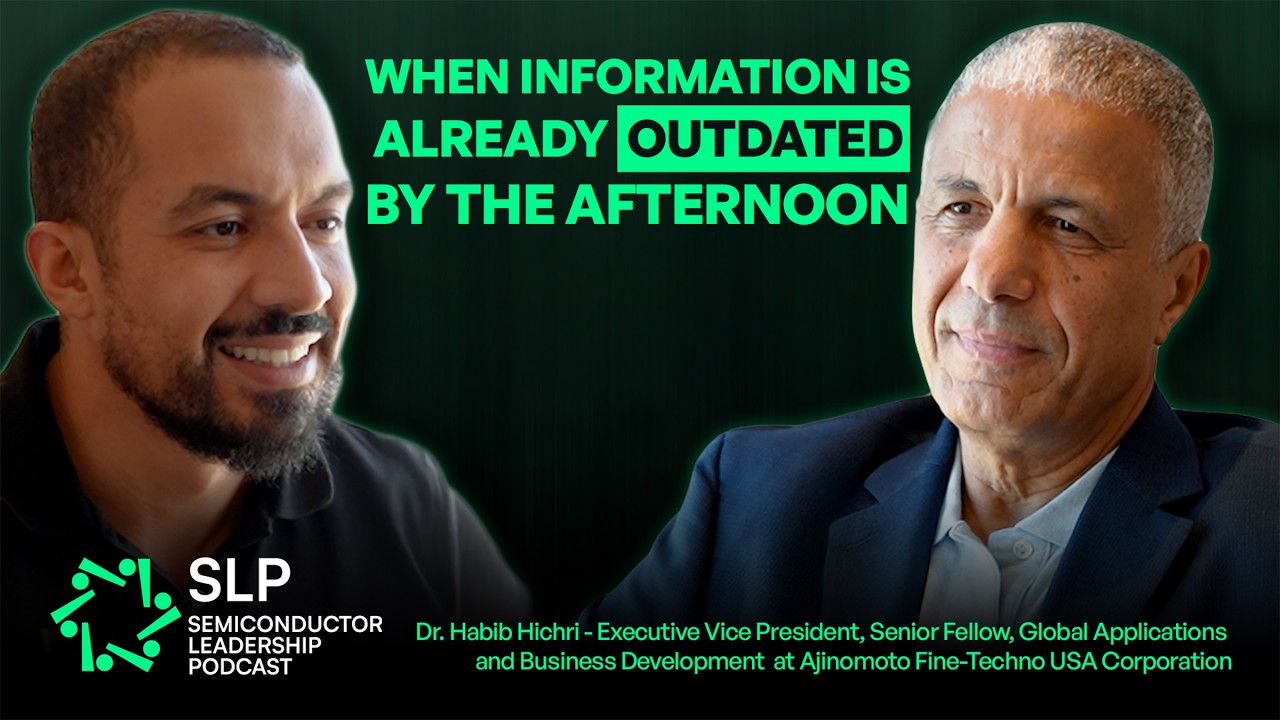
Why the Future of Computing is Being Built Like Legos
Keywords
Summary
171 words
Critical Evaluation
Value of the Information & Strength of the Argument
The video provides valuable insights from a seasoned industry expert, offering a rare perspective on the intersection of materials science, process integration, and business strategy. Dr. Hichri’s arguments are well-structured, drawing on his extensive experience at IBM and Ajinomoto. He effectively explains complex technical concepts like optical proximity correction and heterogeneous integration in an accessible manner. The discussion on non-photo materials for interposers is particularly insightful, presenting a forward-looking view on cost and performance trade-offs. The argumentation is solid, though it relies heavily on anecdotal evidence and personal experience rather than quantitative data or formal studies. The host’s promotional segments and occasional digressions slightly dilute the technical depth, but overall, the value of the information is high for professionals in the semiconductor field.
Scientific Rigor, Source Quality, Title Accuracy
The scientific rigor is moderate; the video is an expert opinion podcast rather than a peer-reviewed presentation. Dr. Hichri references his own publications and industry conferences (e.g., ECTC, IMAPS) but does not provide specific citations or URLs. The description mentions his 40 patents and IBM background, lending credibility. The title ‘Why the Future of Computing is Being Built Like Legos’ is catchy and metaphorically accurate for chiplets, but it is not explicitly scientific. The content aligns well with the title, focusing on modular integration. No comments were provided for analysis, so audience reception cannot be assessed.
234 words
Title / Content Match
The title metaphorically captures the essence of modular chip design (chiplets) discussed in the episode, though it is somewhat catchy and not fully explicit about the semiconductor focus.
Quality & Reliability
7/10
The video features a highly experienced semiconductor executive with over 40 patents, providing credible insider perspectives on advanced packaging and materials. However, it is primarily an opinion-based podcast with limited verifiable data or citations, and the host's promotional content slightly detracts from the scientific rigor.
Chapters
- Celebrating 5,000 Orders of “Game of Chips”
- The Hardest Career Decision: Leaving IBM After 12 Years
- Introducing Dr. Habib Hichri
- From Chemical Engineering to Semiconductors
- Learning the Fab: Process Integration Explained
- Hiring Engineers: Compatibility Over Credentials
- Entering Advanced Packaging & Photonics
- Bridging Front-End and Advanced Packaging
- The Move to Ajinomoto
- IBM’s Transformation & Leadership Lessons
- Node Transitions: 130nm to 14nm
- Optical Proximity Correction & Design-Manufacturing Alignment
- Leadership vs. Management
- Why an MBA Matters in Semiconductor R&D
- Define the Real Problem First
- Company Culture: U.S., Germany, and Japan Compared
- Think “What If?”: The Innovation Mindset
- Chiplets & Heterogeneous Integration
- Material Challenges in Advanced Packaging
- Giving Back Through Industry Associations
- The Next 5 Years: Photonics & Energy Efficiency
Cited Sources
- Game of Chips (book by Salah Nasri) — Mentioned at the beginning as a promotional item, not a scientific source.
- Ajinomoto Fine-Techno — Dr. Hichri's employer, mentioned in the introduction and throughout.
- IBM — Dr. Hichri's former employer, discussed extensively.
Concurring Sources
- Heterogeneous Integration Roadmap — Supports the discussion on chiplets and heterogeneous integration as key industry directions.
- Chiplet Design and Heterogeneous Integration Packaging — Academic article that aligns with the technical content on chiplets.
Contribution & Novelties
The video offers a unique insider perspective on the convergence of front-end manufacturing and advanced packaging, particularly the potential of non-photo materials for interposers. Dr. Hichri’s advocacy for using lithography and dry etch for non-photo materials, backed by his published work, provides a novel angle on cost-effective scaling. The discussion on leadership and problem definition adds a non-technical dimension, emphasizing the importance of defining the real problem before seeking solutions.
Pour aller plus loin :
- Heterogeneous Integration Roadmap — Official roadmap from IEEE, relevant to chiplets and advanced packaging.
- Chiplet Design and Heterogeneous Integration Packaging — Academic article on chiplet design and packaging.
- Advanced Packaging: The Next Frontier — Industry article discussing advanced packaging trends.
115 words
Radar Profile
The radar profile shows high scores in quantity and technical level, reflecting the dense information and expert depth. Quality and reliability are slightly lower due to the opinion-based nature and lack of citations. The overall profile indicates a technically rich but not fully rigorous source.