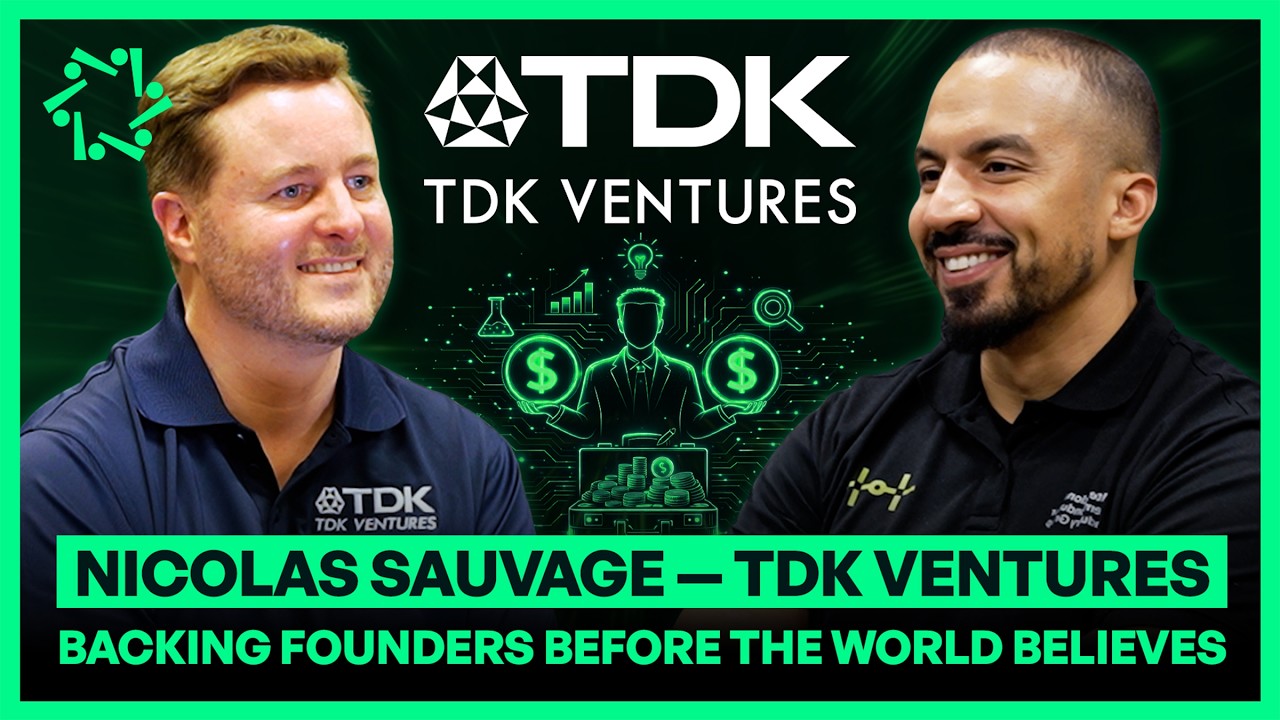
How to Spot the Next Billion-Dollar AI Chip Company Before Everyone Else
Keywords
Summary
157 words
Critical Evaluation
Value of the Information & Strength of the Argument
The value of the information is high for those interested in venture capital and deep tech investing. Sauvage provides concrete examples of investments (e.g., Exponent Energy in India, Novealis in Australia) and explains his investment philosophy with clarity. The argumentation is solid, based on first-hand experience and logical reasoning. He challenges common VC metrics and offers nuanced perspectives on governance and unit economics. The discussion is practical and actionable, though it lacks quantitative data or external validation.
Scientific Rigor, Source Quality, Title Accuracy
The scientific rigor is moderate; the content is based on expert opinion rather than empirical research. No specific sources are cited, but the speaker references his own experience and a professor (Jesper Sorensen) for an analogy. The title is somewhat misleading as it focuses on AI chip companies, but the content is broader. The description provides a clear overview and chapter markers, which aids navigation. No comments were provided for analysis.
163 words
Title / Content Match
The title is somewhat misleading as the episode focuses on general deep tech VC strategies rather than specifically on AI chip companies, though it does touch on AI infrastructure and semiconductors.
Quality & Reliability
7/10
The content is an expert interview with the President of TDK Ventures, providing practical insights into deep tech venture capital. The information is based on professional experience and specific examples, but lacks formal citations or data verification. The discussion is coherent and credible, though subjective and not peer-reviewed.
Chapters
- Welcome to the Semiconductor Leadership Podcast
- Introducing Nicolas Sauvage, President of TDK Ventures
- How TDK Ventures finds “King of the Hill” startups
- Why seed stage matters most in deep tech
- The most important diligence signal in venture capital
- The one KPI that actually matters: unit economics
- Why India is one of the best places for deep tech
- Why 2026 will be a historic year for venture investing
- What great Corporate VC governance really means
- Why predicting the future is the wrong way to invest
- How to power AI when lithium and materials run out
- How TDK Ventures was born
- What “Scaling Impact Scalers” really means
- Why deep tech timelines break traditional VC models
- The truth about power laws in venture capital
- The convergence of AI, energy, and electrification
Contribution & Novelties
The episode offers original insights into corporate venture capital, particularly the distinction between exploitation and exploration missions, and the importance of unit economics in deep tech. It provides a framework for evaluating early-stage startups and highlights underpriced regions. The discussion on being ‘right four years before it’s obvious’ is a valuable perspective.
Pour aller plus loin :
- Corporate venture capital — Overview of CVC structures and strategies.
- Unit economics — Explanation of unit economics and its importance in business models.
- Deep tech — Definition and examples of deep tech startups.
- Venture capital — General overview of venture capital principles.
99 words
Radar Profile
The radar profile shows high scores in quantity of information and fiabilite, with moderate technical level. This indicates a content-rich, credible discussion that is accessible to a broad audience, but not highly technical.