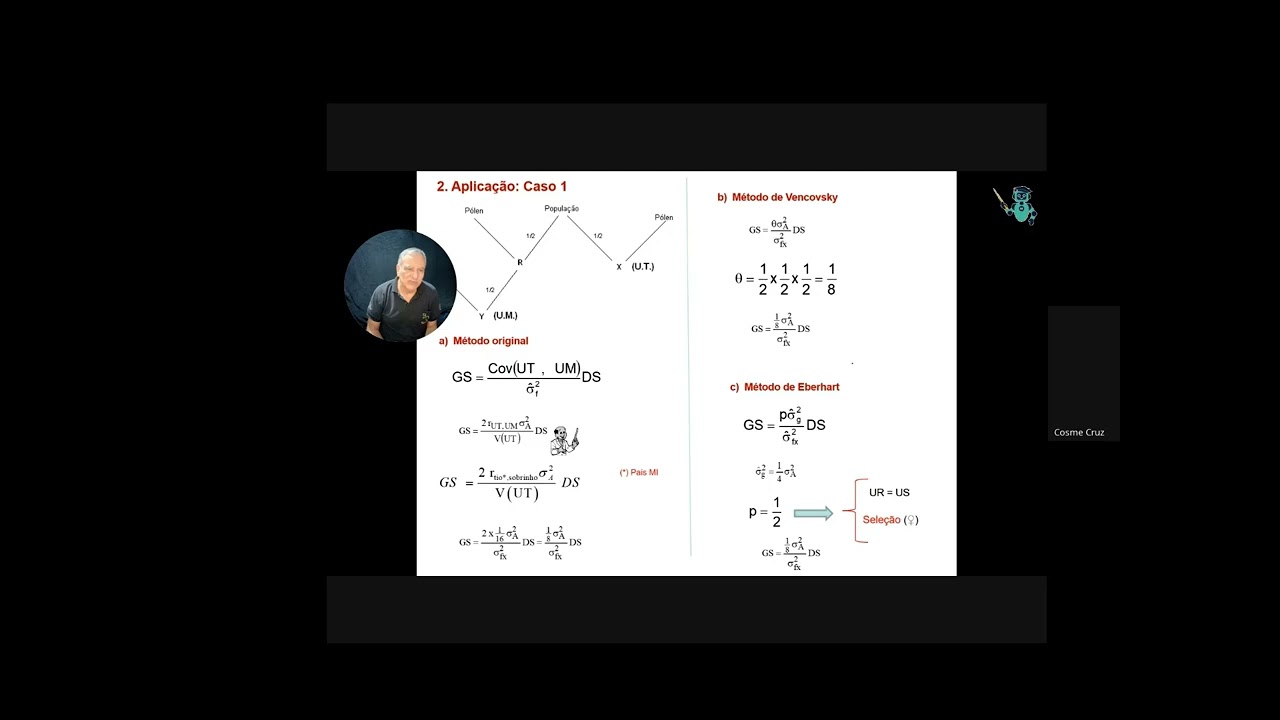
MGV 3707 Biometria Aula10
Keywords
Summary
172 words
Critical Evaluation
Value of the Information & Strength of the Argument
The video provides a thorough and rigorous explanation of selection gain prediction, grounded in quantitative genetics theory. The instructor clearly articulates the mathematical models and their assumptions, and he critically evaluates the limitations of simplified formulas. He uses a concrete example to illustrate the application of these methods, which enhances the practical value of the content. The argumentation is solid, as he connects the statistical estimates to their genetic interpretations, such as explaining that the estimated variance component reflects a fraction of additive genetic variance. He also highlights the role of the biometrician in choosing appropriate analytical methods, which adds depth to the discussion.
Scientific Rigor, Source Quality, Title Accuracy
The scientific rigor is high, as the content aligns with established quantitative genetics principles. However, the video does not cite specific external sources, relying instead on the instructor’s expertise and standard textbook knowledge. The title accurately reflects the content, which is a lecture on biometrics. The video includes a brief mention of a fifth factor—the human element—which is not a standard factor but is presented as a conceptual addition. Overall, the sources are implicit, and the title is appropriate.
198 words
Title / Content Match
The title 'MGV 3707 Biometria Aula10' accurately reflects the content, which is a lecture on biometrics, specifically covering selection gain prediction methods.
Quality & Reliability
8/10
The video is a lecture by an expert in quantitative genetics and biometrics, presenting established methods (e.g., Smith-Hazel index, selection gain prediction) with detailed explanations and practical examples. The content is consistent with standard textbooks and academic literature, though it lacks explicit citations to external sources.
Key Moments
Markers derived by PSI from the transcript: the creator did not define chapters.
- Introduction to the lecture and recap of previous topics on selection gain prediction.
- Discussion on the factors influencing selection gain, including heritability, selection intensity, and genetic variability.
- Explanation of the linear prediction model for selection gain and the importance of understanding variance components.
- Presentation of the practical example with 40 families and two traits, including analysis of variance and heritability estimates.
- Calculation of selection gains using different methods and comparison of results.
- Discussion on the negative genetic correlation between traits and its implications for selection.
- Visual inspection of scatterplot to identify individuals with high values for both traits despite negative correlation.
- Selection of specific families based on the analysis and calculation of expected gains.
- Conclusion and emphasis on the role of biometrics in breeding decisions.
Contribution & Novelties
The lecture provides a comprehensive and pedagogical approach to selection gain prediction, emphasizing the interpretation of statistical estimates in genetic terms. It offers a practical example that illustrates the application of multiple methods and the importance of considering the genetic correlation between traits. The instructor’s emphasis on the biometrician’s role in decision-making adds a unique perspective.
Pour aller plus loin :
- Quantitative Genetics — Provides background on the genetic models underlying selection gain.
- Heritability — Explains the concept of heritability and its estimation.
- Selection differential — Details the measure used in predicting selection response.
- Smith-Hazel index — Discusses the index selection method mentioned in the video.
106 words
Radar Profile
The radar profile shows high scores in information quantity, quality, and reliability, with a slightly lower technical level, indicating that the content is rich and accurate but may require some background knowledge to fully grasp. The balance suggests a well-structured educational resource.