MGV 3707 Biometria Aula 3
Keywords
Summary
187 words
Critical Evaluation
Value of the Information & Strength of the Argument
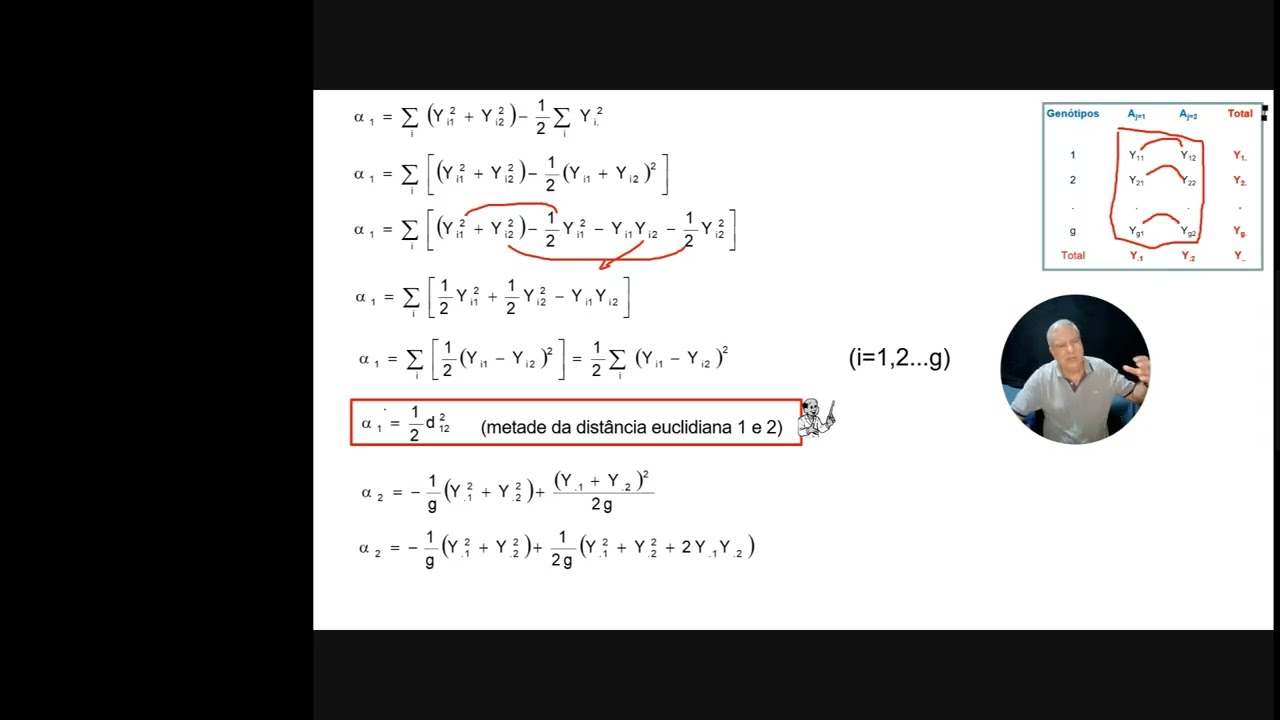
The video provides substantial value by offering a clear, step-by-step derivation of a practical statistical method, which is often presented in a more abstract manner in textbooks. The instructor’s emphasis on ‘savoring’ expressions and interpreting formulas adds pedagogical value, making complex concepts more accessible. The argumentation is solid, as the instructor carefully proves each algebraic step and connects the method to established concepts like Euclidean distance and correlation. The practical examples and the discussion of applications (e.g., environmental stratification) enhance the practical utility of the content.
Scientific Rigor, Source Quality, Title Accuracy
The scientific rigor is high: the instructor presents a well-known method (Lin, 1982) and a classic decomposition (Robertson, 1959) with clear derivations. However, the video does not provide explicit citations or references to the original papers, which limits the ability to verify sources directly. The title accurately reflects the content, which is a lecture on biometrics, specifically focusing on GxE interaction decomposition. The content is consistent with standard quantitative genetics literature, but the lack of formal citations is a minor weakness.
182 words
Title / Content Match
The title accurately reflects the content, which is the third lecture in a biometrics course, focusing on decomposing genotype-environment interaction.
Quality & Reliability
8/10
The video is a formal lecture by an expert in biometrics, presenting a well-established statistical method (Lin's algorithm) with clear derivations and practical applications. The content is consistent with standard quantitative genetics literature. Minor limitations include lack of citations to specific sources and a narrow focus on a single method.
Key Moments
Markers derived by PSI from the transcript: the creator did not define chapters.
- Introduction to the lecture and review of genotype-environment interaction.
- Presentation of the sum of squares formula for genotype-pair of environments.
- Derivation of the alternative expression using Euclidean distances.
- Generalization to any number of environments using pairwise sums of squares.
- Discussion on environmental stratification and the importance of the pairwise matrix.
- Introduction to Robertson's decomposition of interaction into simple and complex parts.
- Detailed proof of Robertson's formula, linking to variances and covariances.
- Interpretation of the decomposition and its implications for breeding.
- Practical recommendations for using these methods in analysis.
Cited Sources
- Lin, C.S. (1982) - Grouping genotypes by a simple method — Mentioned as the basis for the practical algorithm to compute sums of squares for genotype-pair of environments.
- Robertson, A. (1959) - The sampling variance of the genetic correlation coefficient — Mentioned as the source of the decomposition of interaction into simple and complex parts.
Concurring Sources
- Lin, C.S. (1982) - Grouping genotypes by a simple method — The method presented in the video is directly based on this work, which is a standard reference in quantitative genetics.
- Robertson, A. (1959) - The sampling variance of the genetic correlation coefficient — The decomposition of interaction into simple and complex parts is attributed to this classic paper.
Contribution & Novelties
The lecture provides a clear and practical derivation of Lin’s algorithm for computing sums of squares for genotype-pair of environments, which is often presented in a more abstract manner. The instructor’s emphasis on interpreting formulas and ‘savoring’ expressions adds pedagogical value. The detailed proof of Robertson’s decomposition, linking it to variances and covariances, is a valuable contribution for students and practitioners.
Pour aller plus loin :
- Genotype-environment interaction — Provides an overview of the concept and its importance in quantitative genetics.
- Analysis of variance — Foundational statistical method used in the lecture.
- Euclidean distance — The distance metric used in the alternative expression for the sum of squares.
108 words
Radar Profile
The radar profile shows high scores in quantitative information, technical level, and reliability, indicating a dense, technical, and trustworthy lecture. The qualitative information score is slightly lower, reflecting the lack of explicit citations and the narrow focus on a single method.