MGV3702 - Genética de Populações: Aula2
Keywords
Summary
188 words
Critical Evaluation
Value of the Information & Strength of the Argument
The lecture provides a thorough and rigorous mathematical treatment of the Poisson distribution, including its derivation from the binomial distribution and its properties. The instructor carefully explains each step, using clear examples and visual aids to illustrate the concepts. The argumentation is solid, building from fundamental principles (Taylor series) to the specific distribution, and then to its applications in genetics. The value of the information is high for students who need a deep understanding of the statistical foundations of population genetics.
Scientific Rigor, Source Quality, Title Accuracy
The lecture is scientifically rigorous, with accurate mathematical derivations and clear explanations. However, the instructor does not cite any external sources or references, relying solely on the mathematical proofs presented. The title accurately reflects the content, which is a lecture on population genetics focusing on the Poisson distribution and chi-square test. The content is well-structured and follows a logical progression, making it a valuable educational resource.
162 words
Title / Content Match
The title accurately reflects the content: a population genetics course lecture focusing on the Poisson distribution and chi-square test.
Quality & Reliability
7/10
The lecture provides a rigorous mathematical derivation of the Poisson distribution, including its relationship to the binomial distribution and its properties (mean, variance). The content is accurate and well-structured, though it is presented as a formal lecture without external citations or references.
Key Moments
Markers derived by PSI from the transcript: the creator did not define chapters.
- Introduction to the lecture and review of previous topics.
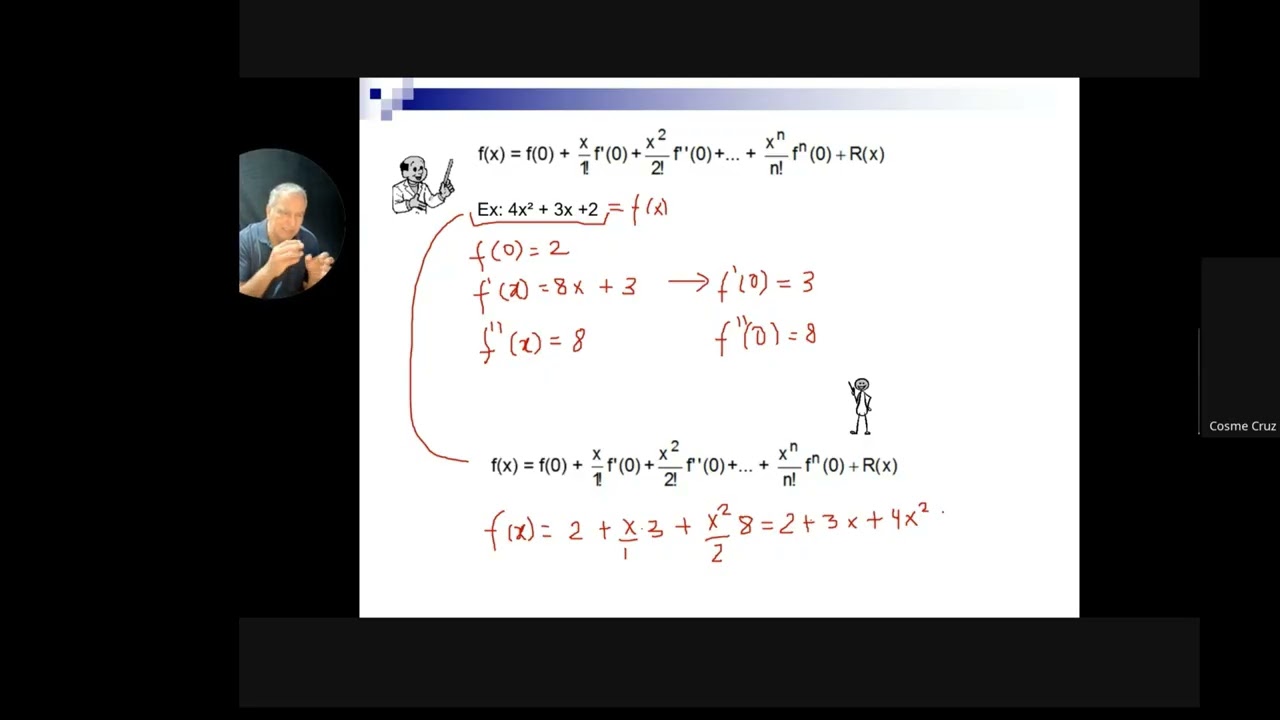
- Explanation of Taylor and Maclaurin series as prerequisites.
- Demonstration of how functions can be expressed as series.
- Introduction to the Poisson distribution and its probability function.
- Proof that the Poisson distribution is a valid probability function.
- Relationship between binomial and Poisson distributions.
- Practical example using the Genes software to compare distributions.
- Derivation of the mean and variance of the Poisson distribution.
- Introduction to the chi-square distribution and its relevance.
Contribution & Novelties
The lecture provides a clear and detailed derivation of the Poisson distribution, emphasizing its connection to the binomial distribution and its application to rare events in genetics. It also introduces the chi-square test, which is essential for hypothesis testing in population genetics.
Pour aller plus loin :
- Poisson distribution — Overview of the distribution, its properties, and applications.
- Binomial distribution — The distribution from which the Poisson is derived as a limiting case.
- Chi-squared test — The statistical test introduced in the lecture for goodness-of-fit and independence.
87 words
Radar Profile
The radar profile shows high scores in quantitative information, qualitative information, and technical level, reflecting the lecture's depth and rigor. The reliability score is slightly lower due to the absence of external citations, but the mathematical derivations are sound.