MGV 3704 Genética Quantitativa Aula 10
Keywords
Summary
198 words
Critical Evaluation
Value of the Information & Strength of the Argument
The lecture provides substantial value by thoroughly explaining the derivation of expected mean squares for a randomized block design, a fundamental topic in quantitative genetics. The instructor’s argumentation is solid, as he systematically builds from model assumptions to the derivation of EMS, and then connects these to practical applications such as estimating genetic variance and heritability. He effectively distinguishes between statistical and genetic interpretations of variance components, which is crucial for proper understanding. The use of a concrete example (families of half-sibs) helps illustrate the concepts. The argumentation is logical and well-structured, though it is presented in a conversational style that may require careful attention from the viewer.
Scientific Rigor, Source Quality, Title Accuracy
The scientific rigor is high; the content is consistent with standard quantitative genetics theory. The instructor demonstrates deep knowledge and provides clear derivations. However, no external sources are cited, and the lecture relies on the instructor’s expertise. The title accurately reflects the content, as it is indeed a lecture on quantitative genetics covering expected mean squares. The video is a formal academic lecture, and the lack of citations is typical for such content, but it does limit the ability to verify specific claims independently.
207 words
Title / Content Match
The title accurately reflects the content: a lecture on quantitative genetics, specifically covering expected mean squares in randomized block designs.
Quality & Reliability
8/10
The lecture is a formal academic presentation by a professor in quantitative genetics, covering theoretical derivations and practical considerations. The content is consistent with established statistical genetics principles, and the instructor demonstrates deep conceptual understanding. However, no external sources are cited, and the video is a single lecture without peer review.
Key Moments
Markers derived by PSI from the transcript: the creator did not define chapters.
- Introduction to the lecture and review of previous topics on fixed, random, and mixed models.
- Discussion of the random effects model for RCBD and its assumptions.
- Explanation of the importance of expected mean squares in defining F-tests and estimating variance components.
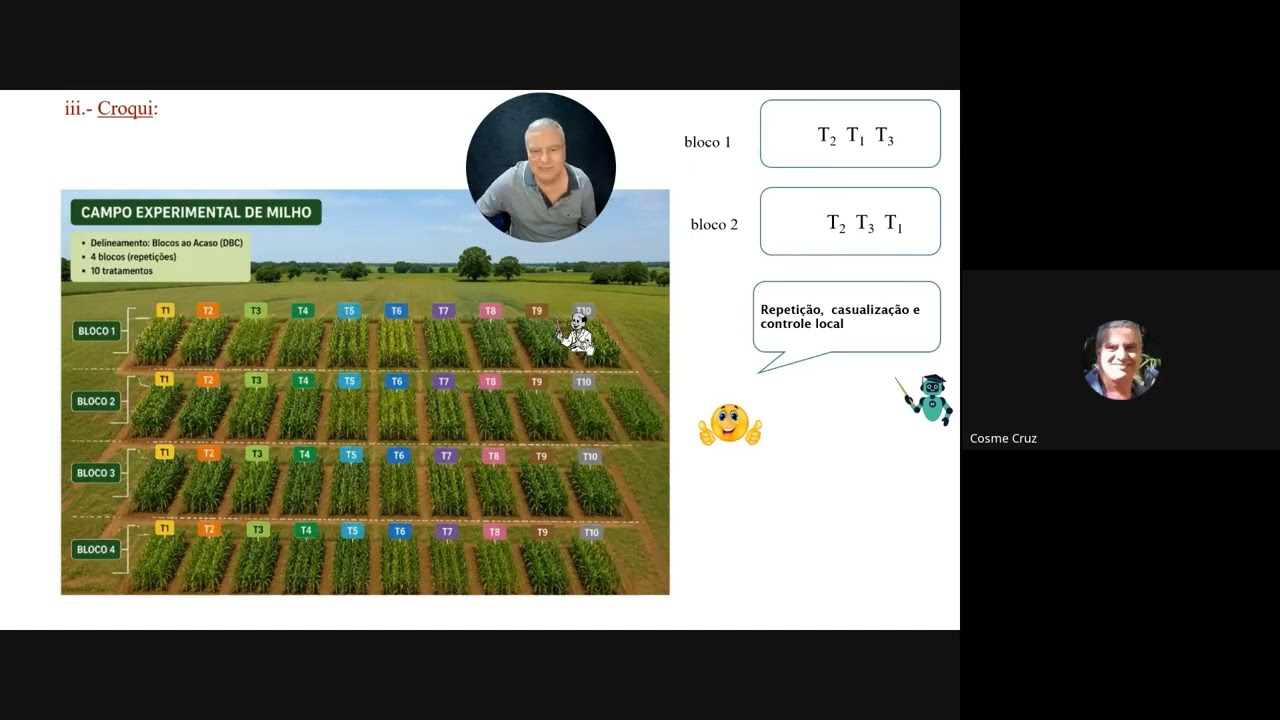
- Presentation of the experimental layout for RCBD, emphasizing principles of replication, randomization, and local control.
- Student question about controls in blocks; instructor clarifies that controls are just treatments.
- Discussion on the analysis of variance table, degrees of freedom, and sums of squares.
- Distinction between statistical and genetic interpretations of variance components, using sigma^2_g as an example.
- Emphasis on the importance of asking the right questions in the age of AI, rather than just obtaining results.
Contribution & Novelties
The lecture provides a thorough and pedagogically effective explanation of expected mean squares in randomized block designs, with a strong emphasis on the conceptual distinction between statistical and genetic interpretations of variance components. This is particularly valuable for students of quantitative genetics. The instructor’s approach of connecting EMS to practical applications like heritability estimation is insightful.
Pour aller plus loin :
- Quantitative Genetics — Provides background on the field and key concepts.
- Analysis of variance — Explains the statistical method used in the lecture.
- Random effects model — Details the model assumptions discussed.
- Heritability — Connects to the application of variance components.
102 words
Radar Profile
The radar profile shows high scores across all dimensions, indicating a well-balanced and comprehensive lecture. The strengths are in the quantity and quality of information, as well as the technical depth, while the overall reliability is also high due to the instructor's expertise.