MGV 3707 Biometria Aula 8
Keywords
Summary
166 words
Critical Evaluation
Value of the Information & Strength of the Argument
The lecture provides a thorough and clear explanation of path analysis, covering both conceptual and computational aspects. The instructor effectively demonstrates the equivalence between the correlation-based and regression-based approaches, which is a key insight for understanding the method. The argumentation is solid, with step-by-step derivations and a worked example that reinforces the concepts. The value of the information is high for students or researchers needing to apply path analysis in genetics or related fields, as it clarifies common pitfalls and provides practical guidance on using software (e.g., Genes).
Scientific Rigor, Source Quality, Title Accuracy
The lecture is scientifically rigorous, with accurate statistical concepts and clear derivations. However, no formal sources are cited in the video or description, which limits the ability to verify specific claims. The title accurately reflects the content, and the lecture is well-structured. The instructor’s expertise is evident, and the content aligns with standard statistical methodology for path analysis.
161 words
Title / Content Match
The title accurately reflects the content: it is a lecture (Aula 8) on biometrics, specifically path analysis.
Quality & Reliability
8/10
The content is a lecture by a professor (likely from a university) on path analysis, a statistical method. It is technically accurate, well-structured, and includes a worked example. The presentation is clear and pedagogical, with a focus on conceptual understanding and practical application. Minor limitations include the lack of formal citations and the informal lecture format.
Key Moments
Markers derived by PSI from the transcript: the creator did not define chapters.
- Introduction to path analysis and its purpose.
- Explanation of direct and indirect effects in a causal diagram.
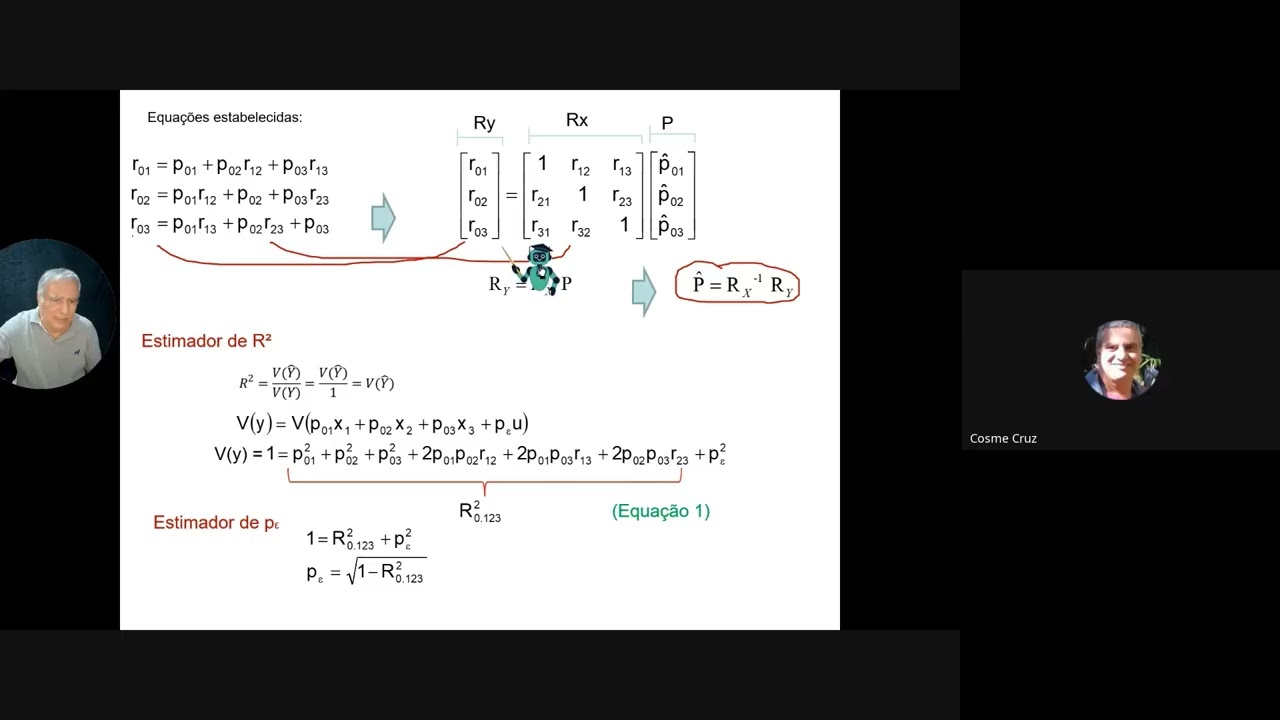
- Discussion of two approaches: correlation decomposition and regression with standardized variables.
- Derivation of the system of equations for path coefficients.
- Explanation of R² and residual effect in path analysis.
- Clarification that the input can be the correlation matrix or raw data.
- Worked example with simulated data, comparing regression and correlation approaches.
- Discussion of multicollinearity and alternative methods like ridge regression.
Contribution & Novelties
The lecture provides a clear and detailed explanation of path analysis, emphasizing the equivalence between correlation decomposition and regression with standardized variables. It offers practical guidance on using the method, including the input data format and interpretation of results. The worked example helps solidify understanding.
Pour aller plus loin :
- Path analysis (statistics) — Overview of path analysis and its applications.
- Wright, S. (1921). Correlation and causation. Journal of Agricultural Research, 20(7), 557-585. — Foundational paper introducing path analysis.
- Multicollinearity — Explanation of multicollinearity and its implications in regression analysis.
90 words
Radar Profile
The radar profile shows high scores across all dimensions, indicating a well-rounded and reliable educational resource. The lecture is technically strong, with good information quality and quantity, and is suitable for an audience with some statistical background.