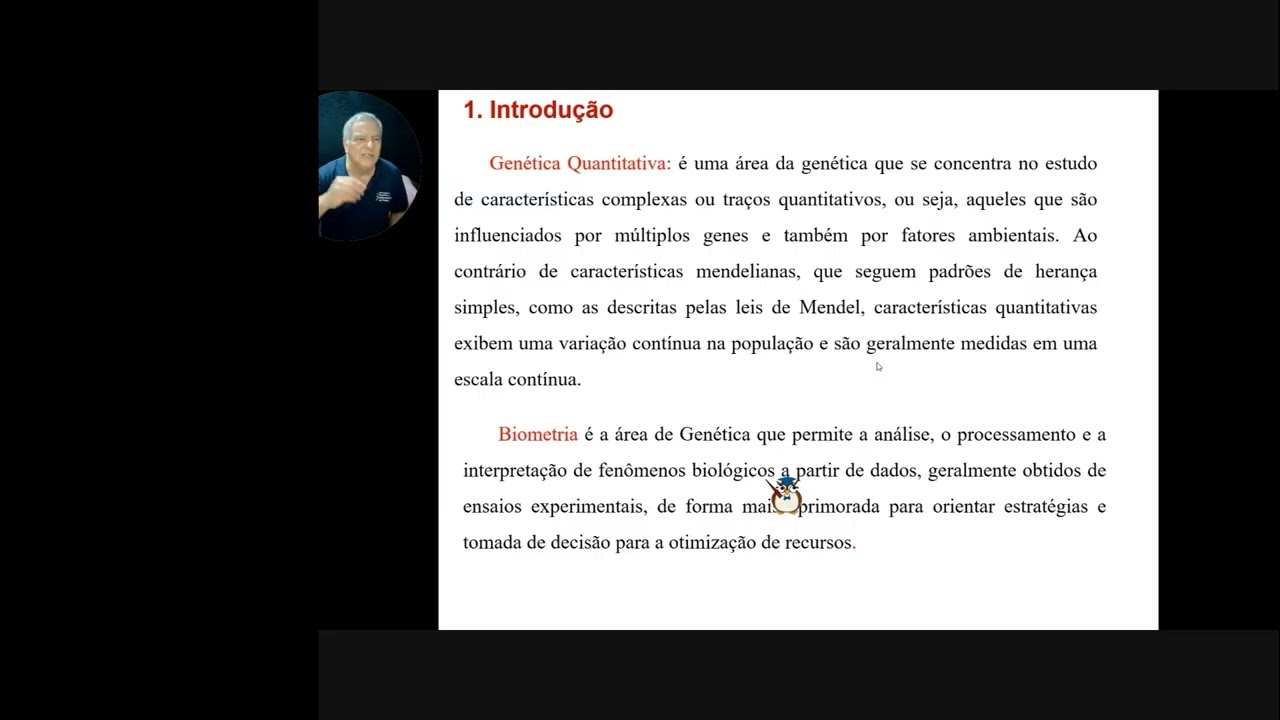
MGV3704- Genética Quantitativa Aula2
Keywords
Summary
150 words
Critical Evaluation
Value of the Information & Strength of the Argument
The lecture provides a solid conceptual foundation for quantitative genetics, clearly explaining the importance of theory in guiding breeding decisions. The instructor effectively argues that understanding the underlying genetic principles is crucial for interpreting biometric analyses. He uses relatable examples and analogies to make complex ideas accessible, and he emphasizes the practical relevance of the material for future breeders. The argumentation is coherent and persuasive, though it relies more on pedagogical explanation than on empirical evidence.
Scientific Rigor, Source Quality, Title Accuracy
The lecture demonstrates scientific rigor by referencing key historical figures and their contributions to the field, such as Galton, Pearson, Fisher, and Wright. However, no specific publications or studies are cited, and the content is presented as general knowledge. The title accurately reflects the content, which is a lecture on quantitative genetics. The instructor’s expertise is evident, but the lack of explicit citations limits the verifiability of the information.
160 words
Title / Content Match
The title accurately reflects the content, which is a lecture on quantitative genetics.
Quality & Reliability
7/10
The lecture is delivered by an academic instructor, likely with expertise in quantitative genetics, and covers foundational concepts with reference to historical figures. However, no specific sources are cited, and the content is presented as a general overview without detailed citations.
Key Moments
Markers derived by PSI from the transcript: the creator did not define chapters.
- Introduction to the course and overview of topics: quantitative genetics and biometrics.
- Discussion on the importance of understanding quantitative traits and the role of genetics in breeding.
- Explanation of the difference between quantitative genetics (theory) and biometrics (application).
- Historical context: contributions of Galton, Pearson, Fisher, and Wright to quantitative genetics.
- Discussion on genetic variance, heritability, and selection gain.
- Addressing student anxieties about the mathematical nature of the subject and the importance of theory.
- Definition of genetic improvement and the role of the breeder.
Contribution & Novelties
The lecture provides a comprehensive overview of quantitative genetics, emphasizing the theoretical foundations necessary for practical breeding. It clarifies the distinction between quantitative genetics and biometrics, and highlights the importance of understanding genetic variance and heritability. The instructor’s pedagogical approach helps demystify complex concepts for students.
Pour aller plus loin :
- Quantitative genetics — Provides a general overview of the field.
- Heritability — Explains the concept of heritability in detail.
- Genotype-environment interaction — Discusses the interaction between genetics and environment.
80 words
Radar Profile
The radar profile shows a balanced distribution across all dimensions, with slightly higher scores in information quantity and quality, reflecting the lecture's comprehensive coverage. The technical level is moderate, suitable for graduate students, and the overall reliability is good, though lacking explicit citations.