MGV3704 Genética Quantitativa Aula 12
Keywords
Summary
194 words
Critical Evaluation
Value of the Information & Strength of the Argument
The lecture provides substantial value by thoroughly explaining the theoretical underpinnings of a specific breeding design. It goes beyond a superficial description, delving into the statistical model, expected mean squares, and the genetic interpretation of variance components. The argumentation is solid, as the instructor carefully derives the expected mean squares and explains the logic behind the statistical tests. He also highlights the violation of a key principle, which is crucial for understanding why this design requires special handling. The lecture is well-structured, building on previous knowledge and clearly connecting statistical concepts to genetic meaning.
103 words
Title / Content Match
The title accurately reflects the content: it is a lecture on quantitative genetics, specifically covering Design 1 of Comstock and Robinson.
Quality & Reliability
8/10
The content is a detailed academic lecture on quantitative genetics, specifically covering Comstock and Robinson's Design 1. The instructor demonstrates deep knowledge, explains statistical and genetic concepts thoroughly, and provides a rigorous derivation of expected mean squares. The video is part of a university course, indicating a structured and reliable educational source.
Key Moments
Markers derived by PSI from the transcript: the creator did not define chapters.
- Introduction to the lecture and overview of population structuring in breeding.
- Explanation of the four fundamental principles of quantitative genetics.
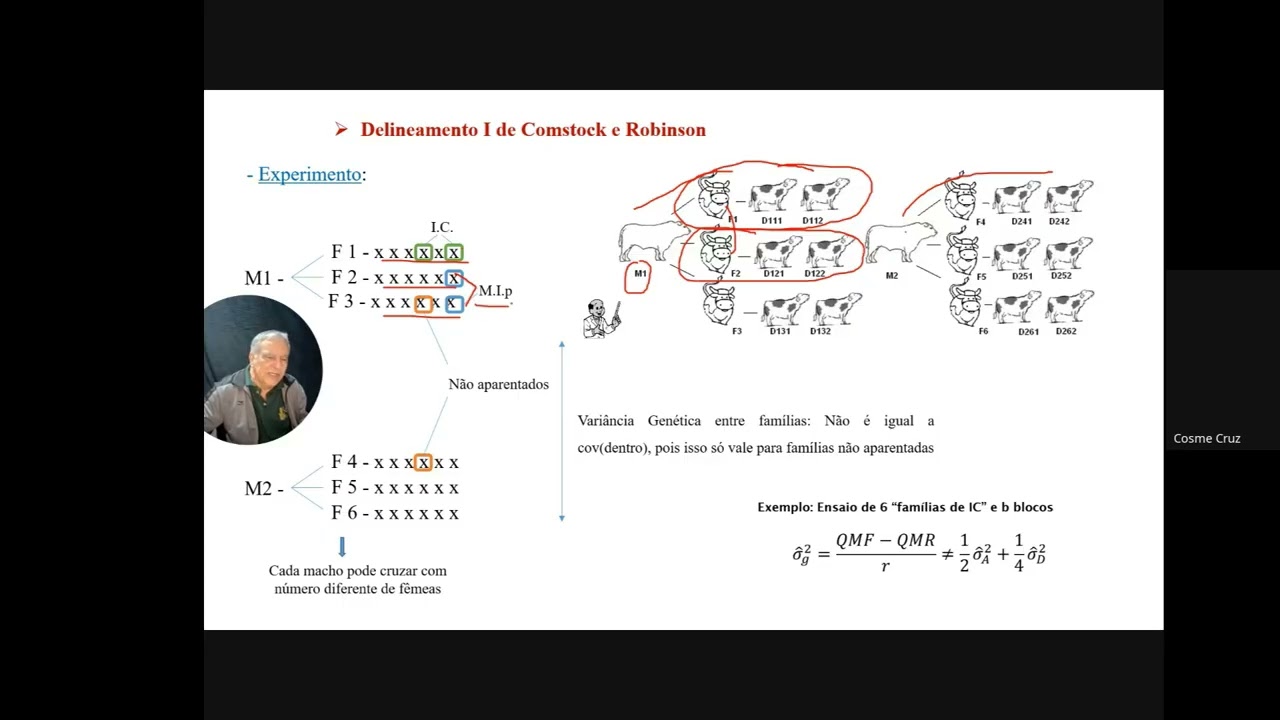
- Introduction to Comstock and Robinson Design 1, hierarchical structure with males and females.
- Discussion on how Design 1 creates both full-sib and half-sib families, violating the fourth principle.
- Partitioning of family effect into male and female within male effects.
- Derivation of expected mean squares for the design.
- Statistical tests for variance components using F-tests.
- Genetic interpretation of covariances between relatives, leading to equations for additive and dominance variance.
- Conclusion and preview of next designs (Design 2 and diallels).
Contribution & Novelties
This lecture provides a detailed and rigorous explanation of Comstock and Robinson Design 1, which is a fundamental experimental design in quantitative genetics. It clarifies the statistical and genetic interpretations of variance components, and highlights the violation of a key principle when families are related. The lecture emphasizes understanding the underlying theory rather than just using software, which is valuable for students and researchers.
Pour aller plus loin :
- Comstock and Robinson (1948) — Original paper describing the designs for estimating genetic variances.
- Quantitative Genetics — Overview of the field.
- Variance components — Statistical concept used in the lecture.
99 words
Radar Profile
The radar profile shows high scores in quantity of information, technical level, and reliability, with slightly lower but still strong scores in quality of information. This indicates a dense, technical, and reliable lecture, though the presentation might be less polished in terms of visual aids or pacing.