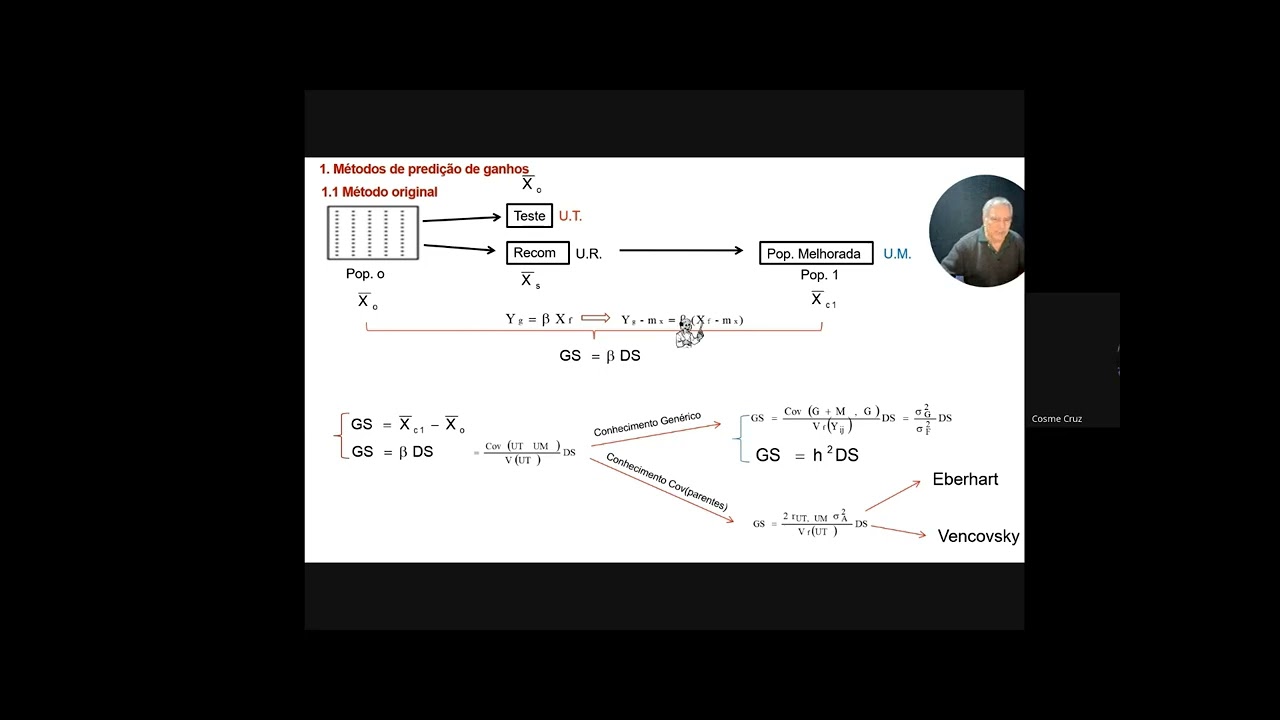
MGV 3704 Genética Quantitativa Aula 14
Keywords
Summary
175 words
Critical Evaluation
Value of the Information & Strength of the Argument
The lecture provides a comprehensive and detailed explanation of selection gain prediction, offering both theoretical foundations and practical insights. The instructor systematically builds the argument from basic genetic principles to advanced concepts, using clear examples and analogies. He effectively demonstrates the application of the breeder’s equation and its components, such as heritability and selection intensity, and addresses common pitfalls in interpretation. The argumentation is solid, grounded in quantitative genetics theory, and the instructor’s expertise is evident. However, the lecture is primarily instructional and does not present new research findings or critical evaluation of alternative methods.
Scientific Rigor, Source Quality, Title Accuracy
The lecture demonstrates strong scientific rigor, as it adheres to established quantitative genetics principles and provides a logical progression of concepts. The instructor references the EBH method and Venkov’s approach, but does not provide specific citations or external sources. The title accurately reflects the content, which is a focused lecture on selection gain prediction. The content is well-structured and technically accurate, though it would benefit from explicit references to literature for further validation. The lecture is suitable for an audience with some background in genetics, as it assumes familiarity with basic genetic variance concepts.
204 words
Title / Content Match
The title accurately reflects the content, which is a lecture on quantitative genetics, specifically focusing on selection gain prediction.
Quality & Reliability
8/10
The lecture is delivered by an expert in quantitative genetics, providing a rigorous theoretical framework and practical applications. The content is consistent with established genetic principles, though it lacks explicit citations to external sources.
Key Moments
Markers derived by PSI from the transcript: the creator did not define chapters.
- Introduction to the lecture and context of recurrent selection
- Explanation of the covariance between relatives and its role in predicting gain
- Presentation of the general equation for selection gain and its components
- Discussion of the three approaches to estimating covariance: generic, genealogical, and EBH
- Derivation of the breeder's equation and explanation of selection intensity
- Clarification of the relationship between selection percentage and intensity
- Explanation of parental control and its impact on gain
- Discussion on genetic variability and its role in the equation
- Importance of heritability and accuracy in predicting gain
- Conclusion emphasizing the dynamic nature of the equation and strategic decisions
Contribution & Novelties
The lecture provides a thorough pedagogical explanation of selection gain prediction, integrating theoretical concepts with practical breeding strategies. It offers a clear comparison of different methods (generic, genealogical, EBH) to estimate covariance, which is valuable for students and practitioners. The emphasis on the dynamic nature of the breeder’s equation and the importance of strategic decisions in population structuring adds practical insight.
Pour aller plus loin :
- Quantitative Genetics — Provides foundational concepts of quantitative genetics, including heritability and genetic variance.
- Heritability — Detailed explanation of heritability and its estimation in breeding programs.
- Breeder’s equation — Discusses the breeder’s equation and its components, including selection differential and response to selection.
- Best Linear Unbiased Prediction — Overview of BLUP, a statistical method used in genetic evaluation, related to the EBH approach.
129 words
Radar Profile
The radar profile shows high scores across all dimensions, indicating a well-rounded and reliable educational content. The lecture excels in providing detailed information and technical depth, with strong scientific rigor and practical relevance.