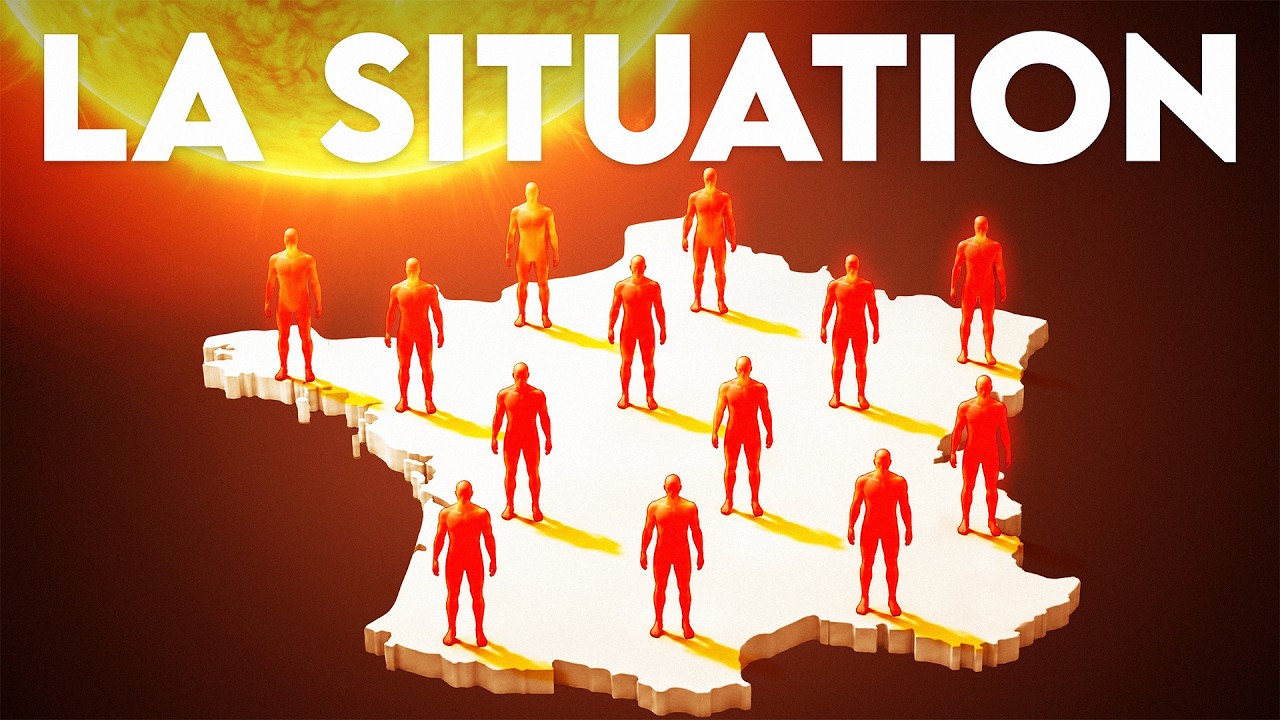
La canicule va faire craquer la France, explications
Keywords
Summary
128 words
Critical Evaluation
The video provides a timely overview of the heatwave’s immediate impacts on French society, focusing on hospital strain, school closures, and government responses. It effectively uses official statements and news reports to convey urgency. However, the scientific depth is limited: while it mentions climate change as a driver, it does not explore attribution studies or long-term trends. The sources cited are primarily news outlets (Le Monde, France Info, Le Parisien) rather than peer-reviewed research or meteorological agency reports. The inclusion of unrelated news items (Strait of Hormuz, Venezuela earthquake, etc.) dilutes the focus on the heatwave, making the title slightly misleading. The video’s strength lies in its accessibility and up-to-date reporting, but it lacks critical analysis of policy effectiveness or systemic failures. The mention of the 2003 and 2025 death tolls provides context, but no new data or expert commentary is added. The government’s response is presented without critique, though viewer comments highlight skepticism about funding allocation. The video does not address adaptation measures beyond air conditioning and exam rescheduling. Overall, it serves as a useful news summary but not as a rigorous scientific resource. The adéquation titre/contenu is moderate: the heatwave is the lead story, but the latter half covers disparate topics. The note is lowered due to the lack of scientific depth and the inclusion of unrelated segments.
220 words
Title / Content Match
The title accurately reflects the main topic (heatwave impact on France), though the content also covers other unrelated news items.
Quality & Reliability
The video reports on a current heatwave in France, citing official sources (minister statements, health data) and news articles. However, it lacks direct scientific references or expert interviews, and the information is presented as a news summary rather than an in-depth analysis. The sources are mostly journalistic, not primary scientific literature.
Key Moments
- Introduction to the heatwave in France
- Evacuation of ships in Strait of Hormuz suspended
- New death toll from Venezuela earthquakes
- Court orders TotalEnergies to include Scope 3 emissions
- Investigation into Vinted listings suspected of child trafficking
- Rent freeze for 1 million apartments in New York
- One Piece exhibit opens at Musée Grévin
- Good news: Ivory Coast qualifies for World Cup round of 16
- Outro
Cited Sources
- Le Monde article on heatwave deaths and hospital strain ✓ verified — Cited for heatwave impact data
- France Info live coverage of heatwave ✓ verified — Cited for departmental vigilance updates
- Le Parisien article on alcohol ban ✓ verified — Cited for alcohol ban measure
Concurring Sources
- Météo France heatwave records — Official weather data supporting record temperatures mentioned in the video
Contribution & Novelties
The video compiles recent news on the heatwave’s societal impact, including hospital strain, school closures, and government measures. It provides a snapshot of the situation but offers no original analysis or new data. The inclusion of other news items reduces its novelty.
Pour aller plus loin :
- IPCC Sixth Assessment Report on heatwaves — Comprehensive scientific assessment of climate change impacts on extreme heat.
- Santé Publique France report on heatwave mortality — Official French health agency data on heat-related deaths.
- Plan ORSAN documentation — French government’s health emergency response plan details.
91 words
Radar Profile
The radar shows moderate quantity of information but lower quality and technical depth, reflecting the video's nature as a news summary rather than a scientific analysis. The fiabilite_globale is average due to reliance on journalistic sources.
💬 Négatif — Les commentaires expriment une forte colère envers le gouvernement, accusé de détournement des fonds de la journée de solidarité et de manque de préparation face à la canicule, avec des critiques sur l'absence de climatisation dans les hôpitaux et écoles.