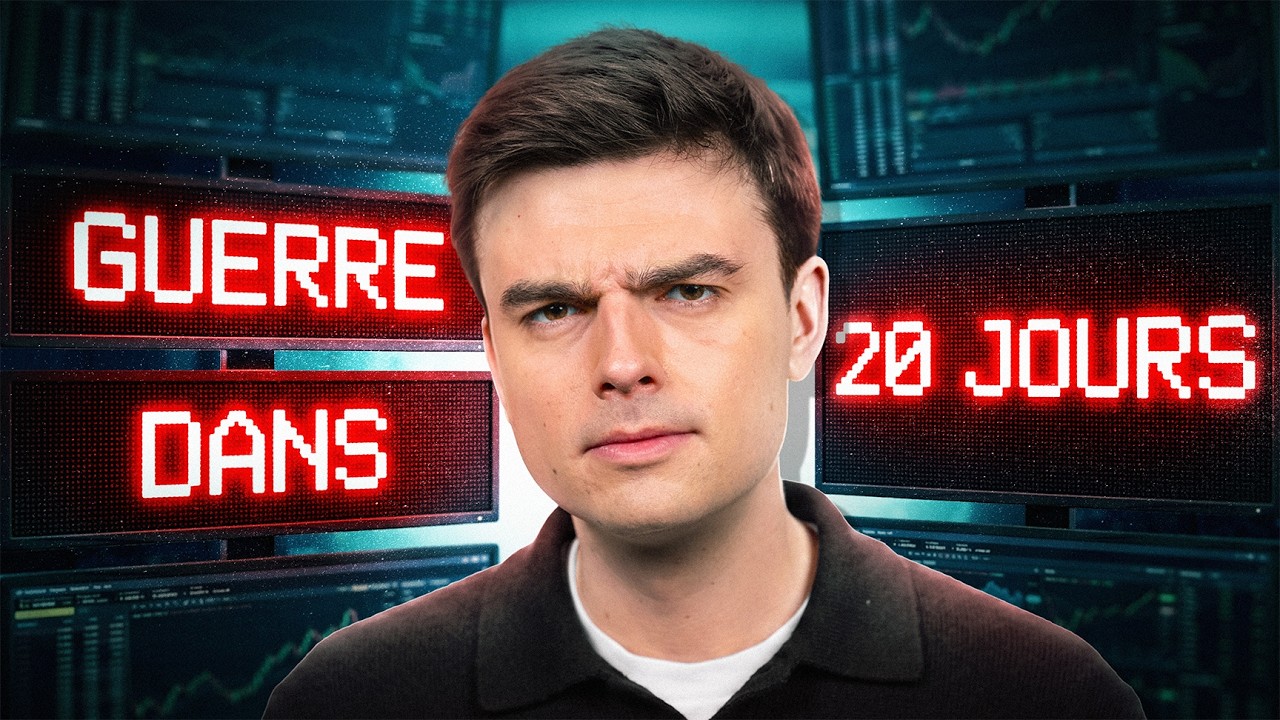
Révélations sur les prédictions de guerre pour s'enrichir
Keywords
Summary
196 words
Critical Evaluation
The video presents a timely and relevant topic: the application of AI to predict wars for financial gain. It effectively contextualizes the issue by citing statistics on the rising number of conflicts and their economic impact, drawing from reputable sources like the Peace Research Institute Oslo and the Institute for Economics and Peace. The main claim—that companies like Verisk Maplecroft are developing algorithms to forecast conflict probability—is supported by references to Bloomberg and other financial media, lending credibility. However, the video does not provide direct access to the underlying studies or models, making it difficult to verify the claimed 66% prediction accuracy. The analysis is balanced, acknowledging both the potential utility for investors and the ethical concerns, such as the risk of normalizing war and creating self-fulfilling prophecies. The video also draws a parallel to catastrophe modeling for natural disasters, which is a well-established practice, thus grounding the discussion in existing financial risk assessment frameworks. The argumentation is logically structured, moving from the problem (rising conflicts) to the proposed solution (AI prediction) and then to the caveats. The sources cited in the description are mostly news articles and official websites, which are appropriate for a news review format. However, the video lacks direct citations of academic papers or technical documentation of the AI models, which limits its scientific rigor. The inclusion of other news segments (heatwave, Middle East, train collision, Bolivia, AI education, dolphin protection) diversifies the content but dilutes the focus on the main topic. The title accurately reflects the core subject, and the overall quality is solid for a daily news summary, though it does not provide deep technical analysis. The video’s strength lies in its clear communication of a complex issue to a general audience, but it could benefit from more detailed sourcing and critical examination of the AI models’ methodologies.
304 words
Title / Content Match
The title accurately reflects the main topic: financial markets using AI to predict wars for profit.
Quality & Reliability
The video reports on a developing trend (AI-based war prediction for financial markets) with references to credible sources like Bloomberg and the Peace Research Institute Oslo, but lacks direct citations of the original studies or models. The analysis is balanced, noting both potential benefits and risks, but remains at a journalistic level without deep technical scrutiny.
Key Moments
- Introduction to the main topic: financial markets using AI to predict wars.
- Statistics on global conflicts in 2025 and economic impact.
- Introduction of Verisk Maplecroft's AI algorithm for war prediction.
- Discussion of ethical concerns and potential self-fulfilling prophecies.
- Heatwave update in France: 80 departments on alert.
- Middle East situation: ceasefire collapse and Iran's threat to close Strait of Hormuz.
- UK train collision: one dead, 89 injured.
- Bolivia: end of social crisis with agreement between government and unions.
- France to introduce AI education in high schools from 2027.
- Dolphin protection: fishing suspension in Gulf of Biscay for winter 2027.
Cited Sources
- Wall Street natural disaster catastrophe prediction models wars — Main source for the story on financial firms using catastrophe models for war prediction.
- Wall Street war risk catastrophe models AI prediction — Additional source on AI-based war risk models.
- Wall Street gaining access catastrophe — Yahoo Finance article on Wall Street's use of catastrophe models.
- Une canicule historique : 35 départements en vigilance rouge — Source for the heatwave alert in France.
- Fête de la musique : consommation d'alcool interdite dans les départements en vigilance rouge canicule — Source for alcohol ban during heatwave.
- Moyen-Orient : comment le cessez-le-feu a volé en éclats — Source for the Middle East ceasefire collapse.
- Guerre au Moyen-Orient : l'Iran dit fermer le détroit d'Ormuz — Source for Iran's threat to close Strait of Hormuz.
- Angleterre : violente collision ferroviaire entre deux trains au nord de Londres — Source for the UK train collision.
Concurring Sources
- Peace Research Institute Oslo (PRIO) conflict data — Cited in the video for the record number of conflicts in 2025.
- Institute for Economics and Peace (IEP) report — Cited for the $22 trillion economic impact of violence.
Contribution & Novelties
The video highlights a novel application of AI in financial risk assessment: predicting wars for profit. It connects this to broader trends in catastrophe modeling and raises ethical questions about commodifying conflict. The coverage is timely, given the record number of conflicts in 2025.
Pour aller plus loin :
- Catastrophe modeling — Overview of the field that inspired war prediction models.
- Verisk Maplecroft — Company mentioned in the video; their risk analytics platform.
- Polymarket — Prediction market platform, relevant to the discussion of predictive markets.
85 words
Radar Profile
The radar shows moderate scores across all dimensions, indicating a balanced but not deeply technical news piece. The highest score is in information quantity (6), reflecting the coverage of multiple topics, while the lowest is in technical level (4), as the video avoids in-depth analysis of the AI models.
💬 Négatif: Many commenters criticize the ethical implications of profiting from war predictions, expressing frustration with the financial system. A few defend the utility of prediction, but the overall tone is critical.