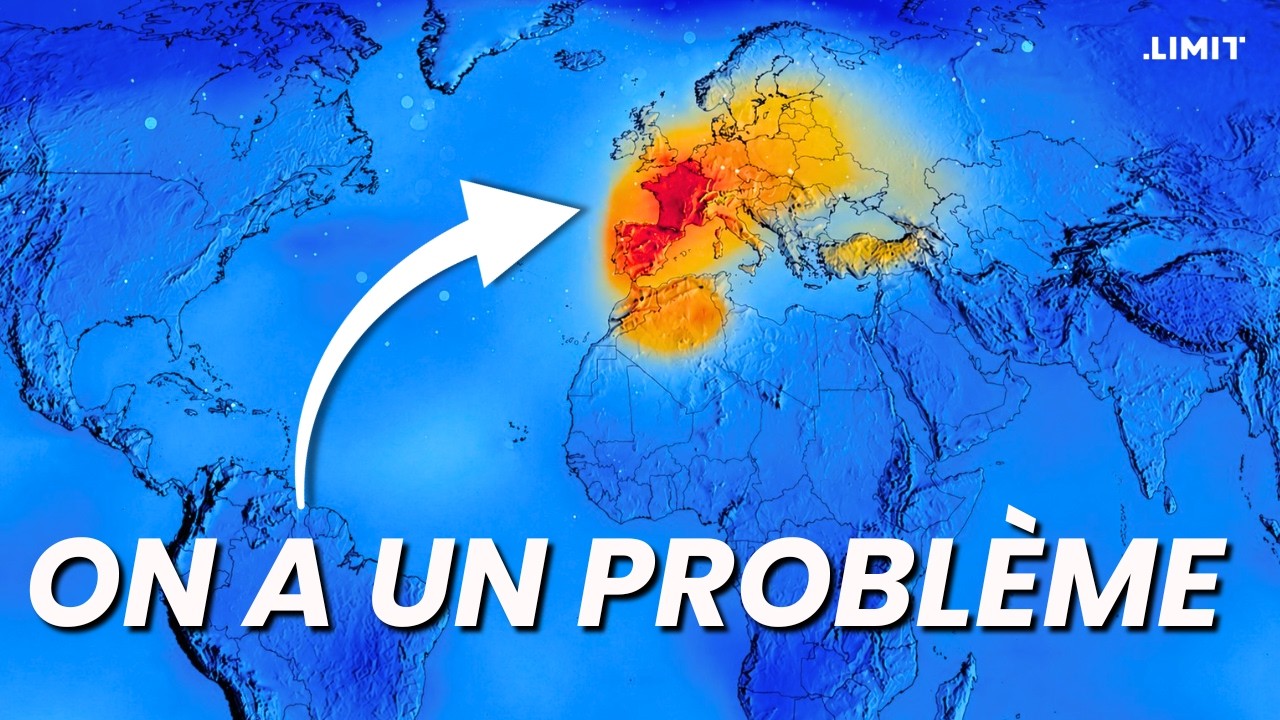
Pourquoi la France se réchauffe plus vite que le reste du monde ?
Keywords
Summary
124 words
Critical Evaluation
The video provides a well-structured and accessible explanation of the regional amplification of global warming in Europe. It correctly identifies the key mechanisms: aerosol reduction, albedo feedback, jet stream dynamics, and the differential heating of land vs. ocean. The use of analogies (t-shirt black/white, beach sand vs. water) helps convey complex concepts to a broad audience. The argumentation is generally sound, and the video acknowledges the role of CO2 while clarifying why it doesn’t explain the regional difference. The sources are provided in a linked document, which adds credibility, though the video itself does not cite specific studies. The presentation is engaging, but it occasionally oversimplifies, such as the claim that each degree multiplies risks by 2-10, which is a rough estimate. The final section on opportunity and resilience is more opinion-based and less scientifically rigorous, but it is clearly framed as a call to action. Overall, the video is informative and scientifically accurate, though it could benefit from more explicit citations and nuance.
164 words
Title / Content Match
The title accurately reflects the content, which specifically addresses the reasons for France's faster warming compared to the global average.
Quality & Reliability
7/10
The video presents a clear and structured explanation of the four main factors behind the faster warming in France/Europe, referencing scientific concepts such as aerosols, albedo, jet stream, and ocean heat capacity. It uses visual aids and cites sources in a linked document. However, it simplifies complex climate dynamics and does not provide explicit citations within the video itself, relying on the description for sources. The overall scientific accuracy is good, but the presentation is somewhat dramatized.
Chapters
Cited Sources
- Sources document (Google Docs) — The video description links to a Google Docs document containing sources for the information presented.
- LIMIT website — Official website of the channel, providing additional content and context.
- Video: Monnaie locale — Recommended video on local currencies as a solution.
- Video: L'entraide — Recommended video on mutual aid.
- Video: Nouveaux modèles d'entreprises — Recommended video on new business models.
- Video: Villes et sociétés de demain — Recommended video on future cities and societies.
- Video: Victor Quilichini - espoir — Recommended video by Victor Quilichini on hope.
- Video: Victor Quilichini - espoir 2 — Another recommended video by Victor Quilichini.
Concurring Sources
- IPCC AR6 Report — The IPCC report provides comprehensive scientific evidence on global warming and regional variations, supporting the video's claims.
Dissenting Sources
Contribution & Novelties
The video synthesizes existing scientific knowledge on regional climate amplification into an accessible format, highlighting the specific situation of France and Europe. It emphasizes the counterintuitive role of aerosol reduction and the importance of ocean heat capacity, which are often overlooked in public discourse.
Pour aller plus loin :
- Aerosol forcing — Provides background on how aerosols affect climate.
- Albedo — Explains the albedo effect and its role in climate.
- Jet stream — Details on jet stream dynamics and its influence on weather.
- Climate change in Europe — Overview of climate change impacts in Europe.
95 words
Radar Profile
The radar profile shows high scores in quantity and quality of information, with moderate technical level and reliability. This indicates a well-researched video that is accessible to a general audience but may lack depth for experts.
💬 Positif. Sur les 30 commentaires analysés, la majorité exprime des inquiétudes sur l'avenir climatique, mais aussi des remerciements pour la clarté de la vidéo et un appel à l'action.