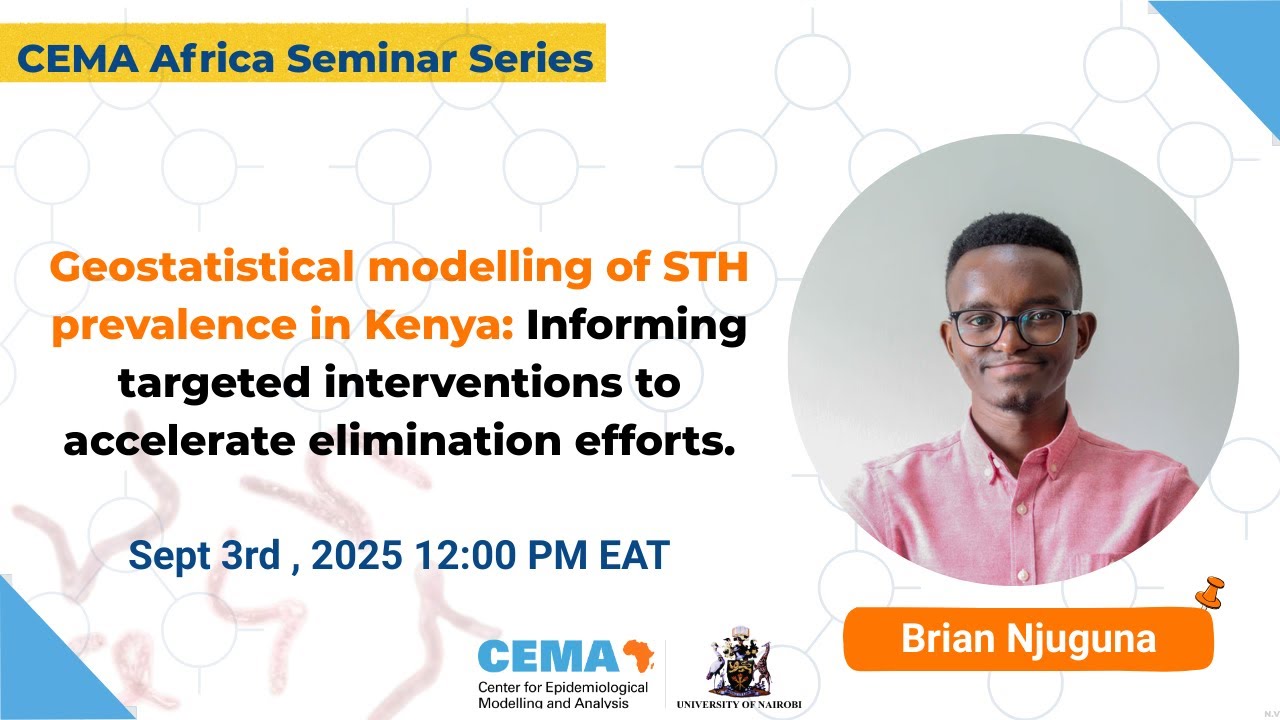
Geostatistical Modelling of STH Prevalence for Targeted Control in Kenya
Keywords
Summary
165 words
Critical Evaluation
Value of the Information & Strength of the Argument
The presentation provides valuable information on the application of geostatistical modeling to map STH prevalence, which is crucial for targeted control programs. The argumentation is solid, as the speaker systematically explains the methodological steps, from data collection to model validation. The use of empirical variograms to justify the need for spatial modeling is a strong point. The speaker also discusses the limitations, such as the suboptimal performance of the hookworm model due to low prevalence. The inclusion of cross-validation metrics adds to the credibility of the results. However, the presentation is at a seminar level, and some technical details are glossed over, but the overall argument is coherent and well-supported.
Scientific Rigor, Source Quality, Title Accuracy
The scientific rigor is high, as the study follows established geostatistical methods and uses a comprehensive dataset. The quality of sources is good, with the speaker referencing the survey data and providing links to the paper and dashboard. The title accurately reflects the content. The presentation does not include a formal literature review, but the methods are standard in the field. The Q&A session shows engagement with the audience, and the speaker addresses questions appropriately. Overall, the presentation is rigorous and well-structured.
207 words
Title / Content Match
The title accurately reflects the content, which focuses on geostatistical modeling of soil-transmitted helminth prevalence to inform targeted control in Kenya.
Quality & Reliability
8/10
The presentation is based on a rigorous geostatistical modeling approach, using a substantial dataset from a national survey, and includes cross-validation. The methods are clearly described, and the results are presented with uncertainty intervals. However, the presentation is a seminar talk, and some details are omitted, and the model performance for hookworm was suboptimal.
Key Moments
Markers derived by PSI from the transcript: the creator did not define chapters.
- Introduction to STH species and their life cycle.
- Description of the survey data used for the study.
- Explanation of empirical variogram and spatial correlation.
- Discussion of covariates and their selection process.
- Presentation of predicted prevalence maps for each STH species.
- Aggregation to sub-county level and population-weighted prevalence.
- Assessment of probability of exceeding programmatic thresholds.
- Cross-validation results and model performance.
- Key findings and implications for targeted control.
- Q&A session addressing questions on drivers and resolution.
Cited Sources
- Paper on geostatistical modelling of STH prevalence in Kenya — Mentioned at the end of the presentation as a link to the paper.
- Dashboard for interacting with the survey data — Mentioned at the end of the presentation as a link to the dashboard.
Concurring Sources
- Global distribution of soil-transmitted helminths — WHO fact sheet on STH infections, consistent with the study's findings on prevalence.
Contribution & Novelties
This study provides the first national-level, high-resolution maps of STH prevalence in Kenya, integrating environmental and socioeconomic covariates. The use of geostatistical modeling allows for uncertainty quantification and probability-based targeting of interventions. The presentation also highlights the importance of spatial correlation in disease mapping and demonstrates a rigorous variable selection process.
Pour aller plus loin :
- Geostatistics — Foundational concepts of geostatistics.
- Soil-transmitted helminthiasis — Overview of STH infections and control.
- Tobler’s first law of geography — Principle underlying spatial autocorrelation.
81 words
Radar Profile
The radar profile shows high scores in information quantity, quality, and reliability, with a slightly lower technical level, indicating a well-balanced presentation that is accessible yet scientifically robust.
💬 No comments were provided for analysis.