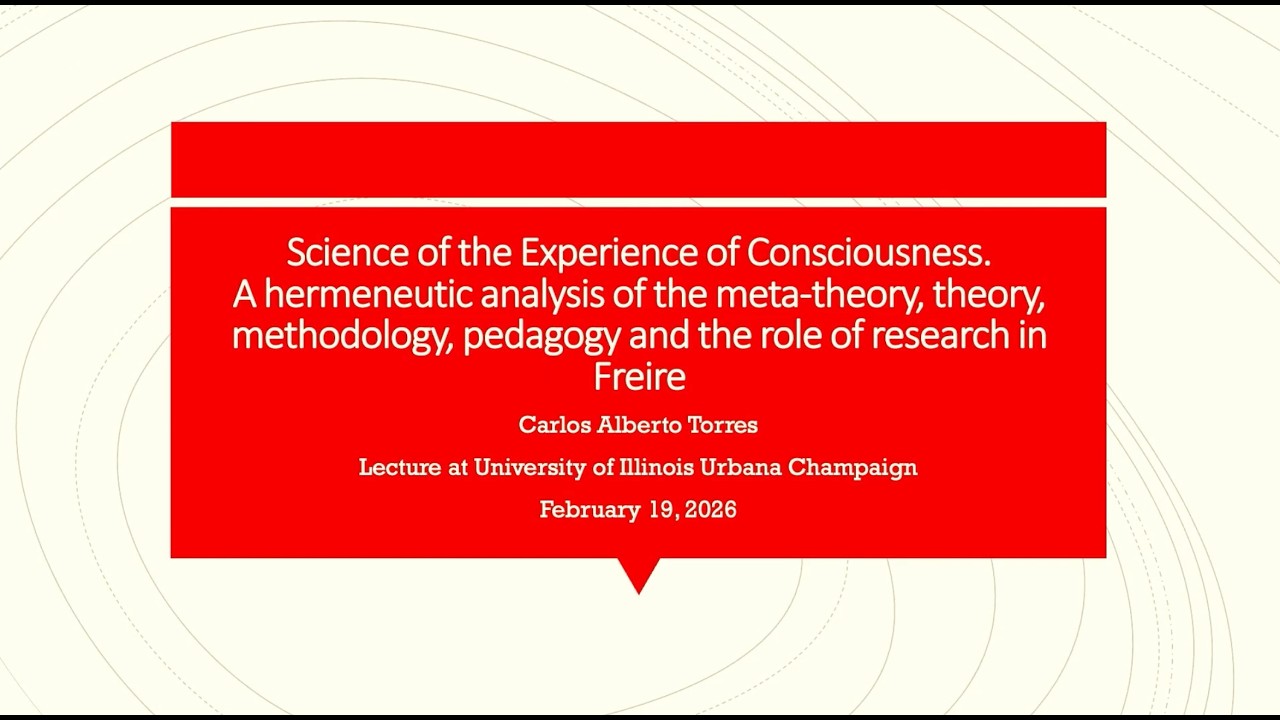
Carlos Torres (Education, University of California, Los Angeles) | Nicholson Spring Lecture 2026
Keywords
Summary
124 words
Critical Evaluation
Value of the Information & Strength of the Argument
The lecture offers valuable insights into Freire’s life and work, drawing on Torres’s personal relationship and scholarly expertise. Torres argues for Freire’s continued relevance, citing his critique of oppression and neoliberalism. The argumentation is coherent, blending biographical details with theoretical analysis. However, some claims are presented without detailed evidence, relying on anecdote and authority.
Scientific Rigor, Source Quality, Title Accuracy
Torres demonstrates scholarly rigor through his familiarity with Freire’s texts and his own publications. He references specific works, such as ‘Pedagogy of the Oppressed’ and his own books, but does not provide formal citations. The title accurately reflects the lecture’s content, which is a scholarly presentation on Freire’s pedagogy.
118 words
Title / Content Match
The title accurately reflects the content: a lecture by Carlos Torres on Paulo Freire, given as part of the Nicholson Spring Lecture series.
Quality & Reliability
8/10
Lecture by a leading expert on Paulo Freire, based on extensive personal acquaintance and scholarly work. The content is well-structured and grounded in Freire's texts and biography, though it is an oral presentation without formal citations.
Key Moments
Markers derived by PSI from the transcript: the creator did not define chapters.
- Introduction by Dee Ruggles, including land acknowledgement and speaker introduction.
- Torres begins his lecture, discussing Freire's relevance and his personal connection.
- Anecdote about Freire writing 'Pedagogy of the Oppressed' and his obsessive note-taking.
- Discussion of Freire's meta-theory and the importance of research as intervention.
- Torres outlines Freire's core concepts, including work, communication, and humanization.
- Exploration of Freire's model of critical literacy and its political implications.
- Torres discusses Freire's critique of neoliberalism and his last conversation with him.
- Conclusion and summary of Freire's legacy and relevance.
Cited Sources
- Pedagogy of the Oppressed — Freire's seminal work, discussed throughout the lecture.
- Education for Critical Consciousness — Mentioned as a book by Freire with an introduction by Torres.
- The Wiley Handbook on Paulo Freire — Edited by Torres, mentioned in the introduction.
Concurring Sources
- Pedagogy of the Oppressed — Freire's original work, which aligns with the lecture's themes.
Contribution & Novelties
The lecture provides a personal and scholarly perspective on Freire’s work, emphasizing his meta-theory and the importance of research as intervention. Torres offers insights into Freire’s writing process and his critique of neoliberalism, which are valuable for understanding Freire’s legacy.
Pour aller plus loin :
- Paulo Freire - Wikipedia — Overview of Freire’s life and work.
- Critical Pedagogy - Wikipedia — Context for Freire’s educational theory.
- Conscientization - Wikipedia — Key concept in Freire’s pedagogy.
75 words
Radar Profile
The radar profile shows high scores in information quantity, quality, technical level, and reliability, indicating a well-rounded and authoritative lecture. The lowest score is in technical level, but it remains high, reflecting the academic nature of the content.