A Theory of Learning with Autoregressive Chain of Thought (Heb)
Keywords
Summary
166 words
Critical Evaluation
Value of the Information & Strength of the Argument
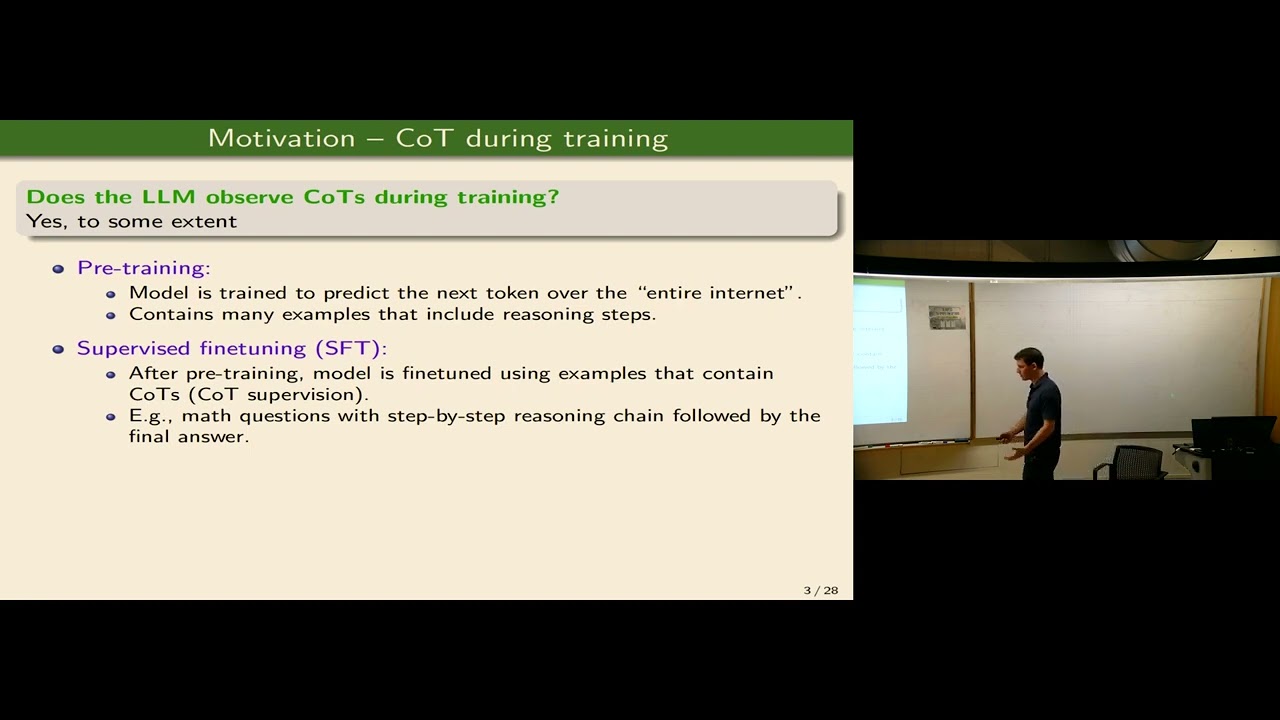
The talk provides a rigorous theoretical framework for understanding the benefits of chain-of-thought in language models. The argumentation is clear and well-structured, with formal definitions, theorems, and proofs. The speaker motivates the problem with practical observations and then develops a mathematical theory. The value lies in providing sample and computational complexity bounds that quantify the advantage of CoT, and in identifying a simple class of models that allows efficient universal CoT learning. The argumentation is solid, with careful attention to technical details and a clear logical flow.
Scientific Rigor, Source Quality, Title Accuracy
The talk is scientifically rigorous, with formal definitions and proofs. The speaker cites his own work and mentions related work by Ran El-Yaniv on time-dependent settings, but does not provide specific references. The title accurately reflects the content. The talk is a research presentation, not a review, and the speaker does not provide external sources. The audience appears to be researchers, and the technical level is high.
169 words
Title / Content Match
The title accurately reflects the content: a theoretical study of learning with autoregressive chain-of-thought.
Quality & Reliability
8/10
Talk by a senior researcher at Weizmann, presenting a formal PAC-learning framework with rigorous definitions and proofs. The content is technical and appears scientifically sound, though not peer-reviewed in this format.
Key Moments
Markers derived by PSI from the transcript: the creator did not define chapters.
- Introduction and motivation for chain-of-thought in language models.
- Definition of autoregressive model and chain-of-thought.
- Formal setting: base class F, time-invariant vs time-dependent, and notation.
- Definition of PAC learning for E2E and CoT settings.
- Sample complexity results: finite classes and VC dimension.
- Lower bound for E2E learning and logarithmic improvement with CoT.
- Focus on linear threshold functions: sample complexity bounds.
- Computational complexity: CoT learning is easy, E2E is hard.
- Expressiveness result: autoregressive linear thresholds simulate constant-depth circuits.
- Discussion of universality and open questions.
Cited Sources
- No external sources provided in the video description. — The speaker mentions his own work and related work by Ran El-Yaniv, but no specific references are given.
Concurring Sources
- No external sources provided. — The talk is self-contained and does not cite external works.
Dissenting Sources
- No external sources provided. — No conflicting sources are mentioned.
Contribution & Novelties
This talk presents a novel theoretical framework for analyzing chain-of-thought learning, providing sample and computational complexity bounds that highlight the benefits of CoT. It introduces a simple class of models (linear thresholds) that allows efficient universal CoT learning, and shows an expressiveness result. The work is original and contributes to the theoretical understanding of a key phenomenon in modern AI.
Pour aller plus loin :
- PAC learning — Foundational concept in computational learning theory.
- VC dimension — Measure of capacity of a function class.
- Chain-of-thought prompting — Practical technique in LLMs.
91 words
Radar Profile
The radar profile shows high scores in information quality, technical level, and reliability, with slightly lower scores in information quantity and overall note. This indicates a dense, rigorous theoretical talk that may be less accessible to a general audience.