Irit Chelly - Consistent Amortized Clustering via Generative Flow Networks (Heb)
Keywords
Summary
138 words
Critical Evaluation
Value of the Information & Strength of the Argument
The talk provides a clear and detailed exposition of a novel method, with strong theoretical justification. The argumentation is solid: the speaker explains the limitations of existing methods (e.g., NCP’s order dependence) and shows how GFNCP addresses them via flow matching conditions. The empirical results are presented as outperforming baselines, though specific numbers are not detailed in the transcript. The speaker also addresses questions from the audience, clarifying the distinction between amortized clustering and unsupervised classification, and the assumptions about transferability between training and test clusters. The value of the information is high for researchers in probabilistic clustering and generative models.
Scientific Rigor, Source Quality, Title Accuracy
The talk is based on a paper published at AISTATS ‘25, and the speaker cites the arXiv link (https://arxiv.org/pdf/2502.19337) . The presentation is rigorous, with a clear mathematical formulation of the problem and the GFlowNet framework. The title accurately reflects the content. The speaker’s background (PhD from BGU, publications) adds credibility. However, the talk is a seminar presentation, so some details of the experimental setup are not fully elaborated. The description provides the paper link, which is a reliable source. The adequacy between title and content is excellent.
204 words
Title / Content Match
The title accurately reflects the content: the talk presents a consistent amortized clustering method using Generative Flow Networks.
Quality & Reliability
8/10
The talk presents a novel method (GFNCP) with theoretical grounding in Generative Flow Networks and empirical validation on synthetic and real data. The speaker is a PhD graduate with relevant publications. The presentation is technical and detailed, with clear explanations of the problem and approach. The main limitation is the lack of peer-reviewed publication details beyond the AISTATS '25 paper, but the content is consistent with established research.
Key Moments
Markers derived by PSI from the transcript: the creator did not define chapters.
- Introduction and speaker bio
- Problem definition: amortized clustering
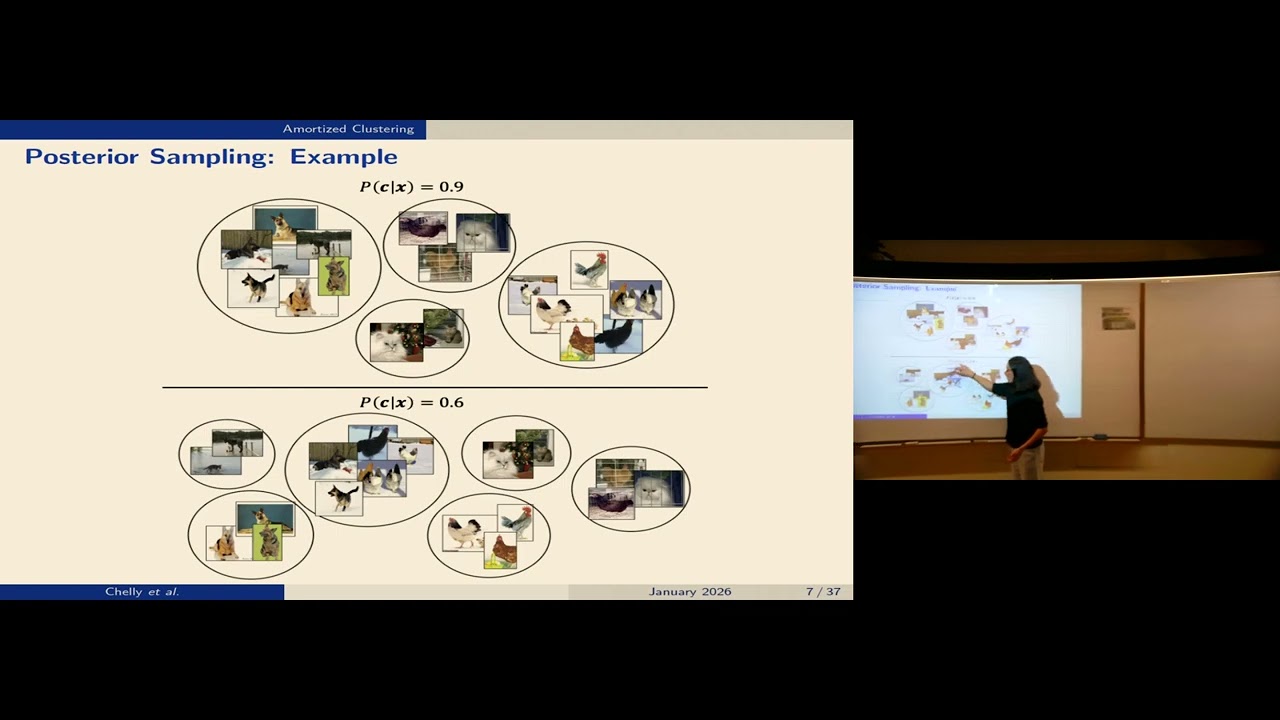
- Visualization of sampling from posterior
- Existing methods: Set Transformer, DeepCBC, NCP
- Background on Generative Flow Networks
- GFNCP formulation and architecture
- Training data generation
- Experimental results and comparison
- Discussion and future work
Cited Sources
- Consistent Amortized Clustering via Generative Flow Networks — The paper this talk is based on, published at AISTATS '25.
Concurring Sources
- Consistent Amortized Clustering via Generative Flow Networks — The paper itself, which is the primary source for the talk's claims.
Contribution & Novelties
The talk introduces GFNCP, a novel framework that applies Generative Flow Networks to amortized clustering, achieving order invariance through a shared energy-based parameterization. The key theoretical contribution is linking flow matching conditions to posterior consistency under marginalization, which is a new perspective in clustering. The method outperforms existing approaches on synthetic and real data, as claimed.
Pour aller plus loin :
- Generative Flow Networks — Overview of GFlowNets, the underlying framework.
- Neural Clustering Process — The baseline method that GFNCP improves upon.
- Amortized Inference — Concept of amortized inference in probabilistic models.
92 words
Radar Profile
The radar profile shows high scores in technical level and information quality, indicating a dense, expert-level presentation. The moderate scores in quantity and reliability suggest that while the talk is rich in content, it may not cover all aspects exhaustively and relies on the associated paper for full details.