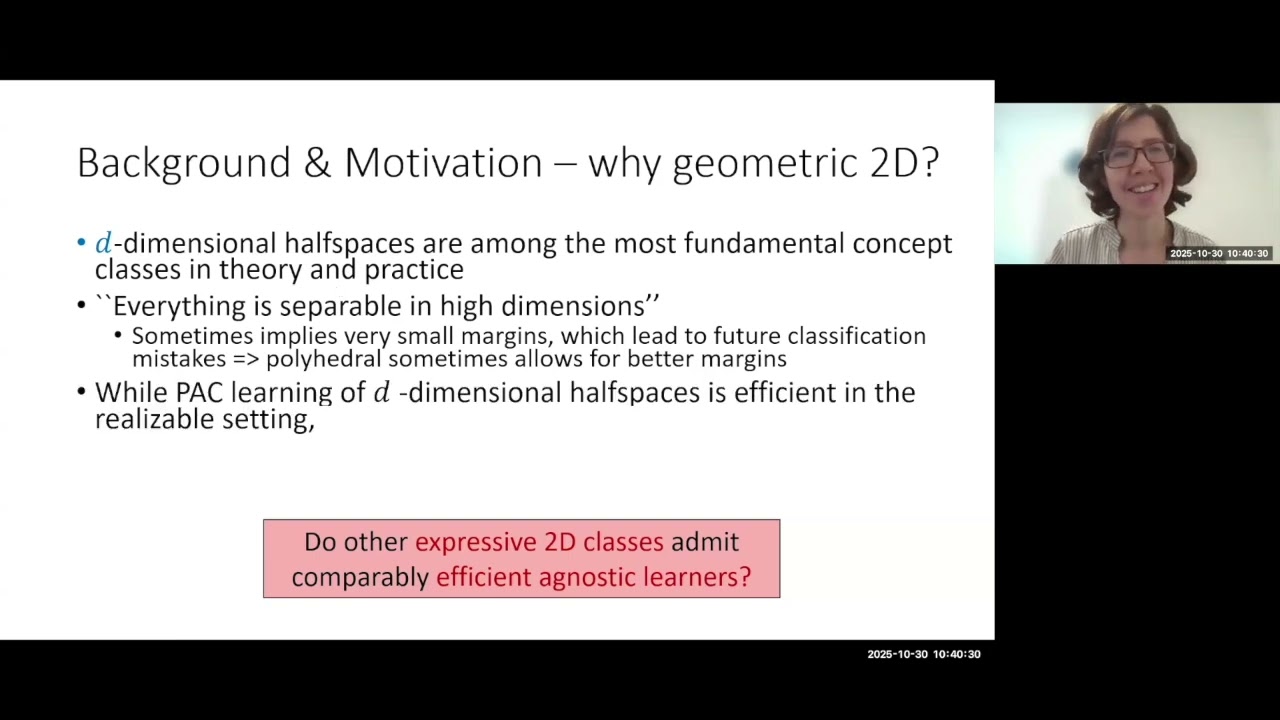
Fast Agnostic Learners in the Plane
Keywords
Summary
224 words
Critical Evaluation
Value of the Information & Strength of the Argument
The talk provides valuable insights into the time complexity of agnostic learning, a less explored aspect compared to sample complexity. The argumentation is solid, building on known results and clearly motivating the focus on 2D geometric classes. The speaker explains the intuition behind the algorithmic framework, which involves constructing a small set of candidate concepts and evaluating them efficiently. The presentation is rigorous, with formal definitions and references to prior work, and the speaker addresses questions from the audience, clarifying technical points. The results are presented as improvements over existing algorithms, with a clear trade-off for convex sets. The connection to property testing adds depth, showing broader implications of the work.
Scientific Rigor, Source Quality, Title Accuracy
The talk is scientifically rigorous, with clear definitions and references to prior work, including the foundational paper by Kearns et al. (1992) and specific results for geometric classes. The speaker cites joint work with Ludmila Glinskih and Sofya Raskhodnikova, and mentions related results by other researchers. The title accurately reflects the content, focusing on fast agnostic learners in the plane. The presentation is technical and assumes familiarity with computational learning theory, but the speaker provides sufficient context. No comments were provided, so no analysis of public reception is possible.
215 words
Title / Content Match
The title accurately reflects the content: the talk focuses on fast agnostic learners for geometric concept classes in the plane.
Quality & Reliability
8/10
Presentation of original research by a recognized expert, with clear technical details and references to prior work. The talk is rigorous but assumes advanced knowledge, and the video has no visual aids or transcript verification.
Key Moments
Markers derived by PSI from the transcript: the creator did not define chapters.
- Introduction and motivation for studying time complexity of agnostic learning.
- Definition of proper agnostic learning and the error measure.
- Discussion of related work and the hardness of proper agnostic learning.
- Focus on 2D geometric classes and the main results for k-gons and convex sets.
- Explanation of the algorithmic framework: building reference concepts and evaluating empirical risk.
- Details on the k-gon learner and the use of range searching data structures.
- Results for convex sets under uniform distribution and the trade-off in sample complexity.
- Connection to property testing and distance approximation.
- Open questions and future directions.
Cited Sources
- Joint work with Ludmila Glinskih and Sofya Raskhodnikova — The presented results are based on this collaboration.
- Kearns et al. (1992) — Foundational work on agnostic learning.
- Sofya Raskhodnikova and others on convex sets under uniform distribution — Prior work on agnostic learning for convex sets.
Concurring Sources
- Kearns et al. (1992) — Foundational work on agnostic learning, consistent with the talk's framework.
Contribution & Novelties
The talk presents new algorithmic results for agnostic learning of geometric concept classes in the plane, improving time complexity while maintaining optimal sample complexity for k-gons. The framework of decoupling the sample for building candidates from the sample for evaluation is a novel approach that could be applied to other concept classes. The connection to property testing provides a new perspective on the relationship between learning and testing.
Pour aller plus loin :
- Agnostic learning — Overview of the agnostic learning model.
- VC dimension — Fundamental concept in learning theory.
- Property testing — Related field with connections to learning.
99 words
Radar Profile
The radar profile shows high scores in technical level and information quality, indicating a dense, expert-level presentation. The lower scores in fiabilite_globale and quantite_information reflect the lack of visual aids and the reliance on verbal explanation, but the overall profile suggests a solid scientific talk.