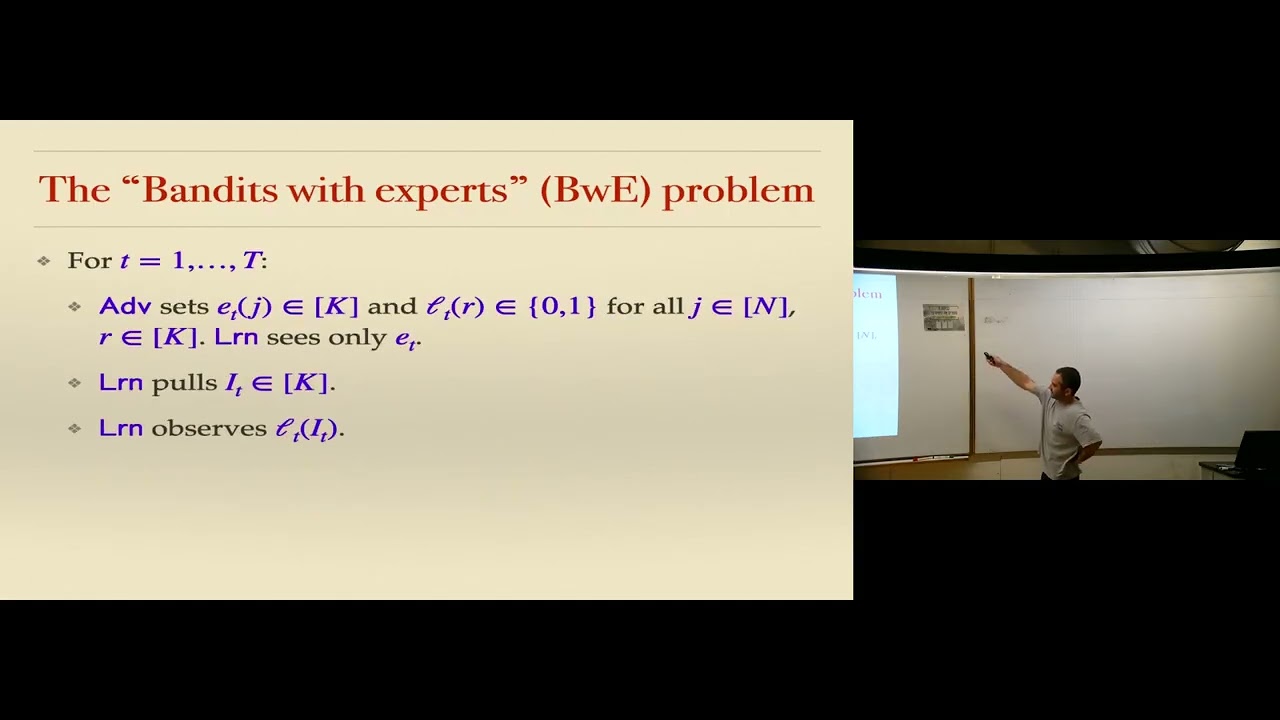
A Tight Lower Bound for Non-stochatic Multi-armed Bandits with Expert Advice (Heb)
Keywords
Summary
184 words
Critical Evaluation
Value of the Information & Strength of the Argument
The talk provides a clear and detailed explanation of a significant theoretical result. The argumentation is solid, with each step of the proof carefully motivated and explained. The speaker effectively uses examples and analogies to illustrate key concepts, making the material accessible despite its technical nature. The value of the information is high for researchers in online learning and bandit theory, as it resolves a long-standing open problem and provides a novel proof technique.
Scientific Rigor, Source Quality, Title Accuracy
The talk is based on rigorous mathematical work, with references to foundational papers by Auer et al. (2002) and Kale (2014). The speaker is a postdoctoral researcher at MIT, lending credibility. The title accurately reflects the content. The presentation is informal but precise, with no apparent errors in the proof sketch. The sources cited are appropriate and directly relevant.
148 words
Title / Content Match
The title accurately reflects the content: the talk focuses on a tight lower bound for non-stochastic multi-armed bandits with expert advice.
Quality & Reliability
8/10
The talk presents a recent tight lower bound for a well-known problem, based on joint work with Zachary Chase and Shinji Ito. The speaker is a postdoctoral researcher at MIT, and the proof is detailed with clear steps. The content is technical and appears rigorous, though the presentation is informal and in Hebrew.
Key Moments
Markers derived by PSI from the transcript: the creator did not define chapters.
Cited Sources
- Auer, Cesa-Bianchi, Freund, Schapire (2002) - The Nonstochastic Multiarmed Bandit Problem — Foundational paper introducing the problem and providing initial upper bound.
- Kale (2014) - Online Algorithms for Online Decision Making — Provides the upper bound matching the lower bound presented.
Concurring Sources
- Auer et al. (2002) - The Nonstochastic Multiarmed Bandit Problem — Provides the upper bound that the presented lower bound matches.
Contribution & Novelties
The talk presents a novel tight lower bound for the non-stochastic multi-armed bandits with expert advice problem, resolving a long-standing open question. The proof technique involves a reduction to a special batch identification problem and uses information-theoretic tools. This work is significant as it closes the gap between upper and lower bounds, establishing the exact minimax regret.
Pour aller plus loin :
- Multi-armed bandit — Overview of the bandit problem and its variants.
- Regret (decision theory) — Definition and context of regret in decision-making.
- Kullback–Leibler divergence — Key tool used in the proof for lower bounds.
96 words
Radar Profile
The radar profile shows high scores in all dimensions, indicating a technically deep and reliable presentation. The talk is particularly strong in information quality and technical level, with a slightly lower but still high score in quantity of information due to the focused scope.
💬 No comments were provided for analysis.