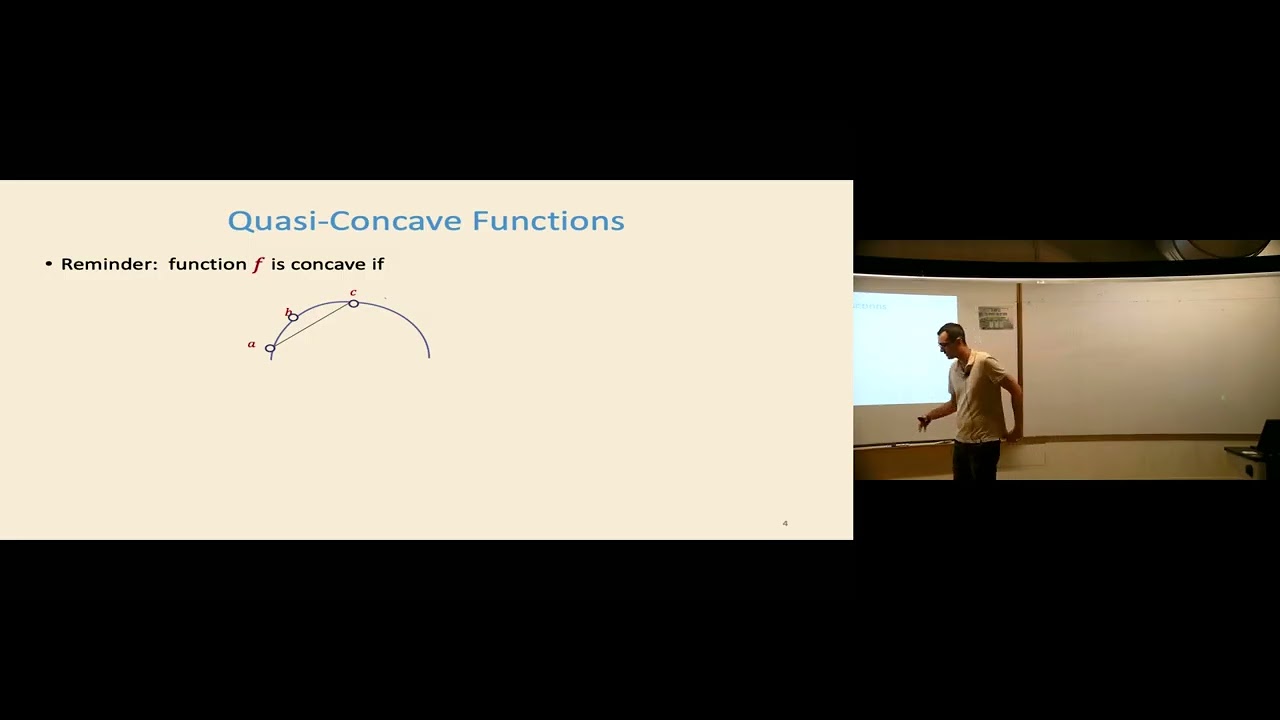
Differentially Private Quasi-Concave Optimization: Bypassing the Lower Bound and Application to Geometric Problems
Keywords
Summary
156 words
Critical Evaluation
Value of the Information & Strength of the Argument
The talk provides significant value by presenting a new upper bound that improves upon existing results for private quasi-concave optimization. The argumentation is rigorous, with formal definitions, theorems, and proof sketches. The speaker clearly explains the problem, the lower bound, and the new technique, making the contribution understandable. The applications to geometric problems (center point and halfspace learning) demonstrate the practical relevance. The reasoning is solid, with references to prior work and a clear logical flow.
Scientific Rigor, Source Quality, Title Accuracy
The scientific rigor is high: the talk is based on a paper accepted at SODA 2026, and the speaker cites relevant prior work (Cohen et al., Bun et al., Beimel et al., Kaplan et al.). The presentation includes formal definitions and proof sketches. The title accurately reflects the content. The talk is a seminar presentation, so it is not peer-reviewed itself, but the underlying research is. The description provides a link to the arXiv paper, which adds credibility.
169 words
Title / Content Match
The title accurately reflects the content: the talk focuses on differentially private quasi-concave optimization and its applications to geometric problems.
Quality & Reliability
8/10
The talk presents original research with formal definitions, proofs, and references to peer-reviewed venues (STOC, FOCS, COLT, NeurIPS, SODA). The speaker is an established researcher. The content is technical and appears rigorous, though the presentation is a seminar and not peer-reviewed itself.
Key Moments
Markers derived by PSI from the transcript: the creator did not define chapters.
- Introduction to differential privacy definition
- Definition of quasi-concave functions and Tukey depth
- Problem statement: private quasi-concave optimization
- Interior point problem and lower bound for infinite domains
- Exponential mechanism and upper bound for pure DP
- Comparison of pure vs approximate DP and log* complexity
- Motivation: applications to high-dimensional geometric problems
- Extension to high-dimensional Tukey depth and coordinate-wise optimization
- Main result: bypassing lower bound for approximated quasi-concave functions
- Applications to center point selection and halfspace learning
Cited Sources
- arXiv paper: Differentially Private Quasi-Concave Optimization — The paper presenting the results discussed in the talk.
Concurring Sources
- Cohen et al. (STOC 2023) lower bound — Mentioned as proving the lower bound for generic private optimizers.
- Bun et al. (FOCS 2015) lower bound — Mentioned as proving lower bounds for center point and halfspace learning.
- Beimel et al. (COLT 2019) upper bound — Mentioned as providing an upper bound for center point selection.
- Kaplan et al. (NeurIPS 2020) upper bound — Mentioned as providing an upper bound for halfspace learning.
Contribution & Novelties
The talk presents a novel algorithm for differentially private quasi-concave optimization that improves the sample complexity from exponential in log*|X| to log*|X| for a class of approximated quasi-concave functions. This is the first work to achieve this improvement for the applications of private center point selection and PAC learning halfspaces. The contribution is significant as it bypasses a known lower bound for generic optimizers.
Pour aller plus loin :
- Differential Privacy — Foundational concept.
- Tukey depth — Geometric depth measure used in the talk.
- Exponential mechanism — Basic tool for private optimization.
- PAC learning — Framework for learning halfspaces.
99 words
Radar Profile
The radar profile shows high scores in information quantity, quality, technical level, and reliability, indicating a dense and rigorous technical talk. The low view count and lack of comments suggest limited audience engagement, but the content is highly specialized and likely of interest to researchers in differential privacy and optimization.