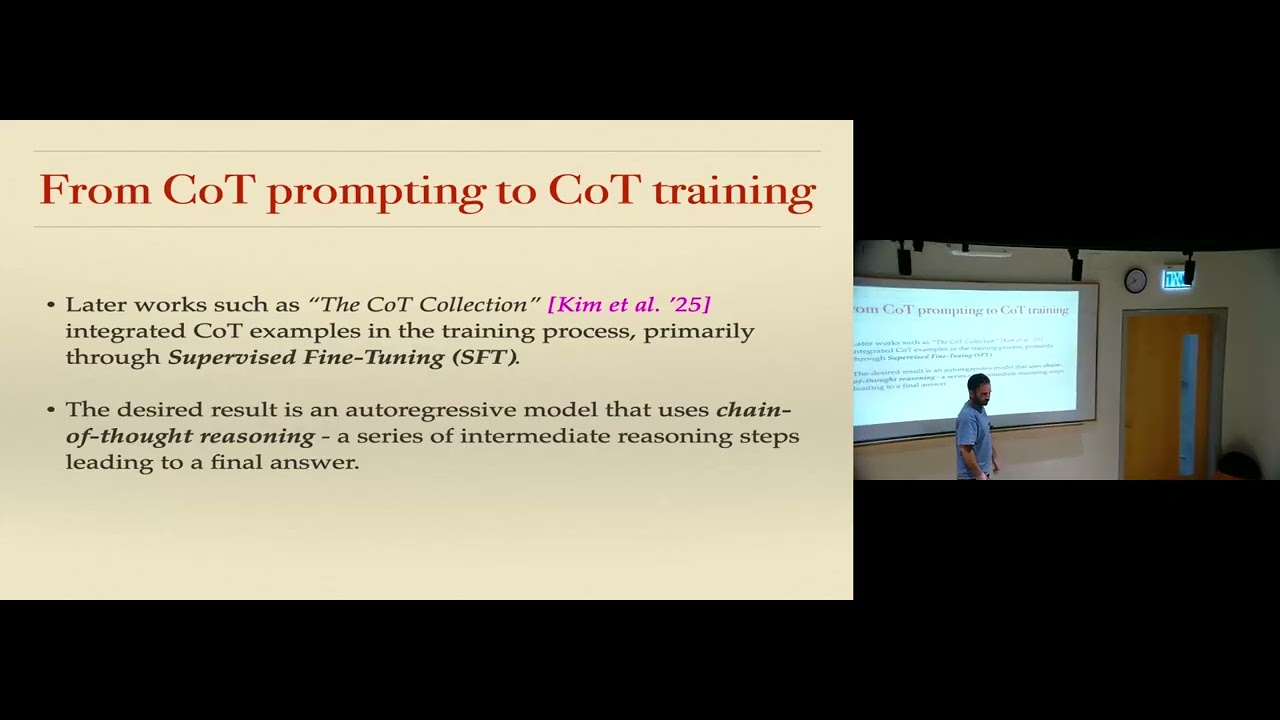
Sample Complexity and Mistake Bounds of Autoregressive Reasoning: CoT vs. EtE
Keywords
Summary
174 words
Critical Evaluation
Value of the Information & Strength of the Argument
The talk provides a rigorous theoretical analysis of a timely topic, offering novel insights into the benefits of chain-of-thought supervision. The argumentation is clear and well-structured, starting with motivation from LLMs, formal definitions, and then presenting results. The speaker effectively uses examples to illustrate concepts and addresses audience questions, strengthening the argument. The results are significant as they provide a theoretical justification for the empirical success of chain-of-thought prompting.
Scientific Rigor, Source Quality, Title Accuracy
The talk is scientifically rigorous, with clear definitions and proofs. The speaker cites relevant prior work, including Joshi et al. (COLT 2025) and the chain-of-thought prompting paper, and mentions ongoing collaborations. The title accurately reflects the content. The talk is based on ongoing research, so the results are not yet peer-reviewed, but the methodology appears sound. The speaker also acknowledges limitations of the model, such as its simplicity compared to real LLMs.
156 words
Title / Content Match
The title accurately reflects the content, focusing on sample complexity and mistake bounds for autoregressive reasoning, comparing chain-of-thought and end-to-end supervision.
Quality & Reliability
8/10
The talk presents original theoretical results, based on two ongoing works, with rigorous definitions and proofs. The speaker is a postdoc at MIT, and the work is joint with known researchers. The presentation is clear and technically sound, though the results are not yet peer-reviewed.
Key Moments
Markers derived by PSI from the transcript: the creator did not define chapters.
- Introduction to autoregressive generation and chain-of-thought motivation.
- Formal definition of the next-token generator model and end-to-end vs chain-of-thought supervision.
- Discussion of the two main questions: scaling with T and benefit of chain-of-thought.
- Presentation of high-level results: rich landscape for end-to-end, collapse for chain-of-thought.
- Technical details and proof sketches for the results.
- Discussion of implications and open questions.
Cited Sources
- Joshi et al. (COLT 2025) - PAC learning framework for next-token generators — Introduced the PAC-learning framework for next-token generators, which is the basis of this work.
- Chain-of-Thought Prompting Elicits Reasoning in Large Language Models — Empirical work showing the benefit of chain-of-thought prompting, motivating the theoretical study.
Concurring Sources
- Joshi et al. (COLT 2025) - PAC learning framework for next-token generators — Provides the formal framework used in this talk.
Contribution & Novelties
The talk presents original theoretical results on the sample complexity and mistake bounds of autoregressive reasoning, showing that chain-of-thought supervision can eliminate the dependence on generation length. This provides a formal justification for the empirical benefits of chain-of-thought. The results are based on two ongoing works, indicating active research.
Pour aller plus loin :
- PAC learning — Foundational framework for statistical learning.
- VC dimension — Key combinatorial measure for PAC learning.
- Littlestone dimension — Analogous measure for online learning.
- Chain-of-thought prompting — Empirical technique for improving reasoning in LLMs.
89 words
Radar Profile
The radar profile shows high scores in technical level and information quality, with slightly lower but still strong scores in quantity and reliability. This indicates a technically dense and reliable presentation, suitable for an expert audience.