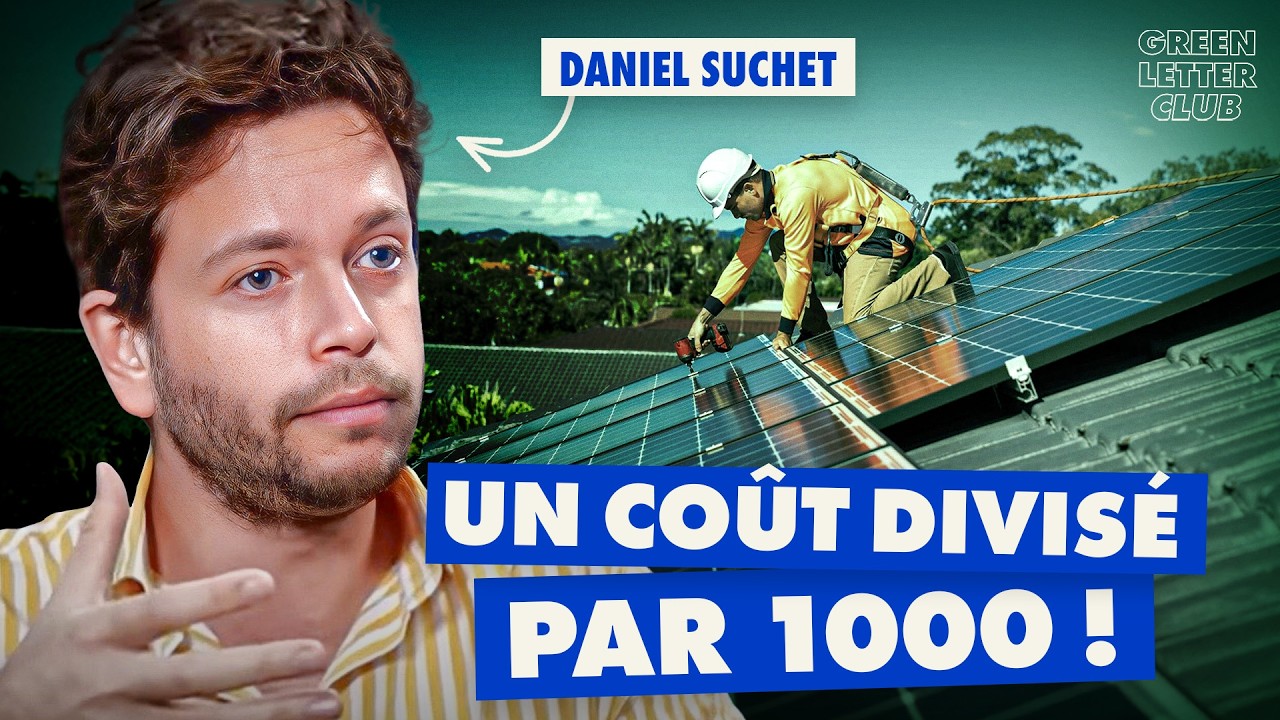
Ce que vous ne savez pas sur le solaire en France
Keywords
Summary
186 words
Critical Evaluation
The interview provides a balanced and technically informed perspective on solar photovoltaics, with Daniel Suchet demonstrating deep expertise. The discussion is structured logically, covering historical development, current status, and future challenges. The quantitative data (e.g., growth rates, capacity figures) are presented clearly, and the interviewer asks pertinent questions that address both benefits and limitations. The argumentation is generally rigorous, though some claims, such as the potential for solar to meet a large share of energy demand, are optimistic and not fully substantiated with specific sources. The discussion of intermittency and grid stability is particularly valuable, acknowledging the real challenges of integrating high levels of solar without adequate storage or backup. The lack of formal citations is a weakness, but the expert’s credibility and the internal consistency of the arguments mitigate this. The title is appropriate, and the content aligns well with it. Overall, this is a high-quality educational resource for understanding solar energy’s role in the energy transition, though it could benefit from more explicit references to data sources.
169 words
Title / Content Match
The title is somewhat generic but accurately reflects the content, which explores lesser-known aspects of solar energy in France.
Quality & Reliability
8/10
The interview features a recognized expert in photovoltaics (Daniel Suchet), provides quantitative data and historical context, and addresses technical and systemic aspects. However, it is an opinion-based discussion without formal citations or peer-reviewed references, and some claims (e.g., growth projections) are not fully sourced.
Chapters
- Extraits
- L'histoire du photovoltaïque
- Une technologie unique
- Une croissance exponentielle ?
- Quantité d'énergie d'origine solaire
- Le développent en France
- Quel potentiel ?
- Quelle emprise au sol ?
- Quelle géographie ?
- Des ordres de grandeurs
- Et l'intermittence ?
- L'équilibre du réseau
- L'effet de foisonnement
- La déstabilisations du réseau
- L'artificialisation des sols ?
- L'agrivoltaïsme
- L'énergie la plus compétitive ?
- Géopolitique du solaire
- Quel rendement ?
- Les cellules tandems
- La durée de vie
- Un engouement populaire
- Climat = une installation rapide
- Une industrie ?
Cited Sources
- RTE 2050 report — Mentioned in the interview as a reference for future energy scenarios in France.
Concurring Sources
- IEA Solar PV report — International Energy Agency data on solar PV capacity and projections.
Dissenting Sources
- Jancovici's critique of solar intermittency — Some commenters reference Jancovici's arguments that solar intermittency is not fully solvable even at European scale, which contrasts with the interview's more optimistic view.
Contribution & Novelties
The interview offers a comprehensive and nuanced view of solar photovoltaics, emphasizing its exponential growth, technical specifics, and systemic challenges. It provides a balanced perspective, avoiding both excessive optimism and pessimism, and highlights the importance of grid integration and land use. The discussion of agrivoltaics and the geopolitical dimension adds depth.
Pour aller plus loin :
- Photovoltaics on Wikipedia — Overview of PV technology and history.
- Agrivoltaics on Wikipedia — Concept of combining agriculture and solar panels.
- Intermittent energy source on Wikipedia — Discussion of variability and grid integration challenges.
90 words
Radar Profile
The radar profile shows high scores in quantity and quality of information, with a moderate technical level and high reliability. This indicates a well-informed and credible discussion, though it may not delve into the most advanced technical details.
💬 Équilibré : Sur les 30 commentaires analysés, les avis sont partagés entre éloges pour la clarté et la profondeur de l'interview, et critiques sur les limites du solaire (intermittence, coûts cachés, manque de stockage). Plusieurs commentaires mentionnent Jancovici pour contrebalancer les propos de l'invité.