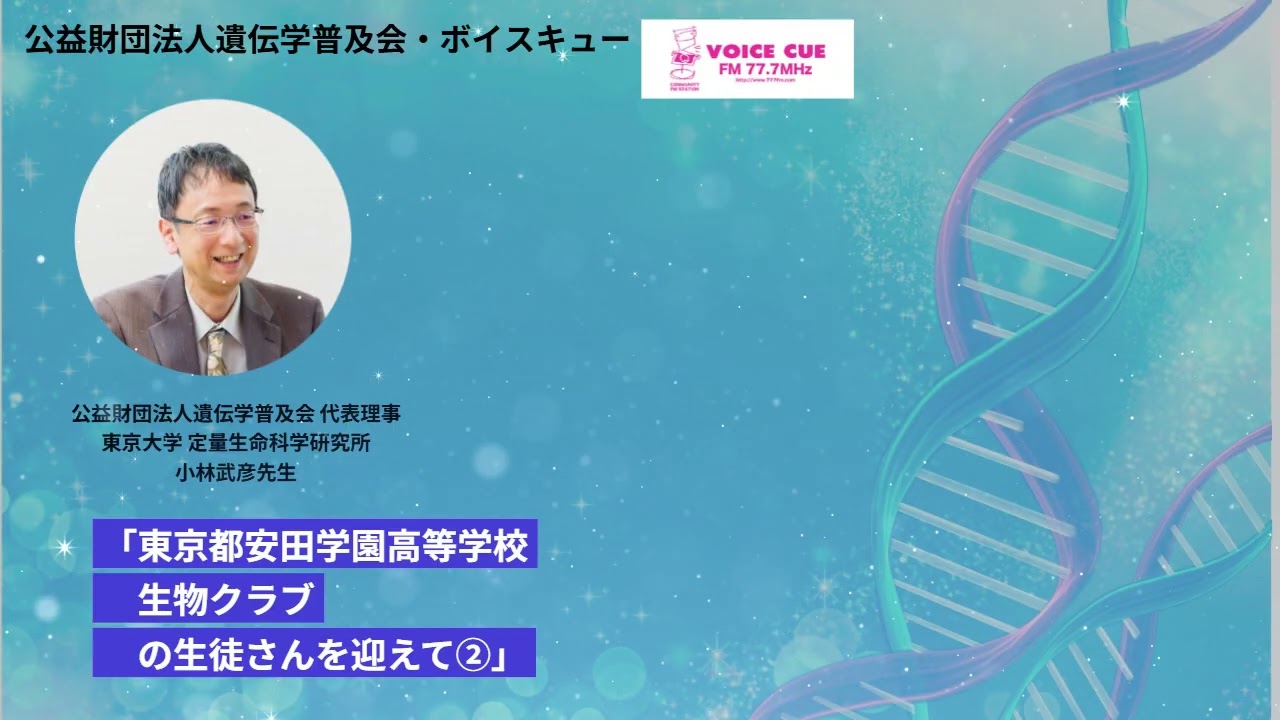
きゅんです!サイエンス| 安田学園高等学校生物部をお迎えして② 東京大学小林武彦先生
Keywords
Summary
149 words
Critical Evaluation
Value of the Information & Strength of the Argument
The video provides valuable insights into the research process of high school students, showcasing their innovative use of AI for behavioral analysis. The argumentation is solid, as the students describe their methodology and results, and the professor validates the significance of their findings. The discussion is engaging and highlights the importance of curiosity and persistence in scientific inquiry.
67 words
Title / Content Match
The title accurately reflects the content: a science talk show featuring the biology club of Yasuda Gakuen High School and Professor Kobayashi from the University of Tokyo.
Quality & Reliability
7/10
The video features a university professor and high school students discussing their research on honeybee communication. The content is presented as a casual conversation, with the professor providing context and validation. The students' research methodology is described but not detailed, and no formal citations are provided. The information is plausible and aligns with known bee behavior, but lacks rigorous scientific detail.
Key Moments
Markers derived by PSI from the transcript: the creator did not define chapters.
- Introduction and guest introductions
- Self-introductions of the four students
- School highlights: exploration class and school festival honey sales
- Discussion on the importance of being true to oneself
- Start of the research presentation on honeybee antennae communication
- Explanation of the experimental setup and AI tracking
- Results: hungry bees tap recipient's head with antennae
- Control experiments with dead bees and discussion on future research
- Professor's summary and praise for the students' proactive approach
Cited Sources
- No external sources cited in the video — The video does not mention any specific sources, but the professor refers to open-source AI tools and contacting paper authors.
Concurring Sources
- Honey bee communication — Provides background on honeybee communication methods, supporting the video's discussion.
Contribution & Novelties
The video highlights an original high school research project on honeybee communication using AI-based tracking of antennae movements, which is a novel approach for a student project. It demonstrates the potential of open-source tools in ethology and encourages further exploration.
Pour aller plus loin :
- Honey bee communication — Overview of honeybee communication methods, including the waggle dance and trophallaxis.
- Trophallaxis — Definition and significance of food exchange in social insects.
- DeepLabCut — An open-source tool for markerless pose estimation, likely used for tracking antennae movements.
86 words
Radar Profile
The radar profile shows balanced scores across all dimensions, with slightly higher scores in information quality and reliability, reflecting the video's educational value and credible presentation. The lower technical level indicates that the content is accessible to a general audience.