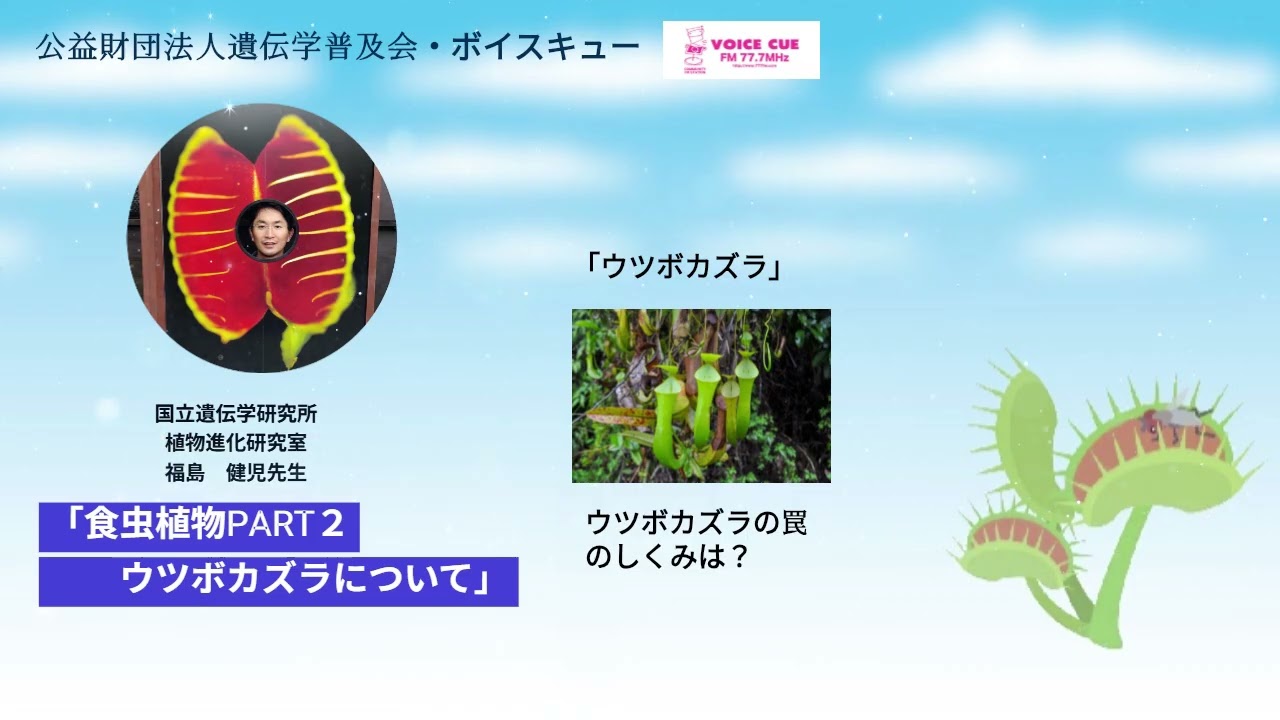
きゅんです!サイエンス ‐ 福島健児先生(2025.9.21)
Keywords
Summary
162 words
Critical Evaluation
Value of the Information & Strength of the Argument
The video provides valuable information about the biology and genomics of Nepenthes gracilis, based on the researcher’s own published study. The argumentation is solid, as Dr. Fukushima explains the scientific basis for each claim, such as the role of oxidative stress genes in digestion and the mechanism of aquaplaning on the peristome. He also contextualizes the findings within broader evolutionary biology, making the content informative for both enthusiasts and students. The discussion is well-structured, moving from general characteristics to specific research findings, and includes practical advice for cultivation.
Scientific Rigor, Source Quality, Title Accuracy
The scientific rigor is high, as the information is presented by a researcher who has conducted original research on the species. The quality of sources is excellent, with the 2023 genome paper being a primary source. The title accurately reflects the content, which is a science communication interview. The video does not cite external sources explicitly, but the researcher’s expertise and the mention of his published work lend credibility. The content is consistent with established knowledge about carnivorous plants, and no discrepancies were noted.
187 words
Title / Content Match
The title accurately reflects the content, as it features Dr. Fukushima discussing science, specifically carnivorous plants, in a casual interview format.
Quality & Reliability
8/10
The video features a researcher from the National Institute of Genetics discussing carnivorous plants, specifically Nepenthes gracilis. The content is scientifically accurate, based on the researcher's own genomic study published in 2023, and includes detailed explanations of trapping mechanisms and evolutionary adaptations. The information is presented in an accessible manner without oversimplification, and the researcher's expertise lends high credibility.
Key Moments
Markers derived by PSI from the transcript: the creator did not define chapters.
- Introduction and overview of the episode, featuring Dr. Fukushima and the topic of Nepenthes gracilis.
- Discussion on cultivation: light requirements, watering, and the fact that feeding is not necessary.
- Introduction to the diversity of Nepenthes species, with 170 species worldwide, and the specific species Nepenthes gracilis.
- Explanation of the mutualistic relationship with small animals that defecate into the pitcher for nutrients.
- Dr. Fukushima's research: genome sequencing of Nepenthes gracilis, including the discovery of expanded oxidative stress genes and sex chromosomes.
- Discovery that Nepenthes gracilis is decaploid, with ten sets of chromosomes.
- Mechanisms of insect attraction: scent mimicking flowers and UV patterns visible to insects.
- The peristome's microstructure causes aquaplaning, making insects slip into the pitcher.
- The lid acts as a springboard, flipping insects into the pitcher when raindrops hit.
- Digestive fluid and waxy inner walls prevent escape; mention of vegetarian pitcher plants like Nepenthes ampullaria.
Cited Sources
- Genome sequencing of Nepenthes gracilis (2023 paper) — Dr. Fukushima mentions his 2023 publication on the genome of Nepenthes gracilis, but no specific URL is provided in the video.
Concurring Sources
- Nepenthes gracilis - Wikipedia — Provides general information on the species, confirming its distribution and characteristics.
- Carnivorous plant - Wikipedia — Supports the general mechanisms of carnivory and pitcher plant function.
Contribution & Novelties
The video provides an original perspective by featuring a researcher who has sequenced the genome of Nepenthes gracilis, offering insights into the genetic basis of carnivory, sex determination, and polyploidy. It bridges the gap between popular science and cutting-edge research, making complex genomic findings accessible to a general audience.
Pour aller plus loin :
- Nepenthes gracilis - Wikipedia — Overview of the species, its distribution, and ecology.
- Carnivorous plant - Wikipedia — General information on carnivorous plants and their adaptations.
- Genome - Wikipedia — Background on genomes and sequencing, relevant to the genomic discussion.
94 words
Radar Profile
The radar profile shows high scores in information quantity, quality, and reliability, with a slightly lower technical level, indicating that the content is rich and credible but accessible to a broad audience. The balance suggests a well-rounded educational video.
💬 No comments were provided for analysis.