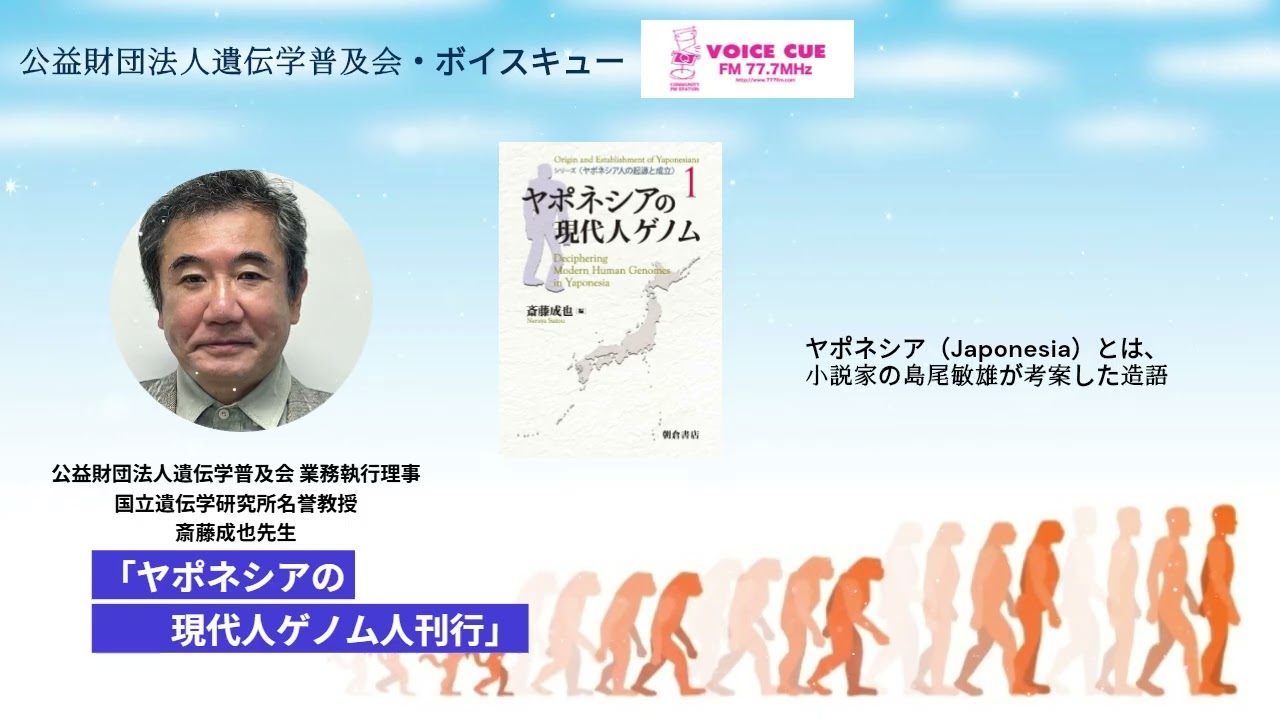
きゅんです!サイエンス ‐ 斎藤成也先生(2025.9.28)
Keywords
Summary
159 words
Critical Evaluation
Value of the Information & Strength of the Argument
The video provides a comprehensive overview of the Yaponesia Genome Project, offering valuable insights into the genetic makeup of the Japanese population. The argumentation is solid, grounded in large-scale genomic data and published research. The expert explains complex concepts clearly, making the information accessible without oversimplifying. The discussion is well-structured, systematically walking through each chapter of the book, and highlights the significance of the findings for understanding Japanese population history.
Scientific Rigor, Source Quality, Title Accuracy
The scientific rigor is high, as the content is based on a peer-reviewed book series and the presenter is a leading authority in the field. The sources cited are the book volumes and the research project itself, which are credible. The title accurately reflects the content, as the video is an interview with Dr. Saitou about the Yaponesia genome. The video does not include any promotional segments.
152 words
Title / Content Match
The title accurately reflects the content, as the video features an interview with Dr. Saitou discussing the Yaponesia genome project.
Quality & Reliability
8/10
The content is presented by a leading expert in population genetics, based on a large-scale national research project (Yaponesia Genome) and published in a peer-reviewed book series. The information is consistent with established scientific knowledge, though some details are simplified for a general audience.
Key Moments
Markers derived by PSI from the transcript: the creator did not define chapters.
- Introduction and personal anecdote about health.
- Overview of the four-volume series and the Yaponesia Genome Project.
- Explanation of the dual structure model and its verification.
- Discussion of genome diversity and regional variations.
- Y-chromosome haplogroups and their distribution.
- Analysis of SNP data and regional clustering.
- Genetic relationships with East Asian populations and population size changes.
- HLA analysis and its implications for regional affinity.
- Discussion of the Ryukyu Islands and the Gusuku period.
Cited Sources
- Yaponesia: Origins and Formation of the Japanese People (4 volumes) — The book series discussed in the video, published by Asakura Shoten.
Concurring Sources
- Genome-wide SNP data of Japanese population — Large-scale datasets used in the studies mentioned, such as those from Genesis Healthcare.
Contribution & Novelties
The video provides an expert summary of the Yaponesia Genome Project, highlighting recent findings on Japanese population genetics. It offers a comprehensive overview of the dual structure model and its refinements, including the ‘inner dual structure’ model. The discussion of regional genetic variations and the influence of Jomon and Yayoi ancestries is particularly informative.
Pour aller plus loin :
- Dual structure model — This model, proposed by Kazuro Hanihara, is central to the discussion.
- Y-chromosome haplogroups in Japan — Provides context on the distribution of haplogroups D and O in Japan.
- Jomon people — The indigenous hunter-gatherer population of Japan, whose genetic contribution is discussed.
105 words
Radar Profile
The radar profile shows high scores in information quantity, quality, and reliability, with a moderate technical level. This indicates a content that is rich in accurate scientific information but presented at an accessible level for a general audience.