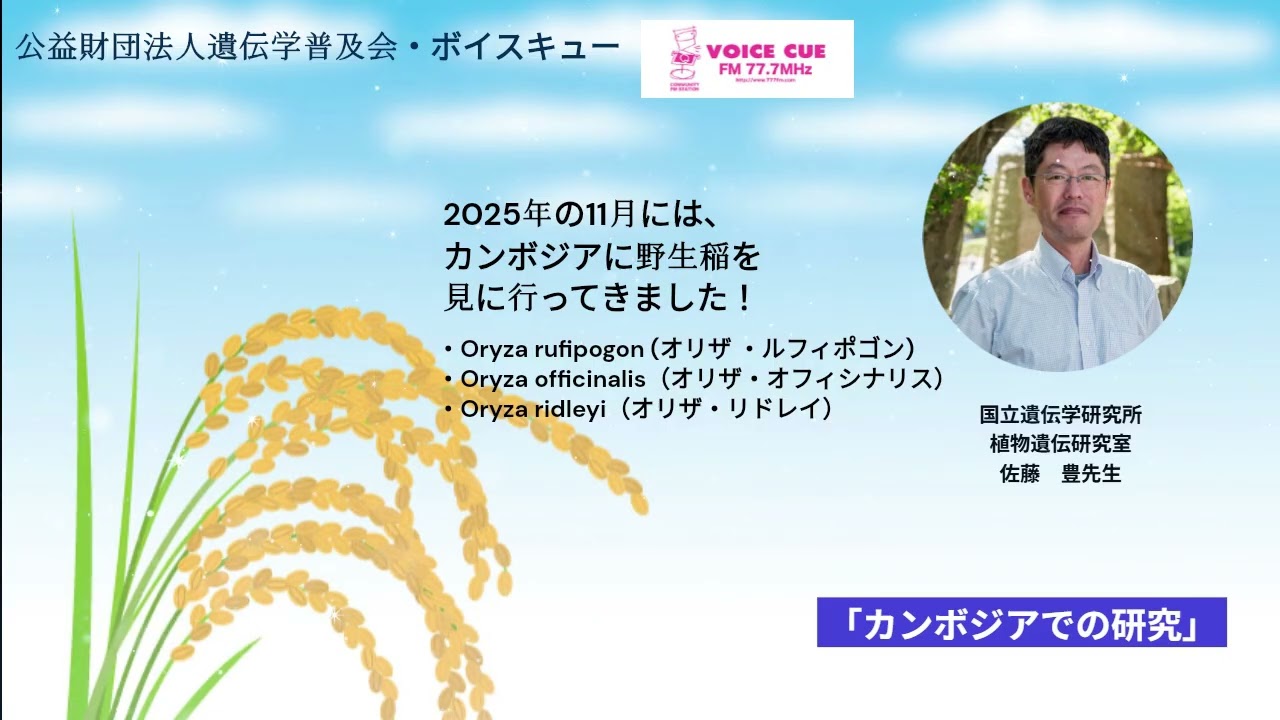
きゅんです!サイエンス ‐ 佐藤豊先生(2026.1.11)
Keywords
Summary
134 words
Critical Evaluation
Value of the Information & Strength of the Argument
The video provides valuable firsthand insights into the ecology and distribution of wild rice species in Cambodia, highlighting the challenges of field research and the importance of local knowledge. The argumentation is based on personal observations and anecdotes, which are compelling but not systematically presented. The professor’s expertise adds credibility, but the lack of quantitative data or references limits the scientific depth.
Scientific Rigor, Source Quality, Title Accuracy
The scientific rigor is moderate: the information is based on direct field observations by a qualified researcher, but no specific sources are cited. The title accurately reflects the content, which is an informal interview. The video does not include any promotional segments. No comments were provided for analysis.
125 words
Title / Content Match
The title accurately reflects the content: an interview with Professor Sato, continuing from the previous week's discussion about Uzbekistan, now focusing on his trip to Cambodia.
Quality & Reliability
7/10
The video is an informal interview with a professor from the National Institute of Genetics, discussing field observations of wild rice in Cambodia. The information is based on direct experience and is plausible, but lacks detailed scientific data or references. The tone is conversational and anecdotal, which reduces its scientific rigor.
Key Moments
Markers derived by PSI from the transcript: the creator did not define chapters.
- Introduction and recap of previous episode on Uzbekistan.
- Discussion about climbing Mount Fuji with Italian researchers.
- Transition to the main topic: Cambodia trip to find wild rice.
- Description of the three target species and their habitats.
- Search for Oryza officinalis and Oryza ridleyi, initial failures.
- Discovery of Oryza officinalis in an unexpected forest habitat.
- Reflections on the findings and future research plans.
Contribution & Novelties
The video contributes original observations on the distribution of Oryza officinalis in Cambodia, documenting a new habitat type (forest interior) not previously reported. This adds to the understanding of wild rice ecology and conservation. For further exploration, consider the following resources:
Pour aller plus loin :
- Oryza officinalis - Wikipedia — Provides taxonomic and distributional information.
- Wild rice species - International Rice Research Institute — Offers resources on wild rice conservation and research.
- Conservation of wild rice - FAO — Discusses global efforts to conserve wild rice genetic resources.
89 words
Radar Profile
The radar profile shows moderate scores across all dimensions, with slightly higher quality and reliability scores compared to quantity and technical level. This reflects an informative but informal presentation with limited technical depth.