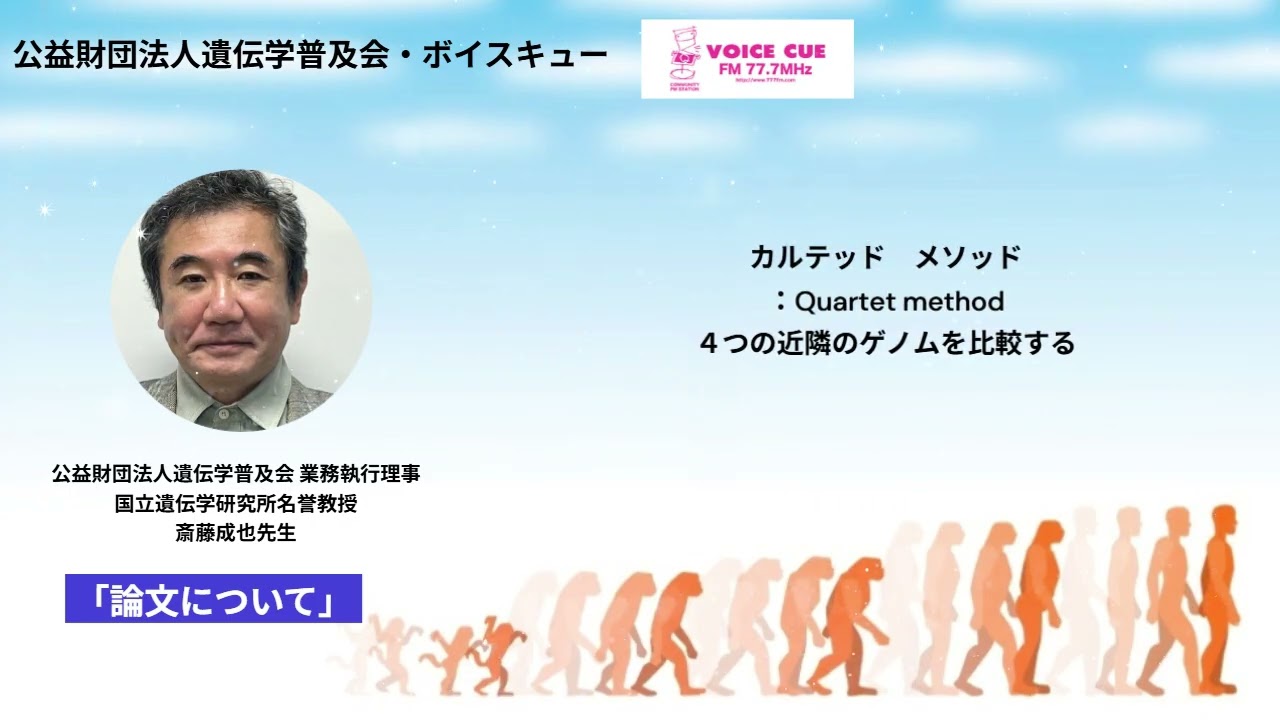
きゅんです!サイエンス ‐ 斎藤成也先生(2026.2.1)
Keywords
Summary
162 words
Critical Evaluation
Value of the Information & Strength of the Argument
The video provides valuable insights into the development of a novel computational method for phylogenetics, highlighting its potential to handle large datasets efficiently. The argumentation is based on the researcher’s personal experience and the method’s conceptual simplicity, but lacks detailed empirical validation or comparison with existing methods. The discussion of the quartet method adds depth, explaining how it can identify functional changes in non-coding regions. However, the presentation is high-level and may not satisfy an expert seeking technical specifics.
Scientific Rigor, Source Quality, Title Accuracy
The scientific rigor is moderate: the speaker is a highly cited expert, but the video does not provide specific references or data. The title accurately represents the content. The description mentions the paper but does not include a link. The discussion is informal, which may reduce the perceived rigor but is appropriate for a general audience. The adequacy between title and content is good.
158 words
Title / Content Match
The title accurately reflects the content: an interview with Dr. Saitou in the 'Kyun desu! Science' series.
Quality & Reliability
6/10
The video is an interview with a renowned geneticist, Naruya Saitou, discussing his recent work on a new phylogenetic method called 'Cliff Finder'. The information is presented in a conversational, non-technical manner, with limited detail on the method's mathematical foundations. The credibility is high due to the speaker's expertise, but the lack of specific data or references in the video reduces the score.
Key Moments
Markers derived by PSI from the transcript: the creator did not define chapters.
- Introduction of the guest, Dr. Naruya Saitou, and the topic: a paper on 'Cliff Finder'.
- Explanation of the 'Cliff Finder' concept: finding cliffs in distance matrices to split taxa.
- Discussion on the speed advantage of Cliff Finder over neighbor-joining for large datasets.
- Mention of the quartet method and its goal to detect conserved non-coding sequences.
- Details on the quartet method: comparing human, chimpanzee, gorilla, and orangutan genomes.
- Discussion on future plans: writing a book on human evolution and potential collaborations.
- Closing remarks and thanks.
Cited Sources
- Paper on Cliff Finder (mentioned in video) — The paper is described as recently submitted, but no specific citation or link is provided in the video.
Concurring Sources
- Neighbor-joining method — The method is mentioned as a comparison and was developed by the interviewee.
Contribution & Novelties
The video presents a new method for phylogenetic inference, ‘Cliff Finder’, which offers a significant speed improvement over existing distance-based methods. The discussion also highlights the quartet method’s potential to uncover functional changes in conserved non-coding regions. The interview provides a personal perspective on the research process and the challenges of publishing novel methods.
Pour aller plus loin :
- Neighbor-joining method — The classic distance-based method mentioned, with high citation count.
- Phylogenetic tree — Overview of phylogenetic inference.
- Conserved non-coding sequence — Relevant to the quartet method discussion.
88 words
Radar Profile
The radar profile shows moderate scores across all dimensions, with a slightly higher score in reliability due to the speaker's expertise. The low quantity of information and technical level reflect the conversational nature of the interview, which may not satisfy viewers seeking in-depth technical details.